August 3, 2026
Giving employees a say over office art may boost wellbeing and job satisfaction, review suggests
 Giving employees more control over the artwork displayed in their workplace could improve wellbeing, job satisfaction and engagement, according to a new systematic review from researchers at the University of Roehampton. The review, published in Psychology of Aesthetics, Creativity, and the Arts, found evidence that visual office art can have a positive effect on employees’ psychological wellbeing and workplace experience, with the greatest benefits seen when workers are able to choose or position artwork themselves.
Professor Mick Cooper and Maritina Peristeri, from the University of Roehampton’s School of Psychology, examined more than 900 published papers on workplace art. However, only eight papers – representing 10 individual studies involving around 1,220 participants – met the criteria for inclusion, highlighting the limited evidence base in this area.
Despite the relatively small number of high-quality studies, the review found consistent evidence that visual art in workplaces can improve psychological comfort, job satisfaction and workplace engagement, while also helping to strengthen social relationships between colleagues.
One of the review’s most notable findings was the importance of employee agency. In two randomised office studies, participants who were allowed to choose or arrange artwork in their workspace reported higher levels of psychological comfort, greater job satisfaction and better work-related outcomes than colleagues whose artwork had been selected for them. Those improvements diminished when participants subsequently lost that control.
The review also suggests that artwork can contribute to creating more welcoming workplaces, encourage conversations between colleagues and foster a stronger sense of belonging.
Overall, the researchers identified four broad areas in which workplace art may have a positive impact: improving work-related outcomes such as job satisfaction, engagement and perceived productivity; enhancing psychological comfort; reducing stress and other forms of psychological distress in some settings; and increasing social interaction between colleagues.
There was also preliminary evidence that nature-based imagery, including landscapes and photographs of outdoor environments, may be particularly effective at reducing stress. One study found that both natural imagery and artwork combining natural and abstract elements were associated with lower levels of stress and anger among male participants.
Lead author Professor Mick Cooper said: “Work can be one of the biggest sources of stress in many people’s lives, so it’s important that we understand everything that can support psychological wellbeing at work. We’re not suggesting that artwork is a solution to workplace stress on its own. However, alongside other measures that support staff wellbeing, the evidence suggests it is a relatively simple way of contributing to healthier and more positive workplace environments.”
Rather than treating workplace art as a purely decorative feature, the research suggests that involving employees in decisions about what is displayed may be just as important as the artwork itself. The authors caution, however, that the evidence remains limited. Although the review identified encouraging findings across a range of psychological and organisational outcomes, relatively few robust studies have been conducted in functioning workplaces, and they argue that further research is needed before firm conclusions can be drawn.
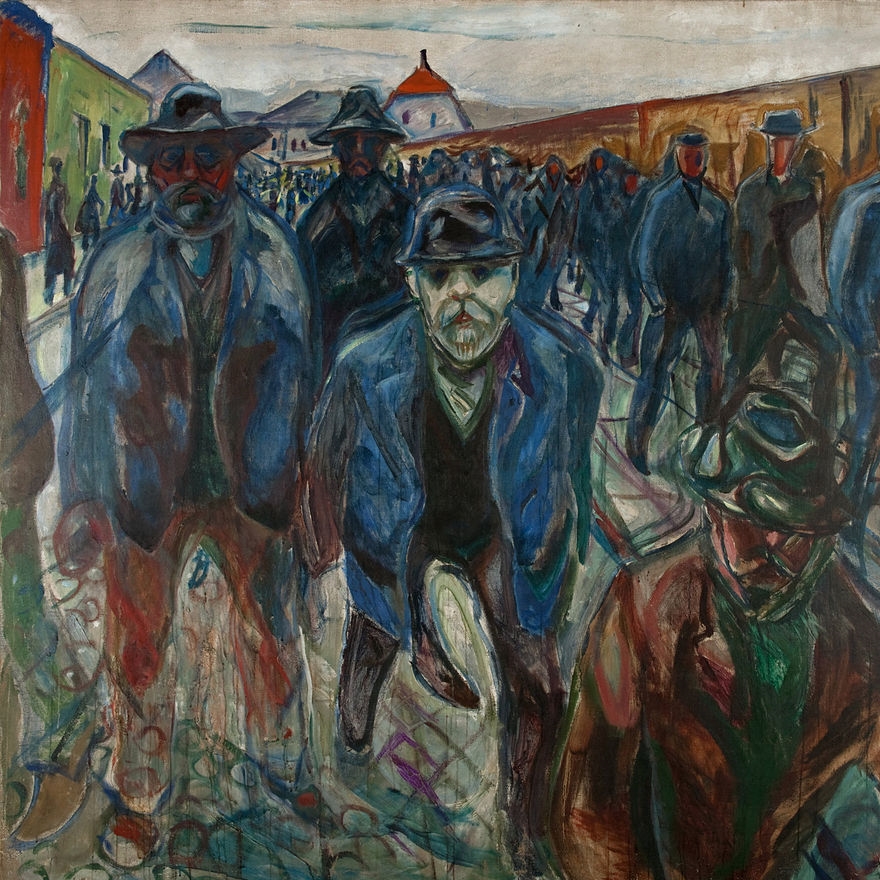
Main image: Edvard Munch, Workers on their Way Home, Public domain, via Wikimedia Commons