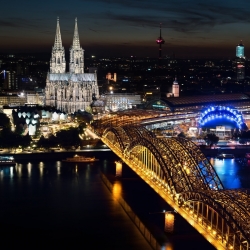
 Like many exhibitions, Orgatec is facing a number of challenges. And one of the biggest of them is people like me. I am one of a still large number of people who remember it in its heyday, both in terms of size and influence. At that time it was one of the two biggest office furniture shows in the world, alongside Chicago’s NeoCon. The European industry marched in step to its biennial return. My first time visiting was in 1992, when its scale was frankly unmanageable for most visitors. Pretty much the entirety of the 14 multi-storey halls of the Koelnmesse were full of office furniture. That’s maybe 250,000 sq.m. – or around 35 football pitches in the way we measure such things. Two ExCels.
Some of the stands were equally imposing. There were several of the then largest German manufacturers dominating whole halls with impressive, but ultimately anachronistic shows of corporate Schwanzvergleich. Most of these firms survive only in either diminished form or as memories.
Orgatec’s influence was similarly colossal. Offering a two-yearly snapshot of developments in what was then a rapidly changing market and a world still working out what the Internet and mobile tech were for, the opportunities to make a mark or shape thinking were immense. Perhaps the best-known example was the launch of the Aeron chair in 1994, arguably the last time an office furniture product crossed over into the consciousness of the general public.
I’ve had a few weeks in which to reflect on last month’s event and a chance to discuss it with a number of people with different perspectives. Old lags from this era are prone to wallowing in nostalgia for this era, blarting into their Kölsch on evenings out in the Altstadt about the way things were, or griping from afar. It’s something I’ve done myself. But we need to stop.
So what if it is smaller? The scale must fall from our eyes. The world has changed and so too must events like Orgatec. Smaller it may be but for industry neophytes it remains eye opening. Not just in terms of its still impressive size, but an expanding conference programme, new features such as the off-site Design Post Köln and the residual draw of networking and socialising in a beautiful and welcoming city.
One thing that hasn’t changed is the way in which the office industry is able to reflect the concerns of its customers in the things it talks about and the products it offers. This can be slightly counterproductive, perhaps especially in the proliferation of pods that emerged in the wake of the pandemic. But it’s still worth paying attention.
Getting misty eyed for the past won’t preserve events like Orgatec for the future. We must embrace it for what it has become, because we’d miss it if it weren’t there.
See you in 2028.













November 20, 2026
One of the biggest challenges Orgatec faces might be people like me
by Mark Eltringham • Comment, Furniture, Workplace design
Some of the stands were equally imposing. There were several of the then largest German manufacturers dominating whole halls with impressive, but ultimately anachronistic shows of corporate Schwanzvergleich. Most of these firms survive only in either diminished form or as memories.
Orgatec’s influence was similarly colossal. Offering a two-yearly snapshot of developments in what was then a rapidly changing market and a world still working out what the Internet and mobile tech were for, the opportunities to make a mark or shape thinking were immense. Perhaps the best-known example was the launch of the Aeron chair in 1994, arguably the last time an office furniture product crossed over into the consciousness of the general public.
I’ve had a few weeks in which to reflect on last month’s event and a chance to discuss it with a number of people with different perspectives. Old lags from this era are prone to wallowing in nostalgia for this era, blarting into their Kölsch on evenings out in the Altstadt about the way things were, or griping from afar. It’s something I’ve done myself. But we need to stop.
So what if it is smaller? The scale must fall from our eyes. The world has changed and so too must events like Orgatec. Smaller it may be but for industry neophytes it remains eye opening. Not just in terms of its still impressive size, but an expanding conference programme, new features such as the off-site Design Post Köln and the residual draw of networking and socialising in a beautiful and welcoming city.
One thing that hasn’t changed is the way in which the office industry is able to reflect the concerns of its customers in the things it talks about and the products it offers. This can be slightly counterproductive, perhaps especially in the proliferation of pods that emerged in the wake of the pandemic. But it’s still worth paying attention.
Getting misty eyed for the past won’t preserve events like Orgatec for the future. We must embrace it for what it has become, because we’d miss it if it weren’t there.
See you in 2028.