 A sudden, intense summer heatwave does more than test a building’s cooling systems; it exposes just how difficult workplace management has become across Europe. During these spikes, employees rethink their commute, meeting rooms fill and empty at different times, quieter corners suddenly become more attractive places to work, and facilities teams work hard to keep buildings comfortable while managing rising energy demands. While these changes may only last a few days, they serve as a useful reminder that workplaces are far more dynamic than we often give them credit for. People no longer use offices in the same way every day, every week or every season, yet many of the decisions shaping the future of our workplaces still assume that they do.
That challenge is particularly acute across EMEA. More than any other global region, we are seeing hybrid working evolve in different directions. Organisations are navigating different labour markets, cultures, regulations and employee expectations, making it increasingly difficult to apply a single blueprint for workplace design. Hybrid working is no longer an experiment, but neither has it settled into a single, predictable model. Organisations throughout the region have spent the past few years redefining workplace policies, rethinking the role of the office and investing heavily in environments designed to support collaboration, creativity and employee wellbeing. While this has triggered one of the most significant workplace redesigns in decades, it also raises an uncomfortable question: are we designing workplaces around the way people actually work, rather than the way we think they work?
Designing for behaviour, not attendance
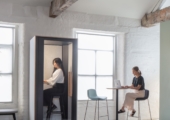
The structural changes taking place across EMEA illustrate the scale of that transformation. Our latest EMEA Occupancy Planning Benchmark Report found that 47 percent of organisations are increasing the number of phone booths within their workplaces, while almost a third are adding more focus rooms. Shared workstations continue to replace dedicated desks, and private offices continue their gradual decline. These are sensible responses to a workforce that no longer spends every day completing individual tasks from the same desk. Today’s office is increasingly expected to support collaboration, focused work, learning and relationship building in equal measure.
Yet while workplaces are changing rapidly, the way employees use them continues to evolve just as quickly. Across EMEA, 60 percent of employees now attend the office between three and five days each week, suggesting hybrid working has become more structured than it was immediately after the pandemic. Looking beneath that headline, however, reveals a distinctly regional story. Almost one in three employees still comes into the office only once or twice a week, while the UK averages just 2.8 office days, below the global average of 3.2. Attendance patterns vary more widely across EMEA than anywhere else in the world, ranging from fewer than two office days a week in some markets to more than four in others. There is no longer a single European model for hybrid working, and that diversity makes workplace design considerably more complex.
That complexity is reflected in how buildings are performing. EMEA is the only global region where office utilisation has declined year on year, falling to 55 percent despite organisations targeting 75 percent utilisation. The gap between actual and target utilisation has widened rather than narrowed, suggesting the challenge is no longer simply encouraging employees back into the office. It is understanding how today’s workplaces are actually being used and whether they are supporting the activities people come in to undertake.
Those questions matter because workplace design has become a long-term investment decision. Organisations are reshaping portfolios, refurbishing buildings and reallocating space on the basis of how they believe employees want to work. Those decisions will shape employee experience for years to come, yet they are often informed by snapshots of behaviour rather than a continuous understanding of how workplaces function over time. A meeting room that feels impossible to book may sit empty for much of the day because employees reserve it “just in case”. Collaboration spaces can appear heavily used because demand peaks for short periods, while quieter environments may seem underutilised simply because they are poorly located or difficult to find. Without understanding the difference between perception and behaviour, even well-intentioned design decisions carry unnecessary risk.
From instinct to insight
Perhaps the clearest sign that organisations recognise this challenge is the way their priorities are changing. Increasing the use of utilisation data in planning has risen from the sixth to the number one occupancy planning priority across EMEA in just twelve months, making it a higher priority than in any other region. Improving reporting now ranks second. Together, these findings suggest workplace leaders are moving away from making decisions based on instinct and towards making them based on evidence.
That shift reflects a simple reality. Workplace design can no longer rely solely on employee surveys, anecdotal feedback or occasional utilisation studies. Organisations increasingly want evidence that allows them to understand how different spaces perform, how behaviours change over time and whether workplace investments are delivering the outcomes they were intended to achieve.
Extreme weather events like this summer’s heatwaves simply make that need more visible. Changes in temperature influence commuting patterns, alter occupancy throughout the day and affect the way employees move through a building. Similar shifts occur during school holidays, transport disruption or major project deadlines. While the causes may differ across EMEA’s diverse markets, the conclusion remains the same. Workplaces are living environments shaped by constantly changing patterns of behaviour, making it increasingly difficult to design offices around fixed assumptions.
AI is only as good as the data behind it
The same principle applies to artificial intelligence, which is generating understandable excitement across the real estate industry. AI promises better forecasting, smarter workplace planning and more responsive buildings, but EMEA organisations are approaching its adoption with understandable caution. Just 8 percent have progressed beyond pilot programmes, while almost one in five organisations still does not audit the accuracy of its occupancy data. Poor data quality remains one of the biggest barriers to wider AI adoption, reinforcing the fact that intelligent workplaces depend on reliable information before they depend on intelligent technology.
For much of the past five years, the hybrid work debate has focused on attendance: how often employees come into the office and whether organisations should encourage them to spend more time there. Across EMEA, that conversation increasingly feels too narrow. The more important question is whether the workplace supports the activities people come into the office to do. In a region where hybrid working looks markedly different from one market to the next, designing successful workplaces requires a deeper understanding of behaviour than ever before.
The recent spell of hot weather will pass, but the lesson it offers employers across EMEA should endure. There is no universal formula for designing the workplace of the future because there is no universal pattern of workplace behaviour across the region. The organisations that succeed will be those that continually learn from how employees use their spaces, adapting workplaces as behaviours evolve rather than relying on assumptions.
Peter Jones is Managing Director, Workplace Management EMEA, JLL

















July 22, 2026
Are we designing workplaces around evidence or assumption?
by Peter Jones • Comment, Facilities management, Property, Workplace design
That challenge is particularly acute across EMEA. More than any other global region, we are seeing hybrid working evolve in different directions. Organisations are navigating different labour markets, cultures, regulations and employee expectations, making it increasingly difficult to apply a single blueprint for workplace design. Hybrid working is no longer an experiment, but neither has it settled into a single, predictable model. Organisations throughout the region have spent the past few years redefining workplace policies, rethinking the role of the office and investing heavily in environments designed to support collaboration, creativity and employee wellbeing. While this has triggered one of the most significant workplace redesigns in decades, it also raises an uncomfortable question: are we designing workplaces around the way people actually work, rather than the way we think they work?
Designing for behaviour, not attendance
The structural changes taking place across EMEA illustrate the scale of that transformation. Our latest EMEA Occupancy Planning Benchmark Report found that 47 percent of organisations are increasing the number of phone booths within their workplaces, while almost a third are adding more focus rooms. Shared workstations continue to replace dedicated desks, and private offices continue their gradual decline. These are sensible responses to a workforce that no longer spends every day completing individual tasks from the same desk. Today’s office is increasingly expected to support collaboration, focused work, learning and relationship building in equal measure.
Yet while workplaces are changing rapidly, the way employees use them continues to evolve just as quickly. Across EMEA, 60 percent of employees now attend the office between three and five days each week, suggesting hybrid working has become more structured than it was immediately after the pandemic. Looking beneath that headline, however, reveals a distinctly regional story. Almost one in three employees still comes into the office only once or twice a week, while the UK averages just 2.8 office days, below the global average of 3.2. Attendance patterns vary more widely across EMEA than anywhere else in the world, ranging from fewer than two office days a week in some markets to more than four in others. There is no longer a single European model for hybrid working, and that diversity makes workplace design considerably more complex.
That complexity is reflected in how buildings are performing. EMEA is the only global region where office utilisation has declined year on year, falling to 55 percent despite organisations targeting 75 percent utilisation. The gap between actual and target utilisation has widened rather than narrowed, suggesting the challenge is no longer simply encouraging employees back into the office. It is understanding how today’s workplaces are actually being used and whether they are supporting the activities people come in to undertake.
Those questions matter because workplace design has become a long-term investment decision. Organisations are reshaping portfolios, refurbishing buildings and reallocating space on the basis of how they believe employees want to work. Those decisions will shape employee experience for years to come, yet they are often informed by snapshots of behaviour rather than a continuous understanding of how workplaces function over time. A meeting room that feels impossible to book may sit empty for much of the day because employees reserve it “just in case”. Collaboration spaces can appear heavily used because demand peaks for short periods, while quieter environments may seem underutilised simply because they are poorly located or difficult to find. Without understanding the difference between perception and behaviour, even well-intentioned design decisions carry unnecessary risk.
From instinct to insight
Perhaps the clearest sign that organisations recognise this challenge is the way their priorities are changing. Increasing the use of utilisation data in planning has risen from the sixth to the number one occupancy planning priority across EMEA in just twelve months, making it a higher priority than in any other region. Improving reporting now ranks second. Together, these findings suggest workplace leaders are moving away from making decisions based on instinct and towards making them based on evidence.
That shift reflects a simple reality. Workplace design can no longer rely solely on employee surveys, anecdotal feedback or occasional utilisation studies. Organisations increasingly want evidence that allows them to understand how different spaces perform, how behaviours change over time and whether workplace investments are delivering the outcomes they were intended to achieve.
Extreme weather events like this summer’s heatwaves simply make that need more visible. Changes in temperature influence commuting patterns, alter occupancy throughout the day and affect the way employees move through a building. Similar shifts occur during school holidays, transport disruption or major project deadlines. While the causes may differ across EMEA’s diverse markets, the conclusion remains the same. Workplaces are living environments shaped by constantly changing patterns of behaviour, making it increasingly difficult to design offices around fixed assumptions.
AI is only as good as the data behind it
The same principle applies to artificial intelligence, which is generating understandable excitement across the real estate industry. AI promises better forecasting, smarter workplace planning and more responsive buildings, but EMEA organisations are approaching its adoption with understandable caution. Just 8 percent have progressed beyond pilot programmes, while almost one in five organisations still does not audit the accuracy of its occupancy data. Poor data quality remains one of the biggest barriers to wider AI adoption, reinforcing the fact that intelligent workplaces depend on reliable information before they depend on intelligent technology.
For much of the past five years, the hybrid work debate has focused on attendance: how often employees come into the office and whether organisations should encourage them to spend more time there. Across EMEA, that conversation increasingly feels too narrow. The more important question is whether the workplace supports the activities people come into the office to do. In a region where hybrid working looks markedly different from one market to the next, designing successful workplaces requires a deeper understanding of behaviour than ever before.
The recent spell of hot weather will pass, but the lesson it offers employers across EMEA should endure. There is no universal formula for designing the workplace of the future because there is no universal pattern of workplace behaviour across the region. The organisations that succeed will be those that continually learn from how employees use their spaces, adapting workplaces as behaviours evolve rather than relying on assumptions.
Peter Jones is Managing Director, Workplace Management EMEA, JLL