
July 22, 2026
Why most marketing teams are using AI wrong (and how to fix it)
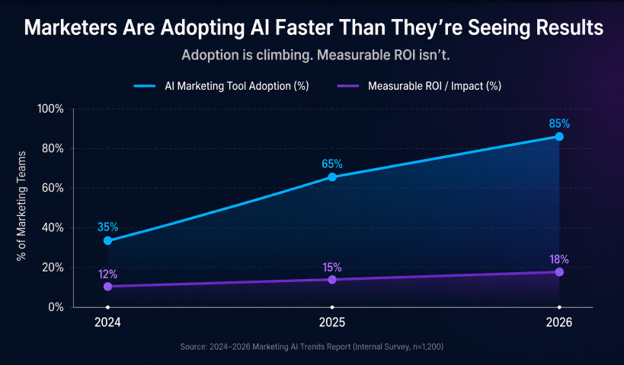
 Nearly nine in ten marketers now use generative AI somewhere in their workflow, up from roughly half just two years ago. That’s one of the fastest adoption curves any marketing technology has ever seen. And yet, according to McKinsey’s ongoing research into marketing’s use of AI, most organizations still haven’t scaled AI beyond isolated pilots, and a majority of European marketing teams in particular haven’t advanced their gen-AI maturity at all.
That gap — widespread adoption, shallow impact — is the real story in marketing right now. Everyone has the tools. Almost nobody has a system. This piece breaks down where teams are getting stuck, and what separates the marketers seeing real gains from the ones just generating more content, faster, into the same void.
The adoption-impact gap is bigger than it looks
Here’s the uncomfortable pattern: usage numbers and results numbers have stopped moving together. Marketers report saving upwards of six hours a week using AI tools, and teams publish significantly more content than they did two years ago. Output is up across the board.
Revenue attribution tells a different story. Most organizations still can’t draw a straight line from “we use AI” to “AI made us money.” The tools got easier to use faster than teams figured out what to use them for — so adoption raced ahead of strategy, and a lot of that saved time went into producing more of the same generic content, just quicker.
Three things tend to separate teams that break out of this pattern:
- They pick a narrow set of high-leverage use cases instead of bolting AI onto every task in the funnel.
- They measure outcomes, not activity — conversions and cost-per-acquisition, not “number of assets generated.”
- They treat AI as infrastructure, not a plugin — it’s wired into their data and workflows, not sitting off to the side as a novelty tool.
Where the real ROI shows up
Not every use case pulls its weight equally. Personalization and content drafting consistently produce the strongest returns, largely because they compound: better-targeted content performs better, which generates more first-party data, which makes the next round of targeting sharper still.
A few areas worth prioritizing if you’re deciding where to focus first:
- Predictive audience targeting Rather than manually building lookalike segments, modern platforms can score prospects on likelihood to convert using behavioral and firmographic signals in real time. Teams doing this well see measurably lower acquisition costs, because they’re spending budget on people already primed to act instead of casting a wide net and hoping.
- Dynamic content personalization Static email blasts and one-size-fits-all landing pages are losing ground fast. Personalization engines that adjust messaging, offers, and even layout based on visitor behavior are now delivering some of the highest returns of any AI application in marketing — largely because they attack the exact problem Salesforce’s State of Marketing research flags as one of the industry’s biggest gaps: the majority of marketers admit their own campaigns still feel generic, even as customers demand the opposite.
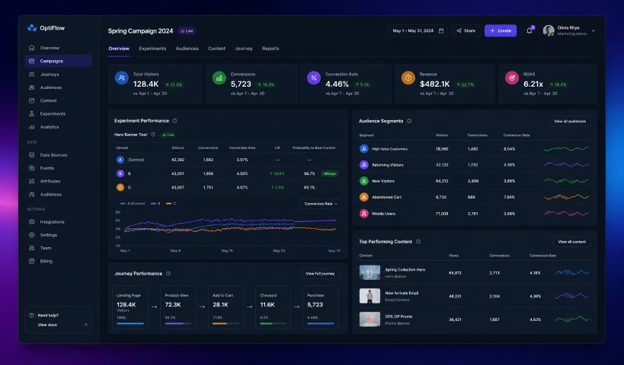
- Campaign orchestration and testing This is where the frontier is moving. Instead of a marketer manually setting up A/B tests, some teams now run dozens of content and offer variations simultaneously, with the system reallocating spend toward whatever’s converting in near real time. It’s a meaningful step up from traditional split testing, and it’s part of why platforms that pull together audience data, content generation, and performance tracking into one workflow — AI marketing tools like these are increasingly where mid-market teams start — tend to outperform teams stitching together five disconnected point solutions.
- Agentic workflows The newest layer: systems that don’t just assist a human but execute parts of a campaign autonomously — adjusting bids, pausing underperforming creative, triggering follow-up sequences — with a human reviewing outcomes rather than approving every step. Adoption here is still early, but it’s the clearest signal of where the category is headed.
The foundation problem nobody wants to fix
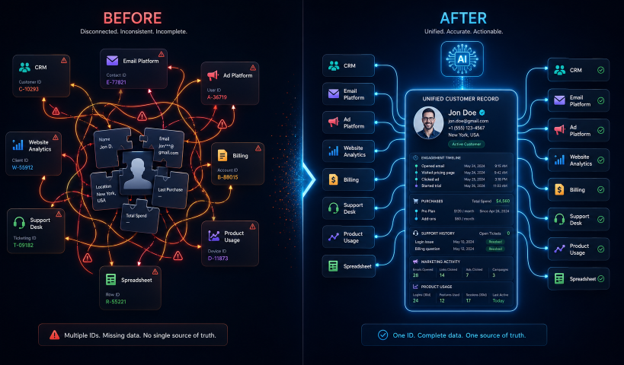
Ask marketing leaders what’s actually holding AI back, and the answer usually isn’t the technology. It’s the data underneath it. Fragmented customer records, inconsistent tagging, and systems that don’t talk to each other mean AI tools end up working with a partial, often contradictory picture of the customer.
This is why the teams pulling ahead didn’t start with a shiny new tool. They started by unifying customer data — one coherent record per customer instead of six half-updated ones scattered across platforms — and only then layered AI on top. It’s slower and less exciting than announcing a new AI initiative, but it’s the difference between a system that compounds and one that just automates the same mediocre output.
It’s also why so many AI rollouts stall at the pilot stage. A model can only personalize based on what it can see, and if what it can see is inconsistent or six months stale, the output reflects that — confidently, and often invisibly, until performance numbers come in flat.
Where this leaves marketing teams in 2026
The tools aren’t the bottleneck anymore. Most of what’s available today is genuinely capable — the gap is almost entirely in how deliberately teams deploy it. Before adding another platform to the stack, it’s worth asking a blunter question: do we actually have clean, unified data to feed it, and do we know exactly which metric we expect to move?
Teams that can answer both questions tend to see the productivity gains actually convert into revenue. Teams that can’t tend to end up with more content, more dashboards, and the same conversion rate they had eighteen months ago.
So here’s the real question worth sitting with: is your team using AI to do the same marketing faster, or to do fundamentally better marketing? Those are not the same thing, and the data-foundation work required to get the second one is usually the part nobody wants to prioritize first.