 In the coming weeks it will be six years since the UK entered lockdown and working life changed overnight. While much has stabilised, the impact of the pandemic still shapes how people experience work, particularly when it comes to connection and belonging. Loneliness is widely recognised as a growing societal issue and government data shows that around a quarter of adults in Great Britain report feeling lonely at least some of the time, rising significantly among younger age groups. Hybrid working has not created this challenge but it has highlighted that for many people the workplace was a consistent source of social interaction.
In partnership with Future Places Studio, HB Reavis has been exploring how changing work patterns are influencing connection. Our research indicates that 35 percent of people report feeling lonely when working from home, rising to 46 percent among 25 to 34 year olds. By comparison, 27 percent of that same age group report loneliness in the office. Digital connectivity enables productivity but it does not fully replicate the everyday interactions that contribute to a sense of belonging.
At the same time, many of our traditional social spaces, from cafés to community venues like pubs and libraries, are under pressure. Rising costs and changing habits mean fewer casual opportunities for interaction in person. Offices therefore have an opportunity to play a broader role, not simply as places of work but as part of the social infrastructure of cities.
This presents both a responsibility and a commercial opportunity for landlords, developers and operators.
Amenity as everyday infrastructure
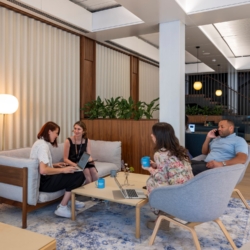
Amenities were once viewed as optional additions. Today they are central to the experience at work informing why people choose to come in to the office. Cafés, shared lobbies, terraces and wellness areas create moments for informal interaction. These are the spaces where familiarity builds over time. A barista who knows your name and your regular order, a front of house team who greet you as you arrive, a lounge space that encourages you to pause rather than pass straight through. These are small details, but they shape how a building feels. They create rhythm in the working day and a sense that you are recognised. Over time, that familiarity becomes connection and connection builds belonging.
A hospitality mindset
Physical design alone does not create connection. Management matters just as much. Some of the most successful hotels and restaurants are not necessarily the most luxurious but the ones where people feel genuinely welcome. There is a clear parallel for workspace.
Front of house teams, community managers and on-site operations teams can set the tone. A proactive hospitality-led approach, where occupiers and their teams are known and supported, can significantly influence the experience of a building day to day. Belonging rarely happens by accident. It is created through culture and stewardship.
Curated, not forced, connection
We are seeing increasing demand from occupiers for opportunities that allow their teams to connect beyond their immediate organisation, through both planned events plus well designed and natural touchpoints. Whether that is thoughtfully curated talks, panel discussions, wellness sessions or informal social events, these can create shared experiences across a building. Done well – these programmes feel additive rather than obligatory and over time they strengthen the fabric of a workplace community.
Designing for choice
Workplace design has already evolved significantly but there is more to do. Breakout areas, informal meeting zones and flexible collaboration spaces encourage people to work alongside one another rather than in isolation. At the same time zoned layouts that balance interactive areas with quiet focus spaces ensure productivity is not compromised.
Designing with choice in mind, including neurodiverse considerations and different working preferences that reflect the diverse demographics of different employees, enables offices to support a broader range of people effectively. Inclusivity is not simply a design principle, it is a performance driver.
From space provider to workplace operator
For landlords and asset managers this shift has resulted in strategic shifts. If the office is part of a company’s answer to hybrid working, then the leasing strategy needs to reflect that reality. Flexibility is no longer a defensive offer, it is part of long-term resilience and attraction.
Providing pathways for expansion and contraction, integrating managed or flexible solutions within core buildings and enabling occupiers to adapt without relocating all contribute to stickier relationships.
At the same time design becomes a leasing differentiator rather than simply a specification line. Efficient floorplates remain essential, but buildings that incorporate genuine third spaces, activated ground floors and well-balanced collaborative and focus zones help occupiers articulate why bringing people together still matters.
In this context the landlord’s role evolves. It is no longer solely about providing space, but about operating workplace infrastructure that supports culture, productivity and connection. This operational mindset, combining flexibility, thoughtful design and active management, is increasingly central to leasing performance.
Where social value meets commercial resilience
Occupiers are increasingly evaluating workspace not only on location and specification but on community, activation and experience. Our research has also identified a direct alignment between social responsibility and commercial performance when it comes to fostering belonging.
This makes the case for designing for pro-social workplace culture supports talent attraction and retention, encourages collaboration and underpins productivity. For landlords this translates into leasing resilience and long-term asset performance.
As we move further into working life shaped by flexibility, technology and evolving expectations, the most successful office buildings will be those that are not only efficient but socially intelligent. And I personally want to choose somewhere that I feel adds something to my working day, where I feel connected and part of something shared.
We set out for our research to be thought provoking, and we recognise loneliness as a complex societal issue which workplaces alone will not solve. However, through the spaces we create we can begin to meaningfully contribute to a solution.
Louise Ioannou is head of workspace at HB Reavis















March 9, 2026
Rebuilding belonging: how offices can overcome loneliness
by Louise Ioannou • Comment, Flexible working, Wellbeing
In partnership with Future Places Studio, HB Reavis has been exploring how changing work patterns are influencing connection. Our research indicates that 35 percent of people report feeling lonely when working from home, rising to 46 percent among 25 to 34 year olds. By comparison, 27 percent of that same age group report loneliness in the office. Digital connectivity enables productivity but it does not fully replicate the everyday interactions that contribute to a sense of belonging.
At the same time, many of our traditional social spaces, from cafés to community venues like pubs and libraries, are under pressure. Rising costs and changing habits mean fewer casual opportunities for interaction in person. Offices therefore have an opportunity to play a broader role, not simply as places of work but as part of the social infrastructure of cities.
This presents both a responsibility and a commercial opportunity for landlords, developers and operators.
Amenity as everyday infrastructure
Amenities were once viewed as optional additions. Today they are central to the experience at work informing why people choose to come in to the office. Cafés, shared lobbies, terraces and wellness areas create moments for informal interaction. These are the spaces where familiarity builds over time. A barista who knows your name and your regular order, a front of house team who greet you as you arrive, a lounge space that encourages you to pause rather than pass straight through. These are small details, but they shape how a building feels. They create rhythm in the working day and a sense that you are recognised. Over time, that familiarity becomes connection and connection builds belonging.
A hospitality mindset
Physical design alone does not create connection. Management matters just as much. Some of the most successful hotels and restaurants are not necessarily the most luxurious but the ones where people feel genuinely welcome. There is a clear parallel for workspace.
Front of house teams, community managers and on-site operations teams can set the tone. A proactive hospitality-led approach, where occupiers and their teams are known and supported, can significantly influence the experience of a building day to day. Belonging rarely happens by accident. It is created through culture and stewardship.
Curated, not forced, connection
We are seeing increasing demand from occupiers for opportunities that allow their teams to connect beyond their immediate organisation, through both planned events plus well designed and natural touchpoints. Whether that is thoughtfully curated talks, panel discussions, wellness sessions or informal social events, these can create shared experiences across a building. Done well – these programmes feel additive rather than obligatory and over time they strengthen the fabric of a workplace community.
Designing for choice
Workplace design has already evolved significantly but there is more to do. Breakout areas, informal meeting zones and flexible collaboration spaces encourage people to work alongside one another rather than in isolation. At the same time zoned layouts that balance interactive areas with quiet focus spaces ensure productivity is not compromised.
Designing with choice in mind, including neurodiverse considerations and different working preferences that reflect the diverse demographics of different employees, enables offices to support a broader range of people effectively. Inclusivity is not simply a design principle, it is a performance driver.
From space provider to workplace operator
For landlords and asset managers this shift has resulted in strategic shifts. If the office is part of a company’s answer to hybrid working, then the leasing strategy needs to reflect that reality. Flexibility is no longer a defensive offer, it is part of long-term resilience and attraction.
Providing pathways for expansion and contraction, integrating managed or flexible solutions within core buildings and enabling occupiers to adapt without relocating all contribute to stickier relationships.
At the same time design becomes a leasing differentiator rather than simply a specification line. Efficient floorplates remain essential, but buildings that incorporate genuine third spaces, activated ground floors and well-balanced collaborative and focus zones help occupiers articulate why bringing people together still matters.
In this context the landlord’s role evolves. It is no longer solely about providing space, but about operating workplace infrastructure that supports culture, productivity and connection. This operational mindset, combining flexibility, thoughtful design and active management, is increasingly central to leasing performance.
Where social value meets commercial resilience
Occupiers are increasingly evaluating workspace not only on location and specification but on community, activation and experience. Our research has also identified a direct alignment between social responsibility and commercial performance when it comes to fostering belonging.
This makes the case for designing for pro-social workplace culture supports talent attraction and retention, encourages collaboration and underpins productivity. For landlords this translates into leasing resilience and long-term asset performance.
As we move further into working life shaped by flexibility, technology and evolving expectations, the most successful office buildings will be those that are not only efficient but socially intelligent. And I personally want to choose somewhere that I feel adds something to my working day, where I feel connected and part of something shared.
We set out for our research to be thought provoking, and we recognise loneliness as a complex societal issue which workplaces alone will not solve. However, through the spaces we create we can begin to meaningfully contribute to a solution.
Louise Ioannou is head of workspace at HB Reavis