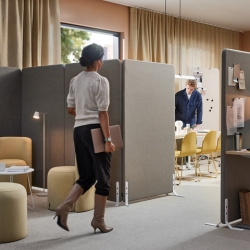
 Most UK offices were not designed with movement in mind. They were designed to fit as many people as possible into a given space, keep overheads manageable and ensure everyone had somewhere to plug in a laptop. According to the British Medical Bulletin, UK office workers spend up to three quarters of their day sitting. Scientific Reports puts it more precisely, between 68 percent and 82 percent of the working day is spent seated, the highest proportion of any occupation.
What is less expected is how this compares to working from home. Our survey of 2,015 UK desk workers found that office-based workers are less likely to take regular breaks than those working entirely from home. Despite the pull of workplace integration and a larger footprint than a home office just 41.4 percent of office workers take at least one break per hour, against 44.9 percent of remote workers.
The layout of most offices reinforces sedentary behaviour. Rows of desks facing screens. Meeting rooms are formal and removed from where day-to-day work happens. The most common way UK workers get to the office is by car, according to the ONS. Walking from the car park to a desk and sitting down for the rest of the day is, for many people, the full extent of their physical activity. Nothing in the workplace environment asks people for regular movement, and workload pressure means most will not choose to.
The 2024 ASICS Global State of Mind study found that two hours of uninterrupted desk time produced a measurable decline in mental health. Four continuous hours was associated with an 18 percent increase in stress levels. Most UK office workers exceed both thresholds on a typical day.
Nearly a third of workers go for three hours or more without a break, and this is a worrying statistic. Inactivity contributes to increased risk of chronic diseases and mental health issues. This data underscores the urgent need to prioritise workplace wellbeing initiatives. These statistics describe a workforce behaving in exactly the way most conventional workplaces exist and expect. Traditional office layouts are built around headcount and space efficiency.
Why office workers move less than home workers
The reasons office workers move less are deeply embedded in how office life works. Workplace culture is the biggest factor. In most offices, being seen at your desk is still equated with being productive. Stepping away carries an unspoken cost, particularly in open-plan environments where absence is noticed. Remote workers do not face the same pressure. They are judged on output, not presence, which makes taking a break a more natural act.
Longer hours compound the problem. Office-based workers consistently log more hours than home-based counterparts, leaving less time and energy for movement. Convenience works against activity too. When everything needed for the day is within a few metres, and lunch can be ordered to the desk, there is little that physically requires anyone to get up.
Who is sitting longest?
The survey data shows exactly where those learned habits are rooted. Workers aged 25 to 34 are the least likely of any age group to take hourly breaks, with only 31.6 percent doing so. This is the demographic most workplaces are currently redesigning to attract, investing in collaboration zones, new amenities and flexible layouts. The physical environment may be changing. The movement habits are not.
By profession, travel agents were the most likely to take regular breaks at 66.7 percent. The natural rhythm of a customer-facing, task-based role builds in interruptions that the average open-plan screen based role does not.
What works?
The most effective interventions are built into the environment, not left to individual choice. A NIHR study of 756 office workers found that providing a sit-stand desk reduced sitting time by over an hour a day compared to those who changed nothing. Floor plans that place shared facilities away from workstations, staircases that are a genuine alternative to lifts, and furniture that encourages posture changes throughout the day all reduce sitting time without asking people to make a conscious decision to move.
The key to better workplace health is to have movement regularly dispersed throughout the day. Frequent desk breaks are just one element of this, and probably the easiest to implement, with far-reaching benefits for mental health and efficacy.
Culture plays an equally important role alongside the physical environment. In our own UK office, the Scandinavian tradition of fika, a set daily break where the whole team steps away from their desks together, puts that into practice. When movement is collective and timetabled, it does not rely on individual willpower.
What needs to change?
The debate around office attendance has focused on productivity, collaboration and culture. The sedentary data raises something that has had far less attention: whether the office, as currently designed and managed, is good for the health of the people using it every day.
Workplace interventions to reduce sedentary behaviour have been shown in the NIHR survey to be cost-effective, delivering health gains alongside measurable productivity improvements. The evidence is well established. The design response across much of the UK’s workplace environments is yet to catch up.
Helen Beebe is MD at AJ Products UK and Ambassador for Happiness at Work
















June 1, 2026
Is being back in the office making you desk bound?
by Helen Beebe • Comment, Wellbeing, Workplace design
What is less expected is how this compares to working from home. Our survey of 2,015 UK desk workers found that office-based workers are less likely to take regular breaks than those working entirely from home. Despite the pull of workplace integration and a larger footprint than a home office just 41.4 percent of office workers take at least one break per hour, against 44.9 percent of remote workers.
The layout of most offices reinforces sedentary behaviour. Rows of desks facing screens. Meeting rooms are formal and removed from where day-to-day work happens. The most common way UK workers get to the office is by car, according to the ONS. Walking from the car park to a desk and sitting down for the rest of the day is, for many people, the full extent of their physical activity. Nothing in the workplace environment asks people for regular movement, and workload pressure means most will not choose to.
The 2024 ASICS Global State of Mind study found that two hours of uninterrupted desk time produced a measurable decline in mental health. Four continuous hours was associated with an 18 percent increase in stress levels. Most UK office workers exceed both thresholds on a typical day.
Nearly a third of workers go for three hours or more without a break, and this is a worrying statistic. Inactivity contributes to increased risk of chronic diseases and mental health issues. This data underscores the urgent need to prioritise workplace wellbeing initiatives. These statistics describe a workforce behaving in exactly the way most conventional workplaces exist and expect. Traditional office layouts are built around headcount and space efficiency.
Why office workers move less than home workers
The reasons office workers move less are deeply embedded in how office life works. Workplace culture is the biggest factor. In most offices, being seen at your desk is still equated with being productive. Stepping away carries an unspoken cost, particularly in open-plan environments where absence is noticed. Remote workers do not face the same pressure. They are judged on output, not presence, which makes taking a break a more natural act.
Longer hours compound the problem. Office-based workers consistently log more hours than home-based counterparts, leaving less time and energy for movement. Convenience works against activity too. When everything needed for the day is within a few metres, and lunch can be ordered to the desk, there is little that physically requires anyone to get up.
Who is sitting longest?
The survey data shows exactly where those learned habits are rooted. Workers aged 25 to 34 are the least likely of any age group to take hourly breaks, with only 31.6 percent doing so. This is the demographic most workplaces are currently redesigning to attract, investing in collaboration zones, new amenities and flexible layouts. The physical environment may be changing. The movement habits are not.
By profession, travel agents were the most likely to take regular breaks at 66.7 percent. The natural rhythm of a customer-facing, task-based role builds in interruptions that the average open-plan screen based role does not.
What works?
The most effective interventions are built into the environment, not left to individual choice. A NIHR study of 756 office workers found that providing a sit-stand desk reduced sitting time by over an hour a day compared to those who changed nothing. Floor plans that place shared facilities away from workstations, staircases that are a genuine alternative to lifts, and furniture that encourages posture changes throughout the day all reduce sitting time without asking people to make a conscious decision to move.
The key to better workplace health is to have movement regularly dispersed throughout the day. Frequent desk breaks are just one element of this, and probably the easiest to implement, with far-reaching benefits for mental health and efficacy.
Culture plays an equally important role alongside the physical environment. In our own UK office, the Scandinavian tradition of fika, a set daily break where the whole team steps away from their desks together, puts that into practice. When movement is collective and timetabled, it does not rely on individual willpower.
What needs to change?
The debate around office attendance has focused on productivity, collaboration and culture. The sedentary data raises something that has had far less attention: whether the office, as currently designed and managed, is good for the health of the people using it every day.
Workplace interventions to reduce sedentary behaviour have been shown in the NIHR survey to be cost-effective, delivering health gains alongside measurable productivity improvements. The evidence is well established. The design response across much of the UK’s workplace environments is yet to catch up.
Helen Beebe is MD at AJ Products UK and Ambassador for Happiness at Work