Search Results for: workplace training

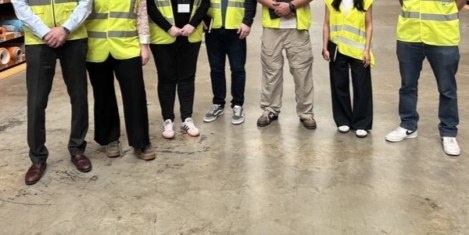
Furniture Makers accepting nominations for 2026 Young Professional Industry Experience 

Furniture Makers accepting nominations for 2026 Young Professional Industry Experience 

The Furniture Makers’ Company, the City of London livery company and charity for the furnishing industry, is accepting nominations for its Young Professional Industry ExperienceThe Furniture Makers’ Company, the City of London livery company and charity for the furnishing industry, is accepting nominations for its Young Professional Industry Experience. The programme provides aspiring young people working in the industry a unique opportunity to visit sector leading companies and understand all areas of the wider trade, including materials, designing, manufacturing, pricing, marketing, sales and customer service. (more…)

People want their jobs to provide them with security and steady pay

People want their jobs to provide them with security and steady pay

Workers are placing greater emphasis on job security, fair pay and employer support for adaptability, according to new global research from the Adecco GroupWorkers are placing greater emphasis on job security, fair pay and employer support for flexibility, according to new global research from the Adecco Group, which suggests the so called Great Resignation has given way to a more cautious approach to how ambitious people would like to seem. The Workforce Trends 2025 report [registration] is based on responses from 37,500 workers and 2,000 senior executives across 31 countries. It finds that while employees continue to value growth, flexibility and meaningful work, these priorities are increasingly secondary to stable income and employment certainty as economic and social uncertainty persists. (more…)

Addressing the problem of burnout in high stress industries 

Addressing the problem of burnout in high stress industries 

This article will explore the root cause of burnout, which often goes unnoticed and unaddressed. You will gain insights into what the early signs look like and how a sustainable workplace design can help reduce unnecessary strain on employees.What would happen if a bridge constantly supports a stream of traffic over time? No matter how robust or well-built it is, there will come a time when the materials begin to strain, revealing cracks and deeper structural issues.  Now, high stress industries tend to operate in a similar manner. Employees, acting as the bridge, may crumble under the continual weight of increasing workloads. Inevitably, burnout awaits at the end of the rope, something which serves as a warning of an overextended system.

This article will explore the root cause of burnout, which often goes unnoticed and unaddressed. You will gain insights into what the early signs look like and how a sustainable workplace design can help reduce unnecessary strain on employees.


Burnout As a Signal of Systemic Imbalance 

For the longest time, burnout has been viewed as an individual failure to cope. However, the fact that this condition is so persistent across industrial sectors reveals something far more structural.

Personal resilience, or lack thereof, becomes secondary when exhaustion and disengagement are reported across roles and sectors. By this stage, burnout has turned into a system-level signal that organizational demands have drifted out of alignment with human capacity.

A 2025 report showed that 72 percent of employees reported moderate to high levels of work-related stress. This marked the highest figure recorded in the past six years. Another independent research conducted the same year discovered that 66 percent of employees were experiencing some form of burnout.

The truth is that certain industries are known to be high-stress, including education, healthcare, emergency services, finance, and technology. When burnout is reported across these, it’s a sure sign that the operating models are relying on endurance rather than sustainability.

Since time pressure and emotional labor are treated as inherent to such sectors and the roles therein, burnout goes largely unaddressed. Common indicators of systemic imbalance include:

  • Workloads remain high despite changing demand cycles.
  • Recovery time is treated as optional.
  • Professionals are given high responsibilities with limited control or discretion.
  • Crisis conditions become normalized, masking long-term risk.
  • Moral and emotional strain occur, especially where workers cannot meet professional standards consistently.

Interestingly, burnout first appears among the most capable employees, those most invested in the outcomes. This should ring alarm bells, but sadly, many continue to see it as an individual issue. It’s time to understand that burnout is an early warning that the system itself is operating beyond sustainable limits.


How Workforce Shortages Intensify Burnout Cycles 

It’s important to note that high-stress industries also suffer from workforce shortages alongside burnout. This means the two are not separate challenges. When staffing levels are inadequate, the result is sustained pressure on remaining employees, no matter the market demand.

Staffing gaps go beyond redistributing work. They reshape job conditions in such a way that burnout only gets worse. The scale of this problem is most evident in the healthcare sector. As per a 2025 report, 72 percent of hiring professionals reported ongoing staffing shortages in their facilities.

What’s more is that such conditions are expected to continue in the near future. When more than two-thirds of managers cannot find enough qualified applicants to fill their vacancies, we can understand that the problem is real.

Under such circumstances, burnout tends to intensify through the following mechanisms:

  • Workloads don’t get reduced, just redistributed. The remaining staff have to work harder to complete the additional tasks generated due to high demand.
  • The work environment continues to stay fast-paced and high-stakes.
  • Experienced staff members spend more time covering direct services and less on mentoring or decompression.
  • Since shortages persist, the workforce doesn’t get replenished properly.
  • As the existing employees strain under pressure, that in itself fuels burnout and attrition rates.


Rethinking Talent Pipelines in High-Stress Sectors 

If organizations operating across high-stress industries are somehow able to replenish and sustain their workforce, that should provide some relief from burnout. The problem is that traditional talent pipelines, particularly in sectors like healthcare, emergency services, and education, were built for linear careers and predictable demand.

Under prolonged pressure, these models struggle to respond quickly enough. As a result, existing staff members are left to absorb the ongoing gaps. Many organizations are now reconsidering how people enter demanding professions in the first place.

In other words, many have decided not to rely solely on early-career entrants. Mid-career transitions and return-to-practice routes are also becoming a part of broader workforce strategies. For instance, in healthcare, career changers with a university degree in other disciplines can also pick up nursing training.

Within this context, online second-degree accelerated BSN programs have emerged as one example of how talent pipelines are being restructured. These programs lead to a Bachelor of Science in Nursing, the standard qualification for registered nurses.

As Elmhurst University shares, students with a prior Bachelor’s in any other discipline will earn their basic nursing degree within 16 months. The online structure addresses burnout in ways that traditional programs may not, as follows:

  • Trainees can stay partially employed while they complete their coursework.
  • The workforce across crucial, high-stress sectors can be replenished faster.
  • Candidates across different regions and demographics can have access to learning.
  • Organizations are able to avoid cyclic depletion caused by pulling staff out for upskilling or retraining.

Such adaptations can reduce the duration and intensity of understaffing across high-stress sectors. However, pipeline flexibility alone cannot resolve burnout. Parallel improvements in workload design and staffing support are also needed. Otherwise, the system already operating beyond sustainable limits will keep feeding itself.


Moving From Wellbeing Rhetoric to Sustainable Work Design 

Addressing burnout through well-being initiatives has become commonplace across high-stress industries. The world is all too familiar with wellness apps and stress management workshops. These interventions do provide short-term relief for individuals. However, they do little to tackle the root of the problem: systemic drivers such as chronic understaffing and excessive workloads.

According to Gallup’s State of the Global Workplace 2025 report, only 33 percent of employees worldwide said they were thriving. 58 percent were struggling to cope, and 40 percent even experienced significant stress “a lot of the previous day.” Such trends cut across sectors, showcasing that burnout and disengagement are not merely isolated personal challenges.

The need of the hour is sustainable work design that addresses how work is structured and paced. Key elements of this include the following:

  • Realistic workload distribution to ensure tasks are aligned with staffing levels and capacity
  • Predictable scheduling that reduces last-minute changes, which could erode recovery time
  • Built-in recovery periods to protect rest as a structural requirement
  • Clarity of roles to prevent overload that results from blurred responsibilities
  • Feedback loops that adjust workflows before the strain escalates

This type of design views burnout as a signal of system failure, rather than an individual employee’s weakness. High-stress industries cannot afford to consider this design as an optional enhancement.

The same is critical to stabilizing teams and protecting workforce capacity so as to mitigate long-term burnout. This is especially important as recent research has emphasized that organizations need to adapt workforce structure and skills to evolving demands.

With that being said, organizations also need to factor in anticipated future pressures, not just current workforce strain. This means the next frontier lies in intelligent workforce design. It would include predictive workload modeling and cross-training of teams for flexibility.

As digital tools and remote learning expand access, changes in workplace policy and culture can help prioritize sustainable work practices. This is crucial because the future of high-stress industries depends on proactive, structural solutions if burnout is to become a thing of the past.

The role of local businesses in promoting mental health and wellbeing

The role of local businesses in promoting mental health and wellbeing

Once seen as an individual responsibility, mental health is now recognised as a shared, community wide issue.Across the UK and over recent years, there has a change in how the general public views mental health and wellbeing. Once seen as an individual responsibility, mental health is now recognised as a shared, community wide issue. Our mental health is both our individual and collective responsibility and requires effort from family members, workplaces and organisations. For many, the workplace is where they spend most of their time. For others, local cafés, gyms, hairdressers, or local shops are their daily social spaces. These are the places that people connect, relax, and interact with other people. It’s in these spaces that local businesses have a unique power to influence how people think and feel as well as their mental health. (more…)

UK employers are missing out on AI productivity gains because of gaps in talent strategy

UK employers are missing out on AI productivity gains because of gaps in talent strategy

A new survey from EY suggests that many UK organisations are failing to realise the full productivity benefits of artificial intelligence (AI) because their talent strategies are not keeping paceA new survey from EY suggests that many UK organisations are failing to realise the full productivity benefits of artificial intelligence (AI) because their talent strategies are not keeping pace with technology adoption. The EY 2025 Work Reimagined Survey, based on responses from 800 UK employees and 180 employers, found that while the use of generative AI at work is now widespread, it is rarely being used in ways that fundamentally change how people work. More than four in five employees said they use GenAI tools, but this is largely limited to routine activities such as searching for information or summarising content. (more…)

UK directors say people must remain central to work as AI adoption accelerates

UK directors say people must remain central to work as AI adoption accelerates

New findings from monday.com suggest UK business leaders expect artificial intelligence (AI) to expand rather than shrink their workforces in the year ahead.New findings from monday.com suggest UK business leaders expect artificial intelligence to expand rather than shrink their workforces in the year ahead. The company’s latest World of Work report [registration], based on feedback from directors in the UK and US, shows that most UK leaders do not foresee headcount reductions in 2026, with almost a third expecting to hire more as AI becomes further embedded in daily operations. (more…)

Design Mumbai hosts the Sustainable Design Collective

Design Mumbai hosts the Sustainable Design Collective

The Sustainable Design Collective joined forces with Design Mumbai to host panel discussions at this rapidly expanding event.The Sustainable Design Collective recently joined forces with Design Mumbai to host panel discussions at this rapidly expanding event. Attracting over 9,000 visitors and 100+ leading, global brands, Design Mumbai’s launch in 2024 marked India’s first-ever B2B international contemporary design trade show for design, architecture, and interiors professionals.  The second iteration was held at Jio World Garden on 26th-29th November 2025. The event has already become a platform, both for Indian brands seeking global recognition and for international companies that want to tap into the prosperous and fast-growing Indian design market. (more…)

Call for accessible design for laboratories to make sure organisations don’t miss out on talent

Call for accessible design for laboratories to make sure organisations don’t miss out on talent

The Royal Society of Chemistry has called for urgent changes to the accessible design and culture of laboratory spaces after a new report revealed widespread barriers facing disabled researchers.The Royal Society of Chemistry has called for urgent changes to the design and culture of laboratory spaces after a new report revealed widespread barriers facing disabled researchers. The organisation warns that the chemical sciences could lose out on major discoveries unless universities, industry and policymakers act to create more inclusive environments. The Disability-Inclusive Laboratories in the Chemical Sciences report draws on contributions from more than 400 chemists and sets out a detailed picture of the physical, cultural and organisational obstacles that shape disabled scientists’ careers. According to the findings, almost a third of disabled chemists have experienced bullying or discrimination linked to disability, while more than a quarter say they do not feel a sense of belonging at work. Three-quarters report a lack of awareness among colleagues about their support needs. (more…)

Industry charity holding third online Christmas charity auction this December

Industry charity holding third online Christmas charity auction this December

The Furniture Makers’ Company, the City of London livery company and charity for the furnishing industry, is organising a third annual Online Christmas Charity Auction, with the hope of raising £10,000 to support its education, training, and welfare programmes.The Furniture Makers’ Company, the City of London livery company and charity for the furnishing industry, is organising a third annual Online Christmas Charity Auction, with the hope of raising £10,000 to support its education, training, and welfare programmes. This year’s auction, running from 1–12 December, features over 25 lots, generously donated by companies and individuals from across the furnishing industry. From premium mattresses and luxury bedding bundles to iconic designer chairs, cultural experiences, and exclusive workshops, bidders will have the chance to secure exceptional items while supporting their industry charity at a key time of year. (more…)

Many people lack the confidence to use life-saving defibrillators at work. Here’s what you can do

Many people lack the confidence to use life-saving defibrillators at work. Here’s what you can do

To address workplace cardiac emergencies, St John Ambulance has launched its easy-to-use HEART defibrillators at work to empower employees to act quickly to save lives.Research from health charity St John Ambulance shows that a quarter of UK adults have experienced a cardiac arrest incident in some way, either as a first aider, bystander or patient. With more than one in seven cardiac arrest incidents occurring in the workplace, access to defibrillators is critical. To address workplace cardiac emergencies, St John Ambulance has launched its easy-to-use HEART defibrillators at work to empower employees to act quickly to save lives. Prompt CPR and defibrillation – which delivers an electric shock to restore someone’s normal heart rhythm – can more than double survival rates during cardiac arrest. Yet, over half of people don’t know how to give CPR, while almost two-thirds lack confidence to use defibrillators at work. (more…)

A break in the workspace-time continuum

A break in the workspace-time continuum

The fracturing of time and place underlies every one of the great workplace issues of our time. Everything that springs from this – the where, when, how, what and why of work – is defined by the shattering of any fixed idea we may once have had of a time and a place to work. Because the challenge to these traditional ideas is now so inextricably linked in our minds with new technology, we might often  forget that people have been asking questions about how we can get the most out of each day for thousands of years. Tempus fugit after all, and as a consequence we’ve always known that how we spend our days is how we spend our lives. (more…)

Text to video GenAI will help drive energy consumption of OpenAI to same level as India

Text to video GenAI will help drive energy consumption of OpenAI to same level as India

A new study has raised concerns about the energy consumption of text-to-video (T2V) models, warning that the technology could become one of the most power-intensive forms of artificial intelligence yet developedA new study has raised concerns about the energy consumption of text-to-video (T2V) models, warning that the technology could become one of the most power-intensive forms of artificial intelligence yet developed. The research coincides with reports from within OpenAI that the firm’s energy consumption will match the current energy use of India within 8 years. The paper, Video Killed the Energy Budget: Characterizing the Latency and Power Regimes of Open Text-to-Video Models, published on the open research platform arXiv, presents a detailed analysis of the power usage of advanced open-source video generation systems. Conducted by researchers Julien Delavande, Régis Pierrard and Sasha Luccioni, the study benchmarks several models and quantifies the way in which video generation consumes energy. (more…)