Key to successful BIM implementation is collaboration, says RICS

Key to success of BIM implementation is collaboration says RICSThe need for collaboration between all the professions working within the built environment was the overriding theme of a free seminar on BIM, hosted by RICS last week, reports RICS’ Schemes and Accreditation Manager Jon Klahn. The event featured speakers from quantity surveying, engineering and architecture, and was designed to help delegates learn more about BIM and RICS’ role in establishing BIM industry standards. Addressing the 80 plus attendees, Dr Anne Kemp FRICS, Director of BIM Strategy and Development at Atkins and Chair of ICE’s BIM Action Group said the various professions can no longer be driven by self-interest. BIM in itself is not the solution. But the change required to make BIM successful will ultimately allow for better construction, better buildings and a better environment. Successful BIM implementation requires a partnership of people, process and technology and for project teams to understand and appreciate each other’s roles as professionals. (more…)

Overdevelopment leads to bad building design, claim Carbuncle Cup judges

TRINITY_SQUARE_GATESHEAD_7Building Design magazine has announced this year’s winners of its annual Carbuncle Cup competition, which aims to name and shame the UK’s ‘unforgivably bad’ buildings. As well as identifying problems with specific buildings, the judges also raised concerns about the catalysts for poor buildings, especially overdevelopment. The judges this year included Owen Luder, former president of the Royal Institute of British Architects, and Prince Charles’s architectural adviser, Hank Dittmar. While the main prize went to Tesco’s ‘inept, lumpen, arrogant and oppressive’ new supermarket in Woolwich in South East London, and the runners up prize went to the 50 storey residential Vauxhall Tower at St George’s Wharf, the most nominated building following the call for entries earlier this year was the Walkie Talkie skyscraper in London. However this office building was deemed ineligible because it is yet to complete. It now looks a shoe-in for next year’s prize however.

(more…)

BIM’s impact on future of built environment mapped out by construction experts

New report by construction group on digital future for built environmentA new report by an influential group of young construction professionals has been published today which illustrates the need for organisations to consider new skills, new processes and develop strategies around emerging technologies that will ensure that the UK stays ahead in embracing the digital construction future. The report by the BIM2050 Group, comprises a compilation of essays authored by BIM2050 work stream leads, and focuses on three key areas; education and skill; technology and process; and the culture of integration. Built Environment 2050: A report on our digital future, highlights the risks and challenges and the opportunities and benefits that come with large scale innovation and game-changing new technologies. Commented Graham Watts OBE, CIC Chief Executive: “It is an important discussion document of ideas and concepts that will, I hope, spark debate in the wider construction community.” (more…)

Natural daylight increases wellness of office workers finds new study

The importance of exposure to natural light to employee health and the priority architectural designs of office environments should place on natural daylight exposure for workers has been highlighted in a new study. According to researchers from Northwestern Medicine and the University of Illinois at Urbana-Champaign office workers with more light exposure at the office had longer sleep duration, better sleep quality, more physical activity and better quality of life compared to office workers with less light exposure in the workplace. Employees with windows in the workplace received 173 per cent more white light exposure during work hours and slept an average of 46 minutes more per night than employees who did not have the natural light exposure in the workplace. There also was a trend for workers in offices with windows to have more physical activity than those without windows. (more…)

A vision of office design that is the exact opposite of all it claims to be

Outstanding Landscape of Affordances 3The currently voguish idea that ‘sitting kills’ finds an interesting interpretation in this conceptual office design by Dutch architects RAAAF and the artist Barbra Visser. Designed with the good intentions of encouraging movement, the hellish outcome has the aesthetics of a stealth bomber crossed with an underpass in Peterborough reimagined by MC Escher, the functionality and appeal of a Snowdonian potholing weekend and is populated by 21st Century hipsters and band members of Kraftwerk. This is the Outstanding Landscape of Affordances, commissioned by the Netherlands’ Chief Government Architect and set to become a real installation in Amsterdam next year. To be fair, the blurb does describe the idea as ‘a first step towards a future in which standing at work is the new norm’, but that doesn’t mean we should ignore its catastrophic shortcomings, even as a talking point.

(more…)

Three major UK office developments get green light following months of talk

UK office developments

Plans for the new Astra Zeneca facility in Cambridge by Herzog & de Meuron

Three of the most talked about UK office developments have been given the go ahead within the space of a few days. The Government has finally announced that the new construction headquarters for HS2 will be in Birmingham, rather than London. Meanwhile, following all of the wrangling about its proposed takeover by Pfizer, Astra Zeneca has announced that the controversial move of its research facility from Cheshire to a new base in Cambridge will involve the creation of a new £330 million complex designed by Swiss architects Herzog & de Meuron.  Finally, planning consent has been granted for the  4.9 million sq ft Wood Wharf development in docklands including nearly 2 million sq ft of office space which the developer claims will be aimed at the thriving London technology, media and telecommunications (TMT) sector.

(more…)

RIBA announce Stirling prize shortlist for best new building 2014

The Shard in the City of London, the Library of Birmingham, the Manchester School of Art, the London School of Economics, the Everyman theatre in Liverpool and the London Aquatics Centre have been named in the shortlist for the 2014 RIBA Stirling Prize for the best new building. The six shortlisted buildings will now go head-to-head for architecture’s highest accolade, to be awarded by the Royal Institute of British Architects (RIBA) on 16 October 2014. The six buildings will be judged by the same criteria: their design excellence and their significance in the evolution of architecture and the built environment. Stephen Hodder, RIBA President said: “The RIBA Stirling Prize is awarded to the building that has made the biggest contribution to the evolution of architecture in a given year. Every one of the six shortlisted buildings shows what great public architecture can do: it can transcend mere construction to something quite poetic.” (more…)

Smithfield mixed use development plans thrown out by Communities Secretary

SmithfieldThe UK’s Communities secretary Eric Pickles has – in no uncertain terms – thrown out the controversial £160m plans to redevelop London’s historic Smithfield Market. The development, which would have been located in the heart of London’s creative and office design communities, was rejected with a strongly worded statement that concluded: ‘the extent of damage that the application would cause to the important heritage assets at Smithfield runs entirely counter to national and policy objectives intended to protect such assets from harm and that this would seriously undermine any economic, social or environmental benefits otherwise arising from the development, such that the proposal would not represent sustainable development.’ Objections to  the plans had been led by the Victorian Society and Save Britain’s Heritage and enjoyed the backing of high profile public figures such as Alan Bennett, Kristin Scott Thomas and RIBA Journal editor Hugh Pearman.

(more…)

Green building design ‘goes mainstream’ in major US cities

Green building design ‘goes mainstream’ in major US cities

Green building design

Minneapolis – the home of US green building design

It’s not just Europe that is experiencing an explosion of interest in green building design. According to a new report from CBRE and Maastricht University, the past ten years have seen a transformation in the way the US corporate real estate market approaches the environmental performance of buildings. According to the National Green Building Adoption Index for 2014, produced by CBRE there has been a remarkable increase in the  application of green building standards in the thirty most important regional commercial property markets in the US. Based on data from the US Green Building Council,  the number of office buildings which are LEED* or Energy Star** certified has surged since 2005. The proportion of LEED certified buildings in America now stands at 5 percent, up from under 0.5 percent over the course of the survey period. The total proportion  of office space which now has some form of green accreditation is just under a fifth.

(more…)

RIBA calls on next Government to put built environment centre stage

RIBA calls on next Government to put architecture and built environment centre stageA new report from The Royal Institute of British Architects (RIBA) sets out a number of recommendations for the next UK Government and calls for greater economic leadership from English cities to rebalance the UK economy and take some of the pressure off London and the South East. RIBA’s report, Building Better Britain: A vision for the next Government, advises that by focusing on architecture and the built environment, the next Government will be better placed to address a sluggish economy, a shortage of new homes, an aging population and the effects of climate change. Building on the findings of the Farrell Review, the report is intended to provide policy makers with a greater understanding of the impact of how places are designed, planned and built and how they affect our day to day lives.

(more…)

Building conservation award goes to Sixty London gatehouse

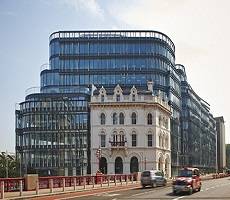
Sixty London gatehouse awardA City Heritage Award for Building Conservation has gone to architects KPF and the City of London Corporation for the rebuilding of the Sixty London gatehouse and restoration of the adjoining Holborn Viaduct. The schemes, which were completed in the Autumn of 2013, were honoured for their high standard of craftsmanship and finish. Sixty London replaces Bath House, a former mixed-use development designed in 1967, and rebuilding the northeast gatehouse, destroyed during the Second World War, was a crucial part of the KPF design. The gatehouse re-establishes the original symmetry of four gatehouses which historically stood at the intersection. The new office building comprises 212,000 sq ft of office space from Basement to ninth floors and is designed to achieve a BREEAM ‘Excellent’ rating. It also won the ‘Best Large Commercial Building’ category at the London region Local Authority and Building Control (LABC) Building Excellence Awards in May. (more…)

The new issue of the Insight newsletter is now available to view online

WP

The new copy of Insight is now available to view online. It’s been a busy few weeks for sure and this edition certainly reflects that. We introduce the new issue of Work&Place, the journal we publish in partnership with Occupiers Journal, with contributors that include Professor Franklin Becker of Cornell University, Chris Kane CEO of commercial projects at the BBC, Andrew Laing of AECOM, Simon Allford of architects AHMM Allford Hall Monaghan Morris, designer and workplace strategist Ziona Strelitz and Ian Ellison of Sheffield Hallam University. Elsewhere, Sara Bean reports on key structural changes in the UK property market, Mark Eltringham ponders what we have learned in the build-up to new flexible working regs, Simon Heath casts a jaundiced eye over a mixed bag of RIBA Workplace Award winners and Justin Miller pays tribute to a product that 20 years ago first radicalised then permanently transformed the way we viewed ergonomics and workplace design.