





October 17, 2014
Firms downsizing property dramatically as agile working takes hold, claims new report
The sharp reduction in the amount of office space used by corporate occupiers as they adopt more agile working practices has been confirmed in a new study from facilities management services provider MITIE. The survey, as reported in the British Institute of Facilities Management (BIFM) magazine FM World, found that between the years of 2008 and 2014 firms reduced their floorspace by an average of 45 percent. The results of the report, based on interviews with property directors, mirror those of the Occupier Density Survey published last year by the British Council for Offices (BCO) which also found a marked (if smaller) reduction. The authors of the MITIE report conclude, similarly, that the economic downturn has been the main catalyst for the reduction in property used by occupiers and that the main way firms have accommodated the fall is with the uptake of flexible working practices.



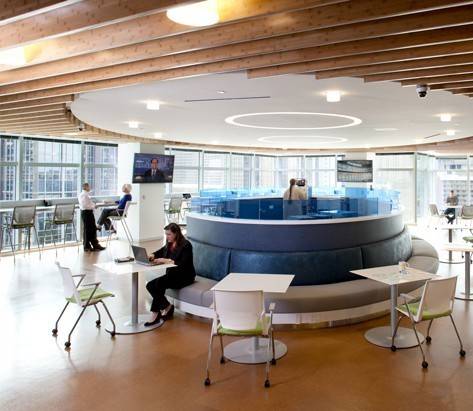



 Amongst all the talk about Generation Y and its impact on the world of work, it can be easy to miss the fact that the modern workplace is not defined by one particular generation, but a number of them. The multi-generational workplace has significant implications for the way we design and manage offices. While we must avoid the more obvious stereotypes about the needs of different age groups, we must still offer spaces that can meet a wide range of cultural, physical and technological needs if we are to create productive workplaces.The latest organisation to bang the drum for the multi-generational workplace is the Chartered Institute of Personnel and Development. It has published new research together with the Scottish Centre for Healthy Working Lives into the experiences and attitudes of SMEs towards age diversity at work.







September 16, 2014
Indoor air quality and the quest for a breath of fresh air in the workplace
by Justin Miller • Comment, Facilities management, Knowledge, Legal news, Workplace design
Edward Hopper, Office in a Small City, Metropolitan Museum of Art, NY
The modern workplace has to work harder than ever before. It must reflect corporate values, express something of the organisation’s brand, allow people to work to the best of their ability as well as look after their wellbeing, keep touch with the pace of changing technology and meet the demands of an ever changing legislative environment and keep costs down. All of these issues conflate around the challenge of providing a sustainable, comfortable and productive working environment in buildings that are filled with an increasing number of people and computers. It is estimated by the Building Research Establishment that even in a typical office each person and their technology will generate some 1500 W of energy per hour, the equivalent of the sort of fan heater that the EU is now keen to ban outright.
(more…)