Search Results for: learning

The ten most read stories on Workplace Insight for 2018

The ten most read stories on Workplace Insight for 2018

We can’t help but feel that the world caught up with us a bit during 2018. We’ve been talking about the intersection of people, place and tech since we started up five years ago. Of course, we weren’t even the first to do this. As we’ve always acknowledged, we’re standing on the shoulders of the giants who first recognised what was happening a quarter of a century ago. Many of the ‘trends’ with which we are presented are nothing more than the crystallisation of ideas first expressed by people in the 20th Century. They seldom get their due.

(more…)

Are open plan workspaces truly evil or is this just fake news?

Are open plan workspaces truly evil or is this just fake news?

A recently published paper describing the results of an academic study by Ethan S. Bernstein and Stephen Turban[1], both of Harvard, has become another unwarranted casualty of the debate within our industry and in the mainstream media on ‘open plan’ offices versus anything else. The researchers conducted two controlled studies in different organisations before and after a workplace refurbishment from dedicated cubicles to dedicated open plan (benching) neighbourhoods, and concluded that face to face interaction reduced significantly, while email and other digital communications increased in the new environment.

(more…)

Don’t be a turkey, get on the commercial property gravy train

Don’t be a turkey, get on the commercial property gravy train

Last week, the RICS Commercial Property conference tackled the biggest issues impacting the built environment sector, arming delegates with fragments of the formula for future success. The morning CEO Question Time panel put a trio of CEOs in the spotlight. In addition to airing concerns about the current political climate, rapidly shifting societal attitudes, diversity and inclusion, the ageing population coupled with the ongoing housing shortage, climate change and the complexities involved in exploring new business models to drive and diversify revenue, they all zoomed in on the accelerated pace of change we’re witnessing, crowning it the key challenge for today’s C-suite.

(more…)

More than half of employees have experienced some form of workplace bullying

More than half of employees have experienced some form of workplace bullying

More than half (52 percent) of employees in global organisations have encountered workplace bullying and felt psychologically unsafe at work, according to a new study conducted by City & Guilds Group. The report also claims that only one in ten firms proactively take steps to support staff mental health, and found a major discrepancy in how senior management and employees view psychological safety in the workplace. Almost all of respondents surveyed (94 percent) said that they consider psychological safety to be “important”, but just 10 percent of businesses are seen to treat it as a priority. In part this seems down to confusion over accountability; almost half (43 percent) of senior management expect HR to deal with the psychological safety of employees at work, while the majority of employees (56 percent), believe line managers and senior management should take the lead.

(more…)

I’m a designer and I job share with an AI

I’m a designer and I job share with an AI

Thomas Edison is credited with the phrase “Genius is one percent inspiration, ninety-nine percent perspiration” and I believe there is no field where this applies more than architecture and design. So often people assume that interior design is such a fun, creative job – that it’s all about drawing, colours and furniture, something like being paid to colour in and shop – when today being a designer is just as much about people management, psychology, project management, documentation, checking codes and standards and managing contracts.  It’s also often about a culture that expects long hours and being always available to the job. “It’s not work when you are passionate about it?” is common. But what if instead we could all work less hours and job share with our computers?

(more…)

How the way we interact with technology is changing the way we think

workplaceWe are all familiar with the emoticon, the little symbol we use to strengthen whatever it is we really mean or would like to convey in a text, chat, message or email. The symbols have become more important as these forms of communication have supplanted some forms of face to face contact. Researchers have now learned that our brains no longer treat emoticons as a form of punctuation, but have started to respond to it as if it were a real face. A study published in the journal Social Neuroscience found that the part of the brain that is activated when we look at real faces is now triggered by smileys too. It’s yet another example of how our brains are adapting to the changing demands placed on them by technology, a subject that not only has profound implications for the way we relate to technology but also the way we work and the ways we design and manage our surroundings and especially how we maintain focus and interact with our colleagues.

(more…)

2019 will be the year of the data-driven digital ecosystem, claims Dell

2019 will be the year of the data-driven digital ecosystem, claims Dell

Dell Technologies have shared their predictions for 2019. Its central forecast is that this will be the year of the data-driven digital ecosystem, bringing us one step closer to 2030, which Dell describes as the next era of human-machine partnerships and a society where we will be immersed in smart living, intelligent work, and a frictionless economy. This includes: The spark of the next gold rush in tech investments, spurred by the greater value to be derived from data; 5G paving the way for micro-hubs to line our streets, and the opportunity for real-time insights; Multi-cloud environments driving automation, AI and ML processing into high gear; Making room in the workforce for Gen Z; and stronger, smarter and greener supply chains

(more…)

Generation Z are more motivated by job satisfaction than money

Generation Z are more motivated by job satisfaction than money

Generation Z more motivated by job satisfaction than moneyGeneration Z, the latest generation to enter the workforce, are more likely to be motivated by job satisfaction and working for social good than by money, a new report claims According to new research from Huawei, in partnership with Chris Brauer, Director of Innovation at Goldsmiths, University of London, based on responses from 2,000 18-25-year olds’ across the UK, also reveals that a new tribe of working professionals among Gen Z is emerging, the ‘New Working Order’. (more…)
Workers waste too much time in poorly designed offices

Workers waste too much time in poorly designed offices

Workers waste more time in poorly designed offices

One in five UK workers has around two unproductive hours every week caused by poor or inadequate office and work environments, claims new research published today. Disruptive colleagues, no natural light, a lack of coffee and tea facilities and noisy offices are just a few factors cited in the report from Mace and its facilities management arm Mace Macro. Across the whole of the UK the average number of hours lost to unproductive workplaces is 2.4 hours a week, and using Office of National Statistics value of time data, this translates to a cost of £4bn in lost output every year to the UK economy. (more…)

Advent of artificial intelligence demands HR managers look at the world in new ways

The HR profession must undergo a mindset shift in order to reap the benefits from artificial intelligence (AI), according to a new white paper. In preparing organisations for the potential gains from AI whilst minimising its risks, HR needs to become more proactive in engaging with change to secure a strategic role, according to the authors. Published by the Institute or Employment Studies (IES), the paper details risks involved in the use of AI, such as the perpetuation of unconscious bias in recruitment selection decisions, as shown in recent issues faced by Amazon.

(more…)

Fostering creativity within organisations through space and culture

Fostering creativity within organisations through space and culture

In organisations around the world, hierarchical structures are breaking down, replaced by deeply interconnected, constantly shifting networks, linked by innovative technology. Meanwhile, huge leaps forward in artificial intelligence promise to fundamentally change the nature of work, either by enhancing or replacing human-beings. Research by McKinsey suggests that half of today’s work activities could be automated by 2055, with repetitive and process-based roles the first to go. For employees, this looks likely to mean a greater focus on creative skills, where humans retain an advantage. These skills are not restricted to being purely artistic, as creativity describes the process of problem-solving in a new way. The rise of creativity is also being driven by new generations entering the workplace with different demands and expectations than those before them.

(more…)

Importance of mental wellbeing underlined on national stress awareness day

Importance of mental wellbeing underlined on national stress awareness day

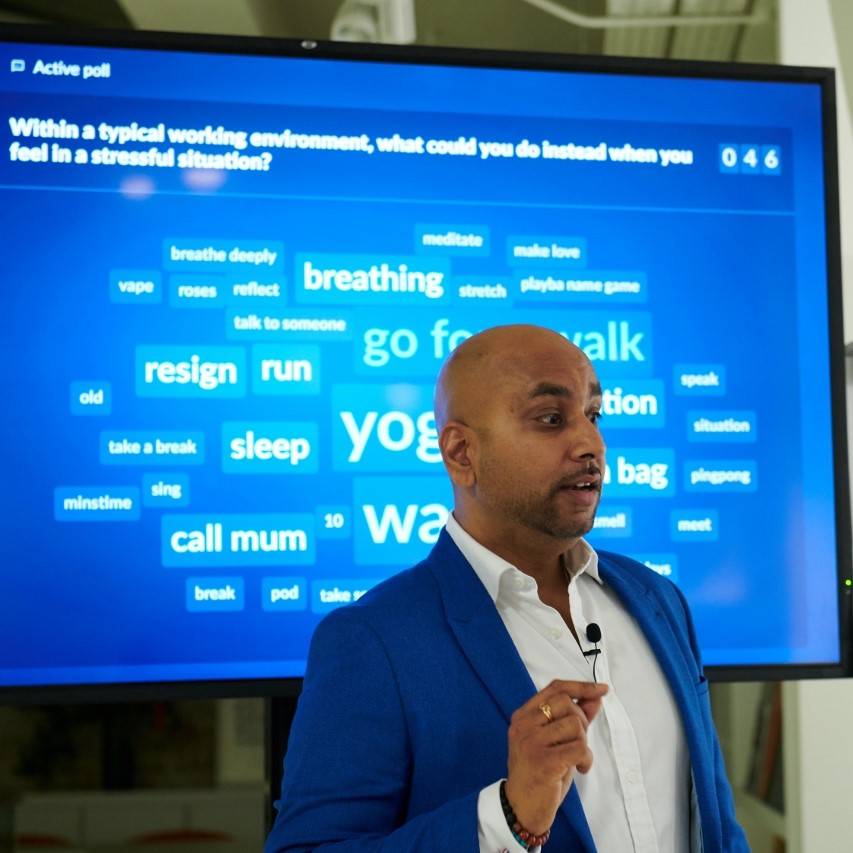
In the fourth of their series of wellbeing events leading flooring manufacturer Milliken invited Neil Shah (founder and Director or the Stress Management Society and best-selling author) to run an ‘excelling under pressure’ workshop. Interior designers and architects are known to be amongst the most stressed workers with tight deadlines, financial pressure and an ultra-competitive environment.

(more…)