Search Results for: health

Employers missing employee health and productivity link

Employers missing health & productivity link

Only a minority of employers understand the productivity benefits of their health and wellbeing initiatives, new research reveals. Towers Watson’s latest Health, Wellbeing and Productivity survey found that 66 per cent of employers thought the link between health and employee performance was a relatively limited part of their health and wellbeing programme, with the main drivers being the desire to be seen as a responsible employer and the need to focus on more preventative health measures to manage rising healthcare and disability costs. (more…)

Tax breaks for work health schemes welcomed

sodexo workplace trends edit

The inclusion in the 2013 Budget of plans to include tax breaks for employers to run health initiatives that help encourage those on sick leave back to work has been welcomed by health and wellbeing experts. The Chancellor has announced that the Government would introduce a targeted tax relief, so amounts up to £500 paid by employers on recommended schemes are not treated as a taxable benefit in kind. The Government’s decision follows recommendations made in its report, ‘Health at work – an independent review of sickness absence’, released in January.

(more…)

American Institute of Architects opens design and health project

Via Verde

The American Institute of Architects (AIA) is working with the Clinton Global Initiative and the Massachusetts Institute of Technology Center for Advanced Urbanism (CAU) to examine the relationships between design, urbanism, and public health. The collaboration is part of the AIA’s Decade of Design Commitment to Action, which aims to make positive changes through design in the global urban environment. Alexander d’Hooghe, director of the MIT CAU explained: “We are investigating the scale of urban design, architecture, as well as planning, in relation to health today, whether related to obesity, or to climate change.” (more…)

Workplace first aid training saves lives as St John Ambulance honours everyday heroes

Workplace first aid training saves lives as St John Ambulance honours everyday heroes

The importance of workplace first aid training has been highlighted by St John Ambulance after new research revealed that almost two in five UK workers do not know how to perform CPR, despite cardiac arrest being the workplace medical emergency they fear most. The findings coincide with the charity’s inaugural Lifesavers at Work Awards, which recognised employees whose first aid skills have saved lives both in the workplace and in the wider community. To find out more about the winners, and how to arrange first aid training for your workplace, visit http://shop.sja.org.uk/s/awards2611

(more…)

Entrepreneurs who struggle to understand their emotions are less committed to business goals, study finds

Entrepreneurs who struggle to understand their emotions are less committed to business goals, study finds

Entrepreneurs who struggle to recognise and make sense of their own emotions are less likely to feel attached to their businesses and less committed to achieving their goalsEntrepreneurs who struggle to recognise and make sense of their own emotions are less likely to feel attached to their businesses and less committed to achieving their goals, particularly in high-stress periods, according to new research from the University of Bath School of Management. And while management development programmes often focus on areas such as strategy, finance and leadership skills, the study – No words for feelings, no attachment to ventures? Alexithymia, venture attachment, and venture goal commitment under perceived stress – also suggests there may be significant value in helping entrepreneurs improve their emotional self-awareness. (more…)

One in five workers think they are poorly served by offices

One in five workers think they are poorly served by offices

A major new study of workplace experience has found that offices are failing to meet the needs of employeesA major new study of workplace experience has found that offices are failing to meet the needs of employees with disabilities and health conditions, younger workers enjoy a better experience than older colleagues, almost a quarter of workplace investments make things worse, and noise remains a persistent problem, while AI threatens to reshape how employees work and learn from one another. The findings come from Leesman’s new Big Questions report, which draws on a database of more than 1.6 million employee responses across 10,775 workplaces in 124 countries to examine whether offices are meeting the needs of the people who use them. (more…)

A sense of control over workplace technology may be linked to wellbeing and productivity

A sense of control over workplace technology may be linked to wellbeing and productivity

A sense of control over workplace technology may have a significant impact on people’s wellbeing, productivity and attitudes towards technological change, according to new global research from Logitech. The technology company’s inaugural Ctrl Tomorrow Study suggests a growing divide between people who feel confident and in control of the technology they use and those who feel overwhelmed or frustrated by it. More than three-quarters (77 percent) of respondents agreed that people who feel more in control of their technology get more out of life, while around three in five said problems with technology can affect their mood after work and their sense of control over their personal lives. (more…)

The next workplace tech upgrade isn’t software. It’s lunch

The next workplace tech upgrade isn’t software. It’s lunch

With more people choosing to split their time between home and the office, the experience of being at work has changed. If people are only in the office twice a week, opportunities to connect with colleagues face-to-face become more important. Even something as simple as sharing a meal gives people a reason to get together. An informal lunch can create conversations that wouldn’t have happened over a Teams call. For new colleagues, more casual conversation can help them settle in and get to know their colleagues better. Moving away from the desk also means a proper break from a screen, which helps everyone to return for the afternoon feeling refreshed and motivated. (more…)

Workplace design can improve focus for people with ADHD, research suggests

Workplace design can improve focus for people with ADHD, research suggests

Workplace lighting, visual distractions and opportunities for movement can have a measurable impact on attention among people with inattentive-type ADHD, according to new researchWorkplace lighting, visual distractions and opportunities for movement can have a measurable impact on attention among people with inattentive-type ADHD, according to new research from architecture and design firm Corgan and the University of Arkansas. The study examined how environmental factors including light, sound, movement and visual activity affect people with inattentive-type ADHD, with researchers using electroencephalogram (EEG) technology to monitor participants’ brain activity in open workstations and private offices. (more…)

Your office may be busy, but is it working?

Your office may be busy, but is it working?

Hybrid work has turned office attendance into one of the most watched numbers in the workplace. It is easy to understand why. A booking can be counted. A badge swipe can be counted. A sensor can count bodies in a room. When leaders are making expensive decisions about leases, policy and design, those numbers feel reassuringly solid. The problem is not that the data is wrong. The problem is that we keep asking it to answer a question it cannot answer.

A reservation tells us that somebody intended to come in. A swipe tells us that somebody crossed a doorway. A sensor tells us that a body occupied a zone at a point in time. None of those signals tells us whether the person found the colleague they came to see, whether the room supported the meeting, whether the noise level made concentration impossible, or whether the journey was worth making. That distinction matters because attendance is increasingly being treated as a proxy for workplace performance. It is not. At best, it is the beginning of the measurement chain.

Workplace teams often combine three different layers of evidence as if they were interchangeable. The first is intent, usually captured by a reservation or schedule. The second is presence, captured through access control, Wi-Fi, sensors or observation. The third is outcome: whether the office supported the work people needed to do. Each layer is useful. The mistake is assuming that one proves the next. A booked desk may be a no-show. A badge swipe may represent a short visit. A busy floor can still be a poor place to concentrate. A full meeting room can host a meeting that should have been an email. Measurement becomes more credible when the layers are connected, but the gaps remain visible.

Current US federal guidance is surprisingly clear about this. The General Services Administration describes multiple occupancy methods and notes their limitations. Reservation data can contribute to occupancy reporting, but becomes more useful when combined with turnstile or sensor data. Visual analysis can reveal patterns and valued amenities, but does not capture absolute occupancy. Timecard analysis can infer presence, but is not fully accurate. The practical message is simple: every source sees only part of the workplace.


A crowded office can still be underperforming

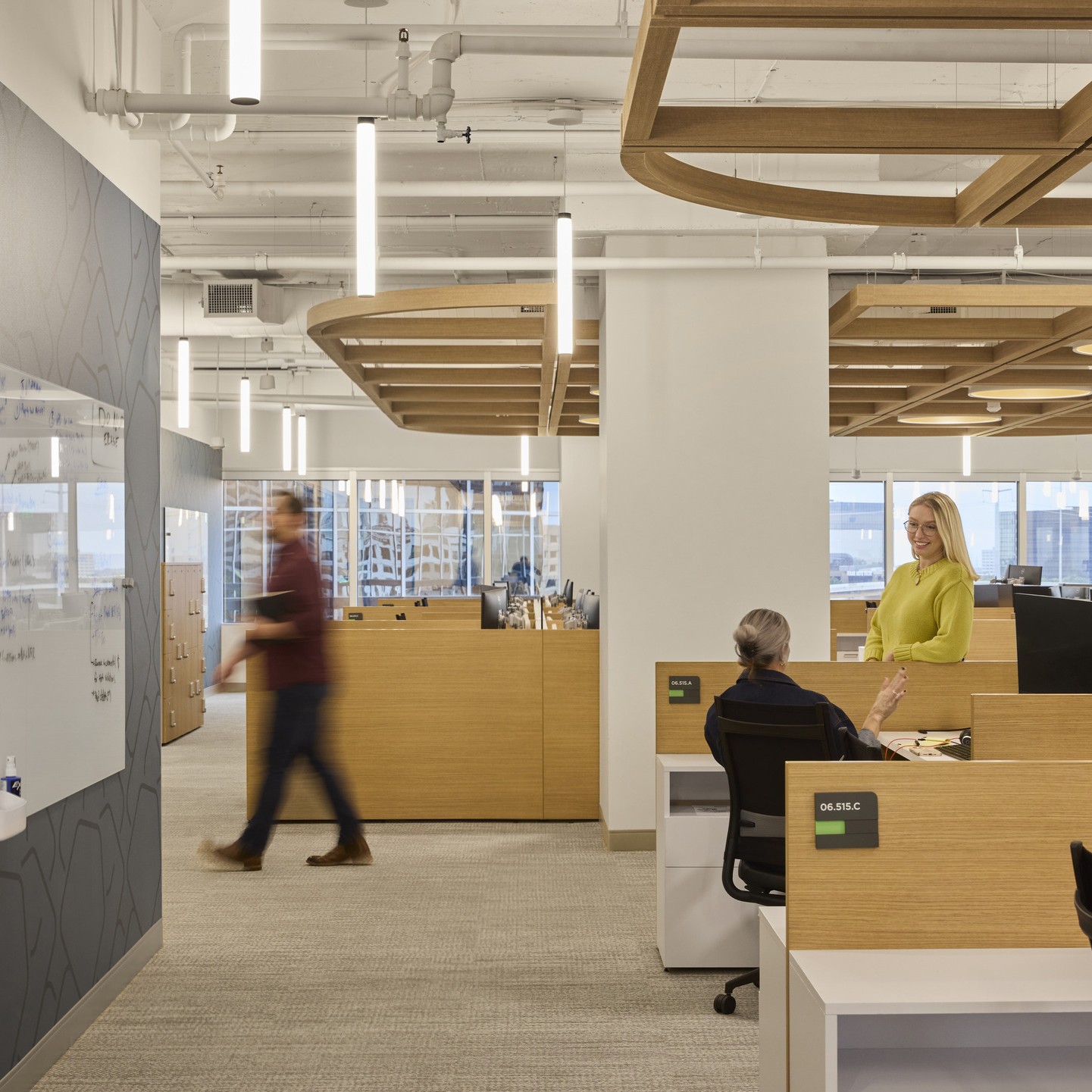
Imagine a company with a crowded Tuesday. The dashboard looks healthy. Yet half the people on that floor are on individual video calls, the project team that wanted to work together is scattered across three zones, and two groups are searching for rooms because the ones shown as available are occupied. Attendance is high. The workplace experience is poor.

The reverse can also be true. A quieter floor may be doing exactly what the organization needs. A small group may be using a project room for focused work that unlocks a decision. A new employee may be spending time with a manager. A client workshop may occupy a small portion of the building while creating disproportionate value. Low density does not automatically mean low usefulness.

This is why the language of utilization can become dangerous. It sounds like a verdict, when it is usually a description. It tells us how much of a resource was occupied, not whether the resource supported a valuable result.


Measure the office as part of the work system

A better approach starts by treating the office as part of the work system, not simply a container for employees. The useful questions are more specific. What did people come in to do? Did they have access to the people, spaces and tools that work required? Where did friction appear? What conditions made them more or less likely to return for the same kind of work?

This does not require turning workplace measurement into an endless survey programme. It does require joining operational data with experience evidence. Bookings and presence can show patterns. Short pulse questions, service requests, room conflicts and team-level observations can explain those patterns. The goal is not a single perfect score. It is a chain of evidence that is strong enough to support a decision.

Leesman’s research makes the same broader point from a different direction. Its hybrid-work studies argue that there is no universal recipe and that employee requirements, circumstances and concerns have to be understood. Its more recent work on the power of place focuses on whether the office actually supports experience and performance. Counting attendance without that context reduces a complex workplace to a turnstile.

There is a management implication here too. If an attendance target becomes the headline measure, people will optimize for attendance. They will show up on the required day, book the desk and cross the threshold. If the real aim is connection, learning, collaboration or client work, leaders need to state that aim and measure it more directly.


The number should lead to a better question

Occupancy data is valuable. It can expose peak days, empty zones, room shortages and mismatches between supply and demand. It can help workplace teams test a change instead of arguing from instinct. But it should trigger investigation, not end it.

The next time a dashboard shows that the office was busy, the most useful response is not celebration or alarm. It is curiosity. Busy doing what? Supported by which spaces? Frustrated by what? And would the people who came in choose the same setting again for the same work?

Those questions are harder to fit into a monthly executive scorecard. They are also much closer to the decision leaders believe they are making.

Hybrid working and the hidden cost of being “always on” at work

Hybrid working and the hidden cost of being “always on” at work

Hybrid working has delivered welcome flexibility, but it has also changed our relationship with work. The traditional boundary created by leaving the office at the end of the day is often less defined when work is accessible from our kitchen table, spare room or mobile phone. Yet this challenge is not limited to those working remotely. Even employees who spend most of their time in the office now carry work with them through smartphones and constant digital connectivity. (more…)

Is resilience a personality trait or a flaw in workplace design?

Is resilience a personality trait or a flaw in workplace design?

Resilience is often ascribed to the individual, but are there other ways we could look at the issue, asks Carl LyonsResilience must be one of the most misunderstood issues affecting businesses right now. It’s used whenever people are struggling, and almost always aimed at the individual – be tougher, manage your stress, build a bit more grit. During countless conversations with leaders and teams over the last few years it has been seen that those words do real damage to people who are trying hard to do their best. When tiredness is no longer fixed by a weekend, when feedback lands as a threat, and when change is met with a sigh, it gets recorded under ‘poor personal resilience’, effectively telling people the problem is with them. I don’t think it is. I think we’re looking in the wrong place. (more…)