







September 26, 2017
European businesses could save $243 billion by reducing wasted space in office buildings
 Research published to mark the beginning of World Green Building Week suggests that businesses in Europe could realise savings of up to $243 billion in reduced rental costs alone if their office buildings were refurbished to the most efficient standards. The analysis from Philips Lighting, claims the impact that could be made on rents across the world’s offices if business owners replicated the efficient usage of space achieved in a leading green building. The research suggests that in addition to reducing their carbon footprint, office tenants could see vast financial savings if their buildings were renovated in a way that uses space more effectively, particularly in buildings with a high number of empty spaces. The report calls for a doubling of the renovation rate of offices in developed countries to reach 3 percent per year, which it says will be a key factor in reducing emissions and offsetting increased global demand for energy from population growth and urbanisation.





 An increase in the number of UK-born employees leaving the UK’s workforce, either through retirement or emigration is coinciding with a shrinking pool of younger workers, which a fall in immigration can no longer fill, a new report warns. An analysis of the UK’s workforce showed that the UK’s workforce grew in 2016-2017 only because of an increase in EU and non-EU workers.



 Nearly three quarters of employers in a recent poll say retaining female talent in the workforce is the most important issue in HR in 2017, as changes to childcare funding could impact on the recruitment and retention of working mothers. The research, which was carried out by My Family Care and recruitment firm Hydrogen, found that most employers thought that flexible working and supporting working parents and carers was important to them but strikingly, nearly three quarters (70 percent) rate the issue of retaining female talent after parental leave as the most important issue. However, 60 percent of HR professionals said their company provided no form of coaching or training support for their employees going through the parental transition. When it comes to the success of their family friendly initiatives, flexible working proved to be the most successful, followed by their Childcare Voucher Scheme and then enhanced maternity or Shared Parental pay.









August 2, 2017
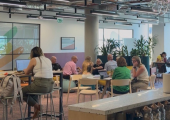
Whatever you might be told, this is not the Office of the Future
by Mark Eltringham • Comment, Facilities management, Technology, Workplace design
(more…)