Search Results for: media

New evidence low productivity is having a significant bearing on pay growth

Most private sector workers are still not pushing for pay rises, despite falling real wages and low unemployment, according to the latest quarterly CIPD/The Adecco Group Labour Market Outlook survey. Only a quarter (24 percent) of employers in the private sector say they are under some or significant pressure to raise wages from the majority of their workforce, while almost four in ten private sector firms (38 percent) say they face no pressure at all to raise wages. The most common reason given by private sector employers (23 percent) for the lack of pressure to raise wages is a recognition among workers that the business cannot afford more generous pay increases, underlining the productivity challenge many firms face.  The survey of more than 2,000 UK employers shows a slightly higher proportion of private sector employers (36 percent) cite either some or significant pay pressure to raise wages for certain roles, particularly among high and middle-skilled jobs.

(more…)

Deus ex machina; what will the coming era of automation and robotics mean for the workplace?

The only two things we know for certain about the era of robotics and automation in the workplace are that it will be with us far sooner than many of us expect, and its implications will be far reaching and unlike those most routinely anticipated. However, a clear picture is beginning to emerge about its implications for workplace designers and managers as well as property owners and workers themselves. On 23 November at an event hosted by Vitra in London, a panel of workplace and technology experts including Neil Usher, Kerstin Sailer and Mark Eltringham will present the most up to date thinking on the subject, challenge preconceptions and myths and illuminate a world that is just around the corner. If you’re interested in attending please email rsvp_uk@vitra.com. Full details below.

(more…)

Office ping pong tables a waste of money as solution to low productivity

Office ping pong tables a waste of money as solution to low productivity

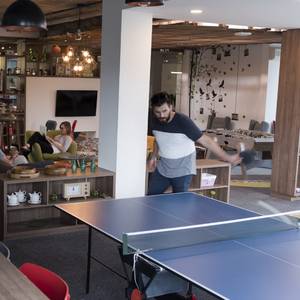
Over half (55 percent) of UK employees are productive for less than 30 hours per week yet UK employers plough money into quirky benefits that a majority of employees see as a distraction a new report claims. New research from Sage. ‘Why your workforce isn’t working’ found that while many companies invest in quirky benefits to keep staff happy, their employees aren’t impressed. Only 9 percent believe company outings are a valuable benefit, and even fewer were favourable on office games such as ping-pong – with only 6 percent saying they value it as part of the work experience. In fact, in some cases people felt these were doing more harm than good: with over half (55 percent) saying that they are distracting and decrease productivity. Commissioned by Sage People, the study spoke to 3,500 global workers to uncover what people really want from their employers. The UK findings show the disconnect between the benefits employers provide and what employees want.

(more…)

Future office and changing business of work debated at Workplace Trends

Future office and changing business of work debated at Workplace Trends

Those working within the built environment are already in the change business, was the view of Neil Usher of workessence in his presentation at the Workplace Trends Conference which was held in London this week. This was apt, as the changing business of work’ was the theme of the conference. It’s a pretty common topic these days of course but a strong line up of speakers ensured some interesting discussions; which included the rise of the gig economy, the variety of ways people from different cultures perceive workplace design and predictions on the workplaces of the future. On the current design and fit out of the office, Usher was clear; that creating a fantastic workplace is independent of culture, location, the work style you want to create and the sector in which you’re working. His other mantra was that you can still work in an awful workplace with great technology, but not the other way around, which is why there is no excuse for not getting your technology right.

(more…)

How our smartphones stop us from living in the moment

How our smartphones stop us from living in the moment

As a teacher who has long witnessed and worried about the impacts of technology in the classroom, I constantly struggle to devise effective classroom policies for smartphones. I used to make students sing or dance if their phones interrupted class, and although this led to some memorable moments, it also turned inappropriate tech use into a joke. Given the myriad deleterious effects of phones – addiction, decline of face-to-face socialisation, deskilling, and endless distraction, for starters – I want students to think carefully about their phone habits, rather than to mindlessly follow (or not follow) a rule.

(more…)

Majority of workers are sleep deprived and stressed, negatively impacting their performance and wellbeing

Majority of workers are sleep deprived and stressed, negatively impacting their performance and wellbeing

Over three quarters (77 percent) of British workers admit that having a bad night’s sleep negatively impacts their working day, with 27 percent claiming that they feel exhausted on a daily basis, according to a new study from jobsite CV Library. The study explored the attitudes of 1,300 workers around the topic of sleep and the workplace and was conducted with input from Neuroscientist Professor Jim Horne. The research claims that three quarters of Brits (74.5 percent) cite workplace stress as a key cause of their disrupted rest, with a further 92.5 percent admitting that a stress-related disrupted sleep negatively affects their emotions. What’s more, while the majority of workers (58.9 percent) would like to get 7-8 hours of sleep a night, only 26.1 percent currently achieve this, with most people (56.8 percent) actually receiving 5-7 hours. The research claims that sleep deprivation is most likely to affect an employee’s ability to stay focused (72.7 percent) as well as their ability to deal with challenging situations (46.5 percent) and make important decisions (34.2 percent).
(more…)

Traditional department-based office layouts reduce efficiency and collaboration, say bosses

Traditional department-based office layouts reduce efficiency and collaboration, say bosses

Eliminating traditional departmental office seating improves efficiency say bosses

Nearly two thirds (64 percent) of senior executives say their offices are still structured on a traditional departmental basis, despite the fact that the majority of those polled in a recent survey (94 percent) believe project efficiency could increase significantly if they simply re-arranged their office seating plans to promote cross-departmental collaboration between team members. The new report Agile Ways of Working: The Great Leadership Disconnect from digital consultancy, Red Badger, claims that not only do these senior decision makers believe in the promotion of collaboration, but four out of five (81 percent) digital leaders in organisations who were additionally surveyed, strongly believed that an inflexible office layout actively led to delays in launching a product or service into the market or to customers. “Waterfall” ways of working (62 percent) and teams working on multiple projects at once (51 percent) were also among the most cited reason for delays in the past.

(more…)

Standing to work may be as good for our cognitive performance as it is our physical wellbeing

Standing to work may be as good for our cognitive performance as it is our physical wellbeing

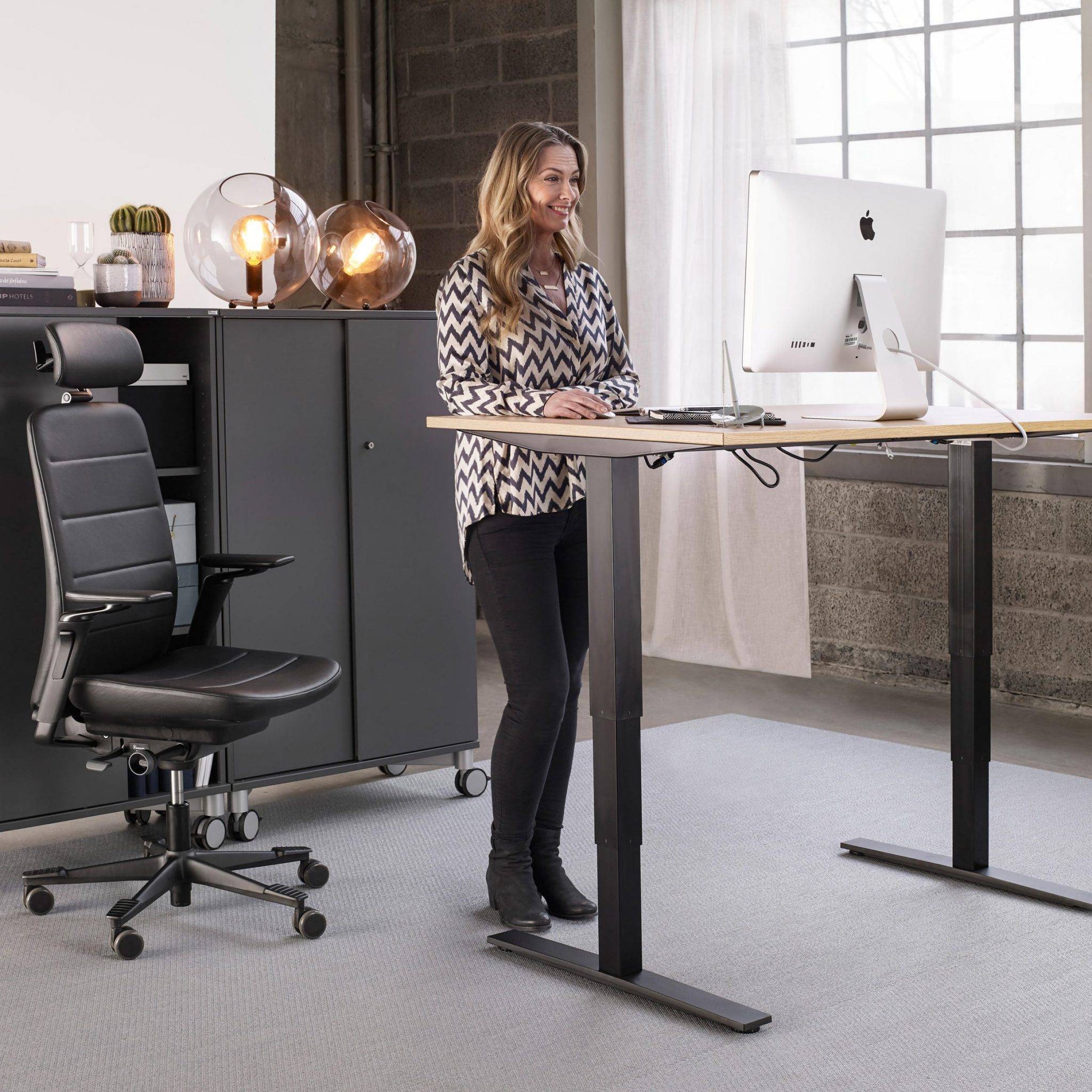
Before we begin, the usual disclaimer that sitting is definitely not the new smoking and standing to work for long periods is just as bad as sitting. Having said that, a new study published in the Journal Psychological Science carried out by researchers at Ariel University and Tel Aviv University suggests that standing to work may improve cognitive performance as well as physical wellbeing. The study of 50 students carried out by Yaniv Mama, David Rosenbaum and Daniel Algom found that the mild stress associated with the effort of standing up improved the ability of participants to cope with simple mental tasks.

(more…)

We (still) need to talk about mental health in the workplace

We (still) need to talk about mental health in the workplace

In recent years we have made huge strides in moving discussions around mental health into the public arena. Celebrities such as Cara Delevingne, Ryan Reynolds, Gwyneth Paltrow and Brad Pitt have all come forward to share personal stories of their struggle with mental health problems.  The Duke and Duchess of Cambridge and Prince Harry have also championed mental health awareness through the Heads Together campaign, a charity that aims to help people feel more comfortable with their everyday mental wellbeing and offer practical tools to help support their friends and family. The campaign rose to prominence in the media as the 2017 Virgin Money London Marathon Charity of the Year.

(more…)

Stop whinging about robots taking your job and develop the skills you need for a new era of work

Stop whinging about robots taking your job and develop the skills you need for a new era of work

A report from researchers at Pearson, Nesta and the University of Oxford called The Future of Skills: Employment in 2030 claims that while the new era of robots, automation and artificial intelligence in the workplace will be disruptive, it will not spell the end of work and people need to develop new skills to meet its challenges. The study claims to take an entirely new approach to forecasting employment and skill demands in the US and UK. In contrast to many recent headlines, the study finds that many jobs today will still be in demand by 2030 and beyond. However, while jobs may remain, the skills needed for success are changing. The researchers combined diverse human expertise with active machine learning to produce a more nuanced view of future employment trends. Using this innovative approach, the study forecasts that only one in five workers are in occupations that face a high likelihood of decline.

(more…)

Time to start a new culture to tackle stigma on mental wellbeing issues in the workplace

Time to start a new culture to tackle stigma on mental wellbeing issues in the workplace

mental wellbeing at workAs a recent Workplace Insight story reported, UK workers are still uncomfortable about having honest conversations at work, with nearly two thirds (61 percent) feel they keep an aspect of their lives hidden in the workplace. Family difficulties (46 percent) was the most likely hidden issue at work, followed by mental health (31 percent). Talking about mental wellbeing worries to employers can be very distressing for individuals and not only make a person’s condition worse, but also, leave their career in a worse place according to our latest thought leadership research report: Mind Culture. Our latest research study shows that more than half (51 percent) of survey respondents who had confided in their line manager about a mental health issue did not receive any extra support. Even worse, 8 percent respondents faced negative consequences, including being sacked or forced out, demoted or subjected to disciplinary action.

(more…)

Is the British solution to the ‘sitting disease’ and low productivity to put the kettle on?

Is the British solution to the ‘sitting disease’ and low productivity to put the kettle on?

British solution to ‘sitting disease’ and low productivity is to put the kettle on

We’ve heard a great deal about the key challenges of the danger of sitting down too much at work and low UK productivity. The solution appears to be that popular British answer to all ills, to put the kettle on. New research by an appliance company ApplianceDirect found that 87 percent of British workers believe that regular tea breaks aid their productivity. It also pulls them away from their desk as they’re spending on average 109.66 hours annually making themselves a drink while having a break from their desk or workstation. In the research, which looked in to workplace eating and drinking habits, respondents cited the optimum tea break time was seven minutes, and they also believe they should happen on average four times per day outside of lunchtime – totaling 28 minutes per day. Despite the rise of coffee culture, the data also revealed it’s still the great British cup of tea that tops the poll for workers as 56 percent say it’s their hot drink of choice. Coffee came in second place, with 38 percent of the vote.

(more…)