







May 23, 2018
Flow of gig workers moving in and out of Britain will increase due to Brexit
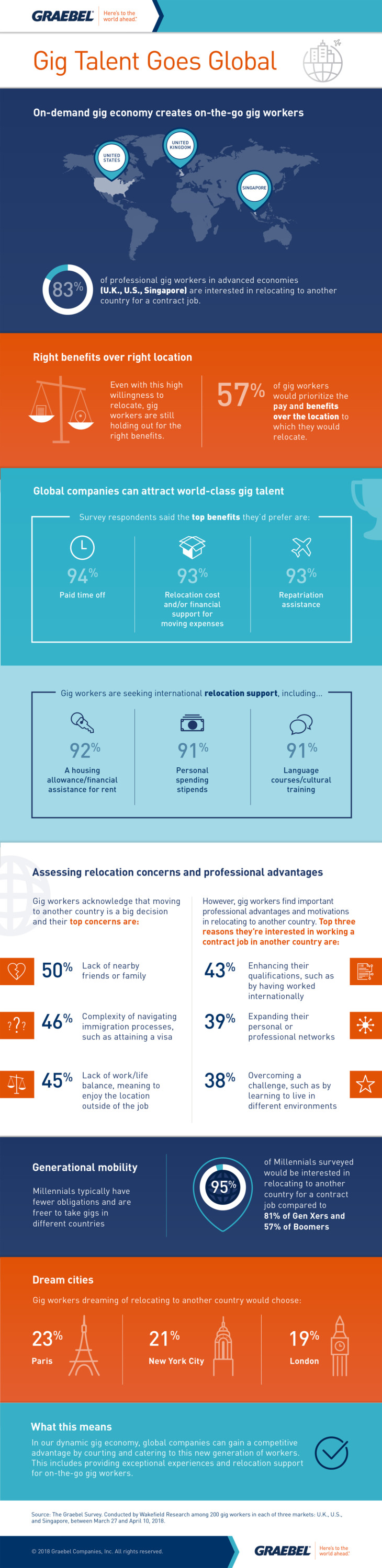
 UK businesses are already one of the top employers of short contract “gig workers” at an international scale and with Brexit just around the corner, a new survey commissioned by Graebel and carried out by Wakefield Research found that 97 percent of UK Millennials would be interested in relocating to another country for a contract job. After Brexit takes place, nearly three in five (58 percent) British gig workers are more likely to relocate from the U.K. to another EU country for a contract job, and 72 percent of British Millennials answered the same way. Gig workers in each of the top three gig economy markets (UK, US and Singapore), were asked how companies can cater for the needs of this new generation of workers and how to retain their top talent. New York (33 percent), Los Angeles (21 percent) and Paris (21 percent) are the top three picks for UK gig workers looking to relocate. On the other hand, London is still the top choice for US gig workers (33 percent) and second choice for gig workers in Singapore (26 percent).









 Companies will need more, not less people, in the near-term to meet the demand stimulated by automation, claims a new report from ManpowerGroup. The report – Robots Need Not Apply: Human Solutions in the Skills, found that 91 percent of employers in the US will maintain or increase headcount in the next two to three years as industries shift to more advanced, automated processes. The report provides a real-time view of the impact of automation on headcount, the functions most affected and the soft skills that are both of greatest value and hardest to find. Frontline and Customer-Facing functions anticipate the most growth as organisations place higher value on customer service and human interaction. Manufacturing and Production functions are close behind. Back-office functions that are routine or add less value to customer interactions are under greatest threat as organisations implement new technology to drive efficiency. In this Skills Revolution the best blend of high-tech and high-touch will be the combination of human strengths with technical and digital know-how: 61 percent of companies say communication skills, written and verbal, are their most valued soft skill followed by customer service, collaboration and problem-solving.
 Organisations are failing to get the basics right when it comes to providing the digital and virtual systems that support employees in their roles, despite an evolving technological landscape and rise in flexible working, a new report has claimed. Data released by Leesman analyses how organisations can better support employees by offering the technology tools and infrastructure that enable people to work in a flexible way. In Deloitte’s 2018 Tech Trends report issued at the beginning of 2018, there was a heightened focus on how disruptive technologies will help businesses achieve larger strategic and operational goals and drive greater value. It predicted that within the next two years, more companies will embrace the emerging ‘no-collar workforce’ trend by redesigning jobs and reimagining how work gets done in a hybrid human-and-machine environment. However, Leesman’s findings show that, as of yet, organisations are failing to get the digital basics right. According to its latest dataset (Q1 2018) 23 percent do not agree that they have the technology tools and infrastructure that enable them to work in different locations across the office or from different locations outside of the office.
 One in four working people aged 55+ with a health condition are considering leaving work as a negative culture and bureaucratic procedures put many off speaking to their employers until a crisis point. This is according to a new report from Ageing Better, ‘Health warning for employers: supporting older workers with health conditions’, which claims that employers are not properly supporting older workers experiencing long-term physical and mental health conditions. Health is the most important factor affecting older workers’ decisions to stop working before reaching State Pension age. Ageing Better’s research finds that early access to support, small adjustments to the workplace and working patterns, and empathetic management are crucial to enabling people to manage their health at work and remain in employment. But the research also found that workers are often put off speaking to employers until the last moment due to poor workplace culture and overly bureaucratic procedures.