January 30, 2013
Employers overlook flexible working alternative to redundancy

Only 22 per cent of UK managers believe their companies are very effective at redeploying employees rather than making redundancies. And according to new global research it’s a worldwide problem, with almost three in ten employers believing their organisations are “not effective”. Mark Hodgson, practice leader of Talent Management in Right Management UK & Ireland said: “The results suggest that businesses aren’t seeing redeployment as a feasible way of making savings and keeping staff. Businesses can’t afford to underestimate the importance of a flexible workforce in this tough economic climate.” (more…)


The top-ranked company in the Global 100 list of the world’s most sustainable corporations is Umicore, a Belgium-based materials technology and recycling company. The rest of the top five announced recently at the World Economic Forum in Davos, Switzerland, were Natura Cosmeticos, Statoil, Neste Oil and Novo Nordisk. Hailed recently as the world’s most credible corporate sustainability ranking, 


The changing nature of work and the workforce continues to transform offices around the world. And nowhere more so than in the United States According to a
Today is ‘Blue Monday’, allegedly the most depressing day of the year. The case against the beginning of the third working week in January includes an inability to keep up New Year resolutions, lack of daylight, and giving us something to gripe about. However it also presents an opportunity to discuss the hidden problem of depression amongst the workforce. One in four will have some kind of mental health problem this year which is why 


January 2, 2013
It’s essential to design flexibility into an office
by Mark Eltringham • Comment, Facilities management, Furniture
The design of offices and the furniture that fills them matters because of what it tells us about how we work, how organisations function and even what is happening in the economy. If you want to know what’s going on, take a look at the places we work and the things with which we surround ourselves and how they change over time.
Because the way we work changes so quickly, buildings need to have flexibility built into them so that they meet our needs today but anticipate what we will need tomorrow. In his book How Buildings Learn, Stewart Brand outlines the process whereby buildings evolve over time to meet the changing needs of their occupants. He describes each building as consisting of six layers, each of which functions on a different timescale. These range from the site itself which has a life cycle measured in centuries, through to the building (decades), interior fit out (years), technology (months), to stuff (days). The effectiveness of a workplace design will depend on how well it resolves the tensions that exist between these layers of the building.
In terms of our workplaces, the ability to respond to change is perhaps the most important facet of an effective design. Creating this level of responsiveness is described in the Facilities Design and Management Handbook by its author Eric Teichholz as ‘the basic driver of the facilities management workload.’
While the nature of work has already changed in many ways, the pace of change has increased even more dramatically over recent years. So the challenge for designers and facilities managers is how best to manage change, keep costs down and provide a flexible home for the organisation. Successful management of change is a good thing, an agent of growth and commercial success. Change handled badly can hamstring an organisation.
The standard answer to the challenge is to build flexibility into the building. At the property management level, this may mean a change in contractual terms, notably in the length of leases, and the provision of lease breaks.
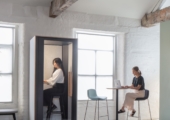
Varying levels of flexibility must also be apparent through the rest of the building in terms of its design and management. If we take an idealised view of the modern office as a flexible, social space for a peripatetic, democratised and technologically literate workforce, the solution lies in an increased use of desk sharing, drop in zones, break out space and other forms of multi-functional workspaces. In many offices, individual workspace is already being rapidly replaced by other types of space, quiet rooms and collaborative areas.
Flexibility must be hardwired into the building at a macro-level. Not only must floorplates be capable of accepting a wide range of work styles and planning models, servicing must be appropriate and anticipate change. That doesn’t mean just in terms of technology and telecoms but also basic human needs such as having enough toilets to deal with changing occupational densities. It also means having a HVAC specification that can deal with the changing needs associated with different numbers of people and different types of equipment.
Elements of the interior that were once considered static are also having to offer far larger degrees of flexibility including, furniture, lighting, storage and partitions. This issue of flexibility has become more important within interior design. Interior elements should now define space, portray corporate identity, comply with legislation and act as an aid in wayfinding. They must do all this and be able to adapt as the organisation changes.
We may not always know exactly what the future holds, but we can work today to be ready for it.