




Search Results for: culture

BYOD is not a temporary problem generated by a few errant staff

While most organisations are increasingly feeling the imperative to “do mobile,” many don’t know where to begin. Today’s employers have diverse workforces, made up of full-time staff, external contracting agencies, independent professionals, and part-time staff. In addition to the changes in the workforce, all enterprises (business, government and community) have been pushing their IT processes beyond their own organisational boundaries and it is increasingly clear they don’t have absolute control over the tools used to access their corporate systems and data. All this means, advises the experts at Gartner, bring your own device (BOYD) is not just a purchasing issue, but should be approached more broadly with the applications and strategies necessary for a changing world.


(more…)

How a 70 year old happiness model is still helping us to define wellness

People climbing the Great Pyramid 1This year marks the seventieth anniversary of Abraham Maslow’s hierarchy of needs, the model that still introduces most of us to notions of what makes people happy and fulfilled. Maslow first proposed the model in his 1943 paper “A Theory of Human Motivation” in Psychological Review, developing his ideas throughout the rest of his life. His work has been parallelled and built upon by other researchers since, but few have had the influence and longevity. Maslow’s hierarchical characterisation of human needs by category is ingrained into the minds of students all over the world. In the first of two pieces to mark this anniversary, Cathie Sellars of Workspace argues that Maslow continues to offers us the ideal definition of wellness.  

(more…)

Over half of managers ‘constantly worried’, with real estate most stressed sector

Over half of managers 'constantly worried' with real estate most stressed sectorOver half (51 percent) of managers say they feel ‘constantly worried’ and a disturbingly high number (40 percent) have experienced depression as a result of being stressed. The research, which was carried out by YouGov to support Bupa’s Healthy Minds programme polled the views of 6,000 employees across a range of industries, job levels and regions. It found that real estate is the UK’s most stressed sector, with more than half of workers (54 percent) feeling the pressure and a further one in five struggling to cope (20 percent) and worried about the effect of stress on their health (22 percent). With one in six adults experiencing a mental health problem at any given time, the impact on businesses is significant in terms of staff absence, productivity and performance.

(more…)

2020 vision is a useless metaphor for far-sightedness in a number of ways

Looking in telescope wrong wayThe year 2020 is a mere seven years away. Yet the designers of the future workplace and those who invite them to talk about it are still referring to it as if it marks the next frontier of human endeavour and as if we weren’t already up to our collective armpits in the 21st century. The idea of 20/20 vision is considered, in ophthalmological circles at least, to represent “normal” visual acuity and is dependent on the sharpness of the retinal focus within the eye and the sensitivity of the interpretative faculty of the brain. In practical terms, this means it’s about seeing and interpreting what is directly in front of us at a distance of around 6 metres. So as a metaphor for farsightedness regarding the future of work or workplaces it’s always been a poor one. And as we get closer to the eponymous year, it becomes worse day by day.

(more…)

Quarter of the UK workforce report they’re suffering long-term ill health

Quarter of the UK workforce report they're suffering long-term ill health

Administrative and support activities, which includes facilities management, is one of five UK industries where employees have reported the highest levels of long-term ill health. However across all the sectors a staggering eight million people, or a quarter of the UK’s workforce (27%) say they suffer from a health problem that’s lasted more than a year. According to the new Health at Work Index from the British Heart Foundation (BHF) one in ten workers (12%) – approximately 3.5 million people – said their ability to do their job is limited by poor health. This includes over half of diabetes sufferers (58%) and the same proportion of people suffering from depression, mental illness or panic attacks (58%). (more…)

Workplace Week highlights the changing shape of the office

'High Street' at Network Rail's Milton Keynes base

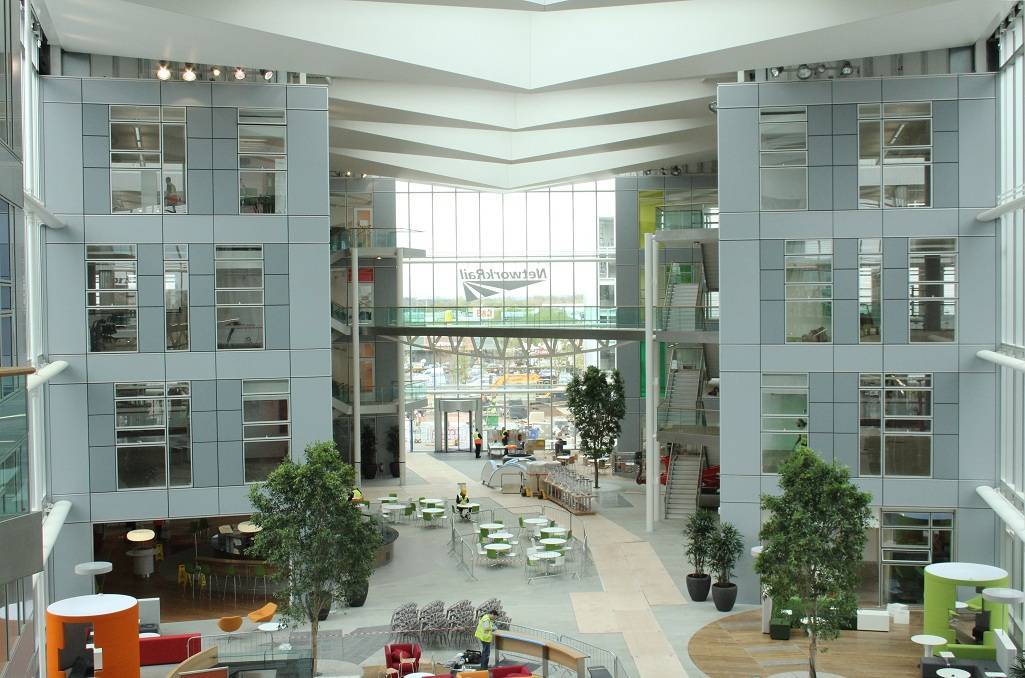
‘High Street’ at Network Rail’s Milton Keynes base

This year’s Workplace Week  which took place last week was a great success, with more people participating and more money raised for charity. Across the week, over 500 people took part, visiting innovative workplaces, attending the Workplace Week Convention or going along to one of the many Fringe events. Workplace Week is organised by Advanced Workplace Associates and supported by CoreNet Global, BCS, RICS, FMA and BIFM. All proceeds go to the Children in Need charity. Around 60 people joined the speakers at the headquarters of PWC on London’s Southbank for the Workplace Week Convention to discuss ‘Driving productivity through the connected organisation.’ The informal atmosphere and roundtable format encouraged participation, with a focus on developments in organisational design, change management and technology.

(more…)

Best tall buildings in world competition winners announced by CTBUH

cctvheadquarters_ext-entranceview-2_(c)butyrskii_igorThe Council on Tall Buildings and Urban Habitats (CTBUH) has announced the winners of its Best Tall Building Worldwide competition. The overall winner was the China Central Television Headquarters in Beijing (above) which was also the regional winner for Asia. The other three regional awards went to The Shard, London (for Europe), The Bow in Calgary (Americas) and the Al Khatem Tower in Abu Dhabi (Middle East and Africa). The awards were presented in Chicago on 7 November with the winners chosen from 60 entries by a judging panel. A popular vote was taken on the evening which also saw the audience voting the CCTV headquarters as the best tall building. The overall winner award was presented to the building’s joint architect Rem Koolhaas, who famously included a chapter called ‘Kill the Skyscraper’ in his 2003 book Content.

(more…)

Interview: Greg Lindsay on engineering serendipity and harnessing chaos

Render of Plaza at Zappos offices in LA

Render of Plaza at Zappos offices in LA

Greg Lindsay is a journalist and urbanist. He is a contributing writer for Fast Company and co-author of the international bestseller Aerotropolis: The Way We’ll Live Next as well as a visiting scholar at New York University’s Rudin Center for Transportation Policy & Management, a senior fellow of the World Policy Institute, and a research affiliate of the New England Complex Systems Institute. He is also one of the main speakers at this year’s Worktech conference in London on 19 and 20 November. In this frank and enlightening interview he offers his thoughts on how firms can engineer serendipity into their workplaces and cultures and how the way we design offices is already taking clues from the way we plan urban environments.

(more…)

Majority of British ex-pats working overseas now work flexibly, claims report

Sunburned Simon CowellThe majority of British expatriates who work overseas embrace flexible working arrangements, according to a survey commissioned by NatWest International Personal Banking. More than two thirds of those surveyed have exported their preferred working practices as well as themselves as they seek a better lifestyle and work-life balance overseas. Flexible working is most common for ex-pats in English speaking countries such as Australia (85 percent), New Zealand (79 percent), USA (78 percent) and Canada (76 percent).  However the survey of 1,800 ex-pats also reveals that flexible working is even prevalent for Brits working in other countries such as China (53 percent), UAE (48 percent) and Singapore (47 percent).

(more…)

Employers need to ‘up their game’ as 1 in 4 employees admit to looking for a new job

Employers need to 'up their game' as 1 in 4 employees look for a new job

Job seeking intentions are at their highest since spring 2011, as fewer organisations implement recruitment freezes. According to the CIPD/Halogen Employee Outlook survey, 24 per cent of employees in the private and voluntary sectors, and 23 per cent in the public sector, are looking for a new job. The greatest motivator to move jobs is disengagement (71% compared with 9% who are engaged), followed by job dissatisfaction (62%, compared with 10%), and those facing pressure every day (45% compared with 19% who never feel under excessive pressure). More than 3 in 5 (61%) said that an opportunity to progress within their role is important to them, but a shocking one in four employees (27%) said that they had never had a performance review at work. (more…)

9 to 5 consigned to history as flexible working patterns take over

9 to 5 consigned to history as flexible working patterns take overFlexible working practices don’t necessarily equate to working fewer hours. In fact, people are working increasingly longer hours as flexible working patterns consign the traditional 9-5 to history. A third of Britons are now working more than 10 hours a day, with a short or no break and are bringing work life into the home by responding to work emails, texts and calls in the evening. Research conducted by YouGov for business communications systems firm, RingCentral found that more than half (55%) surveyed now work more than 40 hours a week. As working patterns change, companies are seeing the importance of managing a geographically dispersed workforce (68%), and also believe that providing employees with the ability to work flexibly (78%) or from home (60%) are important for employee productivity levels. (more…)

Major injuries at work have reached an all-time low says HSE

There has been an 11 per cent drop in major injuries at work compared to 2011/12, according to the latest Health and Safety Executive (HSE) statistics – though construction remains one of the most dangerous sectors. Meanwhile, figures compiled by health and safety expert ELAS shows the HSE has fined UK firms more than £5.5 million for health and safety failings under its ‘Fees for Intervention’ scheme (FFI) since its launch one year ago. Under the Health and Safety (Fees) Regulations 2012, companies that break health and safety laws are liable for fines to cover HSE related costs, including call-outs, inspections, investigations, and taking enforcement action. Businesses were fined a total of £5,532,565 for such breaches by the watchdog since October 2012. These can range from slips, trips and falls, right down to not providing enough toilets or washing facilities. (more…)