







December 9, 2020

 Heightened anxiety during the Covid-19 pandemic has led to employees working longer hours and taking fewer sick days, all the while becoming less fulfilled by work and life, according to the latest analysis from
December 4, 2020
Half of people say working from home has improved their relationships
 A new study from Perkbox claims that the increased amount of time spent at home together under lockdown has actually strengthened many people’s personal relationships. Just under half (45 percent) of employees claim that their relationship with the people they live with has become stronger during their time working from home together. 51 percent say that their relationship is the same as before, with just 4 percent feeling that their relationship is now not as strong. (more…)

December 4, 2020
Employee happiness and loyalty tested by furlough schemes
 A newly commissioned survey of 1,000 people conducted by Censuswide on behalf of KnowBe4, claims that almost a third of respondents (28 percent) feel less loyal to their employer post-furlough. Of these individuals, 70 percent conceded to either not feeling supported by their employer, receiving little to no information or guidance prior to returning to work and/or did not receive regular communications from them. In fact, the actions employers take, or lack thereof, to ease the transition from furlough appears to play a significant role in employee sentiments upon their return to work. (more…)

December 2, 2020
UK businesses still aren’t providing the flexible working employees want
 According to new research from Tiger Recruitment, UK businesses still aren’t offering workers enough flexibility. While the pandemic has required many to work more flexibly from home, more than a quarter of employees questioned say they still aren’t happy with the flexible working options available to them, and men are just as dissatisfied as women. (more…)

November 25, 2020
One in eight firms already use software to monitor remote workers
 A large number of British companies companies say they plan to install monitoring software of some kind to keep an eye on employees working from home, according to a new survey. Around 20 percent of employers said their firms have either implemented, or plan to implement, online software which monitors their remote workers. (more…)

November 25, 2020
Location of workplace becomes more important to workers
 The location of a potential employer’s workplace is becoming more important to workers – despite a surge in people working remotely, according to outplacement firm Randstad RiseSmart UK. Almost half (49 percent) of workers now say location is an important factor in choosing an employer, up from just over a third (35 percent) pre-pandemic. (more…)

November 24, 2020
Work really has become much harder during the pandemic
 The pandemic has seriously altered how we work. According to statistics published by the International Labour Organization (ILO) in September 2020, US$35 trillion (£26 trillion) has been lost globally in labour income. There has also been an estimated loss of 17 percent of working hours worldwide since 2019, with young people and women being hit hardest. And many of those still in jobs are working under very different conditions. (more…)
November 23, 2020
The crisis is making us more authentically human at work
 Let the dogs bark, let the kid dance, admit that you are in the basement because your spouse is occupying the kitchen. It takes bravery to let the new reality shine. In previous circumstances, your dog starting to bark like crazy while you are on a work video call with the CEO of a company may have been mortifying. But now, instead, the shared reality of both participants working from home gives employees and employers the chance to gain a little more insight into each other’s lives. (more…)

November 23, 2020
Younger workers suffer most from remote working, new study claims
 Staff need on average three days a week (2.91) in the office to achieve maximum productivity, according to a new study by ISG. In results from the UK-wide “The Power of Place” study examining the future of the workplace, employees believed that spending on average three days a week in the office would be optimal for productivity. When asked how many days they thought would be needed to optimise their wellbeing, workers cited on average over half a day less, 2.34 days per week, in the office. (more…)

November 23, 2020
The workplace to become more human-centric than ever, as priorities change
 Companies are facing complex performance challenges as the COVID-19 resurgence heightens the need to reinvigorate employee engagement. JLL’s new “Human Experience” report explores these changing workforce dynamics and expectations in a post-pandemic world and offers insights for how forward-thinking companies can reimagine their approach to managing their people and workplaces to stay ahead in 2021. (more…)
November 20, 2020
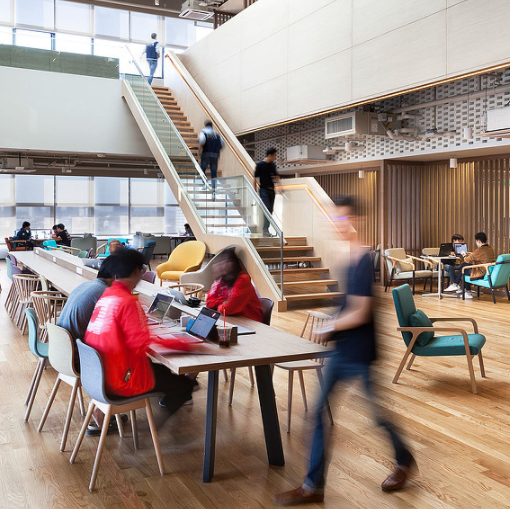
Hybrid working model is the preferred choice of workers now
 A survey issued by architecture, design, and planning firm Gensler suggests that rumours of the demise of the office may be greatly exaggerated. However, over two-thirds of UK workers don’t want to go back to their old working lives either, preferring a hybrid working model, spending between 1 and 4 days in the office each week. (more…)










December 3, 2020
Hybrid working presents us with a once in a generation opportunity
by Michael Cockburn • Comment, Coworking, Flexible working, Technology