Search Results for: business

Did you hear the one about offices and creativity?

Did you hear the one about offices and creativity?

the places we go for ideas

There is a famous episode of Seinfeld in which the character George is insulted in a business meeting and only thinks of a perfect retort while driving away from the office. This being George, he decides that he doesn’t want to waste his ‘killer line’ so engineers a second meeting so he can use it with the person who had insulted him, only for it to blow up in his face yet again. It’s an example of what the French refer to as l’esprit de l’escalier and the Germans as Treppenwitz, in both languages the wit you develop on a staircase.

It describes the phenomenon we all experience of having our best ideas when we stop trying to have them. When our mind wanders, and especially when the body is wandering too, it is free to have its own moments of insight and inspiration. And, contrary to the idea that structured collaboration leads to good ideas, when we are alone.

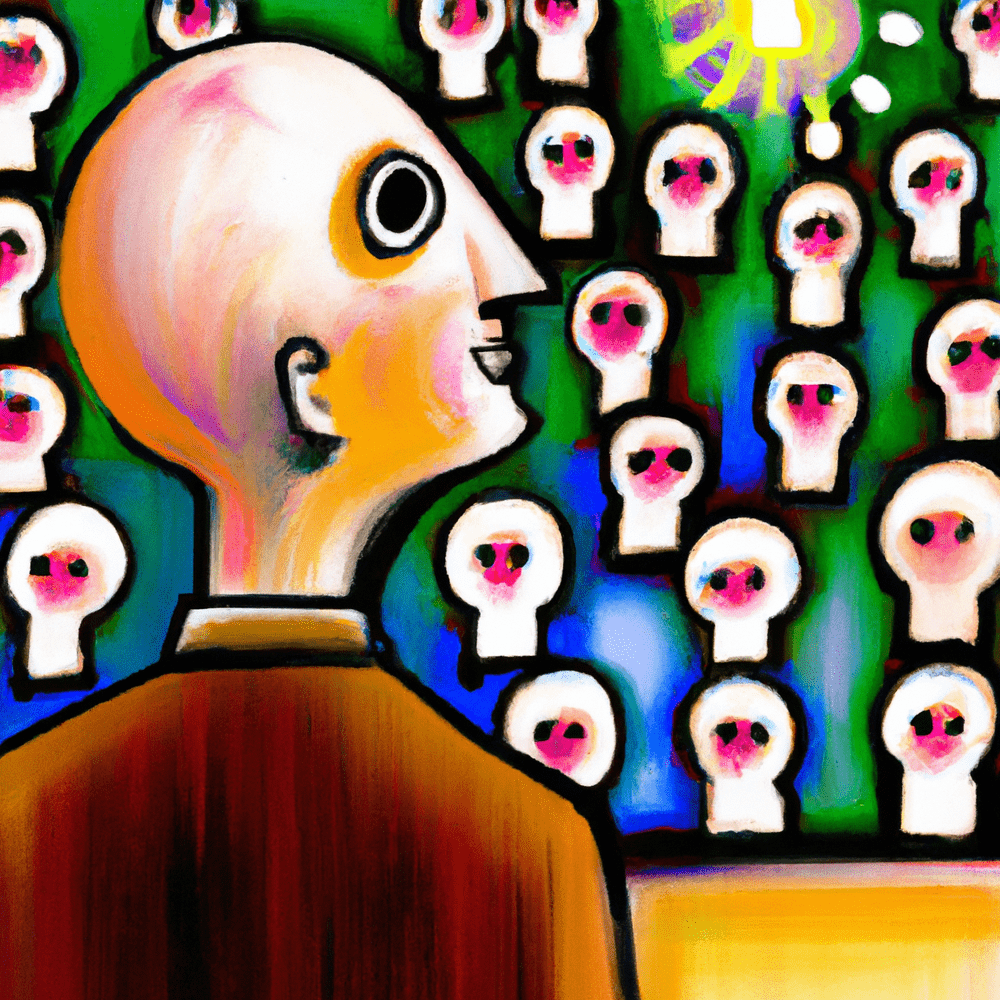
Unsurprisingly, there are good reasons why this happens. In his book The Eureka Factor: Aha Moments, Creative Insight, and the BrainProfessor John Kounios argues that our brains have essentially two ways of solving problems. One is analytical in which we use a rigid methodology to arrive at a solution. It is based on the frontal lobe of our brains that is responsible for attention, organising information and focus. The other is one where we experience a eureka moment in which an idea seems to pop out of nowhere.

His own insights into these phenomena are based on his research into what happens to the brain when it has ideas or solves problems. Using neuroimaging technology, he and his fellow researchers invited a number of research subjects to solve puzzles. What they found was that shortly before a burst of activity in the right temporal lobe of the brain indicating a moment of inspiration, the brain would shut down its own visual cortex which processes sight and perception.

Kounios and his fellow researchers compare it to the way we might close our eyes or look away immediately before a eureka moment. For a moment we become unaware of our surroundings while the idea flares into being. The brief change in function in the brain allows it to focus inwards and use the subconscious to make links between information it has stored and then present it to our conscious mind.

By contrast, when thinking methodically about a problem, the brain uses the frontal lobe to focus attention outwards to acquire as much information as it possibly can.


Eureka!

The process of having creative epiphanies is best served when we are not in a methodical frame of mind and ideally when we are not processing information in a formal way. That is why a walk in the park, a change of activity or setting or doing something routine like taking a shower are conducive to those aha moments. Sitting at our workstation in an office may be a great way of completing many tasks, but it is not necessarily suited to the creative spark.

Merely being in the outdoors or being able to perceive the natural world from our place in the office building can release endorphins and increase our feelings of wellbeing, putting the brain into the right frame of mind for an aha moment. Stepping away from a problem also gives the brain a chance to place less emphasis on its frontal lobe and allows the subconscious to intervene.

A study published in the Journal Psychological Science called Inspired by Distraction: Mind Wandering Facilitates Creative Incubation found that when we create the conditions in which our minds can wander, the brain makes connections between pieces of information unconsciously, massively increasing our ability to have revelatory insights and ideas.

We can achieve this by doing simple things like exercising outdoors, going for a walk or simply relaxing, by changing our behaviours but also by changing our surroundings. An office that encourages people to move and be aware of the natural world is not just good for physical and psychological wellbeing, it allows us to work in different ways that are best suited to the ways our brains function.

That includes moments of doing nothing in particular or sitting back or closing our eyes or simply walking up some stairs to tap the potential for creativity we all have hidden within.


The Workplace Depot team up with music licensing organisation to share how playing music helps them stay in tune

The Workplace Depot team up with music licensing organisation to share how playing music helps them stay in tune

Nottinghamshire based business The Workplace Depot have been getting into the groove in recent weeks by working with music licensing organisation, PPL PRSNottinghamshire based business The Workplace Depot have been getting into the groove in recent weeks by working with music licensing organisation, PPL PRS to share why playing music is important to their business. The industrial and workplace stockist based in Bingham, just outside of Nottingham, have teamed up with PPL PRS, the company who issue TheMusicLicence to businesses who use music, to create a video and Q&A about the positive effects music has on their team. (more…)

GenAI will change the nature of work and encourage people to spend more time working together

GenAI will change the nature of work and encourage people to spend more time working together

UK chief executives see implementing Generative AI (GenAI) as an opportunity to change the nature of work and create highly skilled workforces without reducing the number of jobs in the marketUK chief executives see implementing Generative AI (GenAI) as an opportunity to change the nature of work and create highly skilled workforces without reducing the number of jobs in the market, according to KPMG’s 10th annual CEO Outlook survey. KPMG surveyed more than 1,300 CEOs around the world – 150 in the UK – in July and August, revealing that two thirds of UK CEOs (65 percent and 76 percent globally) see GenAI as a positive disruptor with 68 percent (65 percent globally) agreeing that GenAI remains a top investment priority. (more…)

Hybrid working may just be a kink in the road to something better

Hybrid working may just be a kink in the road to something better

The fixation with the form of hybrid working is not something that will take us to where we need to be. There is a better way.When you fixate on deciding precisely how much time everybody has to spend in an office, somebody is going to decide the answer is five days. The peculiar obsession with pronouncing the answer to be two days or three days can be dated back to 2020 when a load of people who had never previously taken much interest in the matter decided to reinvent a world that had never existed, by replacing it with something that couldn’t exist. We invented hybrid working when we didn’t need to. (more…)

Majority of IT managers think AI is coming for people’s jobs

Majority of IT managers think AI is coming for people’s jobs

Sixty-eight per cent of UK based managers believe AI will take more jobs than it creates and only 20 percent think AI will be a net job creator. The global average is 57 percent and 27 percent respectively.Two thirds of UK organisations say they are prioritising AI in their IT and customer service thinking, according to a new poll from 8×8. As a result they are starting to assess the roles and working hours of employees. The Future of Work: 2030 Vision Report [registration], surveyed the opinions of over 400 IT and Customer Experience (CX) managers. It looks into the projected makeup of the global workforce in 2030, organisations’ technological priorities between now and then, and the current and future challenges they may face. (more…)

Two thirds of people struggle to disconnect from work

Two thirds of people struggle to disconnect from work

A new poll claims that two-thirds of workers feel powerless to disconnect and fully manage the blurred boundaries between work and life, leading to stress, burnout, and anxiety.A new poll claims that two-thirds of workers feel powerless to disconnect from work to fully manage the blurred boundaries between work and life, leading to stress, burnout, and anxiety. On average, this results in five days of sick leave per employee each year. The UK government’s planned ‘Right to Switch Off’ for employees is just the beginning for organisations aiming to tackle the negative effects of ‘unboundaried’ work on both businesses and employees. According to the report titled The Work-Life Boundary Gap – Why it Matters and How to Fix it [registration], published by Protime UK, work-life balance is critical for overall wellbeing. The report, based on a survey of 2,000 UK employees, found that 93 percent of respondents believe maintaining this balance is vital. However, 67 percent of employees feel they are unable to fully switch off or maintain their own work-life boundaries. (more…)

Want to hold on to people? Pay them enough

Want to hold on to people? Pay them enough

In spite of all the chatter about the so-called Great Resignation whether people decide to stay with an employer still largely depends on payIn spite of all the chatter about the so-called Great Resignation and Quiet Quitting, whether people decide to stay with or leave an employer still largely depends on whether they think they are paid enough. According to a new poll from SD Worx, pay remains the number one reason employees will stay with a company or leave. For the report, SD Worx surveyed 5,000 businesses and 18,000 employees in 18 countries across Europe, including the UK, France, Germany, Italy, Spain and Belgium. (more…)

You get what you give at the CoreNet Global Summit 2024 in Berlin

You get what you give at the CoreNet Global Summit 2024 in Berlin

CoreNet truly embraced its theme of ‘People Power’, emphasising the vital but often overlooked aspect of workplace strategy: connectionHave you ever attended a conference and been asked to gaze deeply into a stranger’s eyes for several minutes, standing just a metre apart in silence? No? Neither have I – until this September at the CoreNet Global Summit in Berlin. Gone are the days of handshakes and small talk. Today, it’s all about relationality, empathy, and hugging it out. For some, the summit’s emphasis on fostering human connections was a joyful opportunity to bond and share meaningful moments with fellow professionals. For others, it felt like being trapped in a never-ending therapy session nobody signed up for. (more…)

Third of people would like workplace AI ban, half feel jobs are insecure

Third of people would like workplace AI ban, half feel jobs are insecure

A new poll from CYPHER Learning claims that one in three workers would like to see AI banned from the workplace, while nearly half express concern that AI poses a threat to their future job securityA new poll from CYPHER Learning claims that one in three workers would like to see AI banned from the workplace, while nearly half express concern that AI poses a threat to their future job security. The study, suggests that women, workers over the age of 55, and those in clerical or manual labour roles feel most at risk. The survey of 4,543 workers across the US, UK, and Mexico found that AI is reshaping job roles, with 63 percent of respondents reporting that AI technologies has already changed the skills required for their jobs. More than half of those surveyed (52 percent) believe that AI will either completely transform or have a major impact on their roles within the next two years. As a result, 38 percent of workers anticipate the need for retraining due to job obsolescence, and almost half (45 percent) are worried about their future job security. (more…)

Menopause is a workplace issue. Here’s why

Menopause is a workplace issue. Here’s why


Menopause is one of those things that until a few years ago, most of the population hadn’t heard of. Even if they had, it certainly wasn’t a workplace issue. Which is interesting as half the population will have one in some form. More specifically more than one in every ten people in our workforce is currently menopausal. (more…)

Traditional models of facilities management are no longer fit for purpose, report claims

Traditional models of facilities management are no longer fit for purpose, report claims

facilities managmentWorkplaces need to be maintained and managed in a more agile and responsive way if they are to serve the needs of hybrid working and the so-called return to the office, according to new research from Colliers. Colliers Global Occupier Services’ new report Adaptive Facilities Management – a new vision in agility reveals traditional facilities management (FM) models, where services are delivered at fixed frequencies and costs, are no longer fit for purpose, due to occupancy levels at many workplaces remaining in flux. (more…)

Commercial property market should be more optimistic, but it still needs to change

Commercial property market should be more optimistic, but it still needs to change

JLL’s latest Future of Work Survey claims to reveal new opportunities for the commercial property sector as two-thirds of business leaders expect their CRE budget to riseJLL’s latest Future of Work Survey claims to reveal new opportunities for the commercial property sector as two-thirds of business leaders expect their CRE budget to rise between now and 2030. Despite challenges in the commercial real estate sector and bumpy economic conditions, global business leaders are optimistic about the future, with two-thirds (65 percent) expecting their CRE budgets to increase by 2030, according to the poll. This survey sets out to explore the evolving nature of work, assessing the key priorities, challenges, and strategies for more than 2,300 business and CRE decision-makers. (more…)