Search Results for: culture

Flexible working policies have only a limited effect on how people actually work

Flexible working policies have only a limited effect on how people actually work

A major UK policy reform to expand workers’ rights to request flexible working has not substantially changed how people work in practice, according to new researchA major UK policy reform to expand workers’ rights to request flexible working has not substantially changed how people work in practice, according to new research from King’s Business School, UCL and City, University of London. The study analysed data from more than 15,000 employees in the UK Household Longitudinal Study spanning 2010 to 2020, focusing in particular on the 2014 policy that extended the legal right to request flexible working to all employees with at least 26 weeks’ service, rather than just parents or carers. It found that while women are more likely to reduce their hours following the reform, there was no corresponding increase in remote working or flexitime among either men or women. (more…)

Climate health risks threaten global productivity, warns WEF

Climate health risks threaten global productivity, warns WEF

Climate-related health impacts could strip at least $1.5 trillion from global productivity by 2050, according to a new report from the World Economic ForumClimate-related health impacts could strip at least $1.5 trillion from global productivity by 2050, according to a new report from the World Economic Forum (WEF). The study warns that food and agriculture, the built environment, and health and healthcare are among the sectors most at risk unless businesses take urgent steps to adapt. The report, Building Economic Resilience to the Health Impacts of Climate Change, produced in collaboration with Boston Consulting Group, highlights the growing economic burden of heat stress, infectious disease and other climate-driven health threats. It argues that protecting workforce health is now a strategic priority, not only for humanitarian reasons but also to safeguard business continuity and economic stability. (more…)

People are still powering productivity in the era of AI

People are still powering productivity in the era of AI

The rise in employers committing to employee-first productivity practices is encouraging. Ultimately, people are still at the heart of every organisation. AI will continue to develop, but with teams that bring personality and spark to their roles, businesses can boost efficiency without losing the human element.Employee productivity has been cast into the spotlight in recent months, thanks to the acceleration of AI. Our new research shows that 50 percent of businesses are prioritising employee productivity over the next two years, budgeting for resources that promote individual staff performance and effectiveness. AI’s growing role in the workplace is, of course, a key driver of this trend. But it’s not the only factor. Increased remote work and other operational challenges mean businesses are looking to maximise efficiency and get the best possible return on their investment. (more…)

Redefining the modern workplace: flexibility, zoning, and employee wellbeing

Redefining the modern workplace: flexibility, zoning, and employee wellbeing

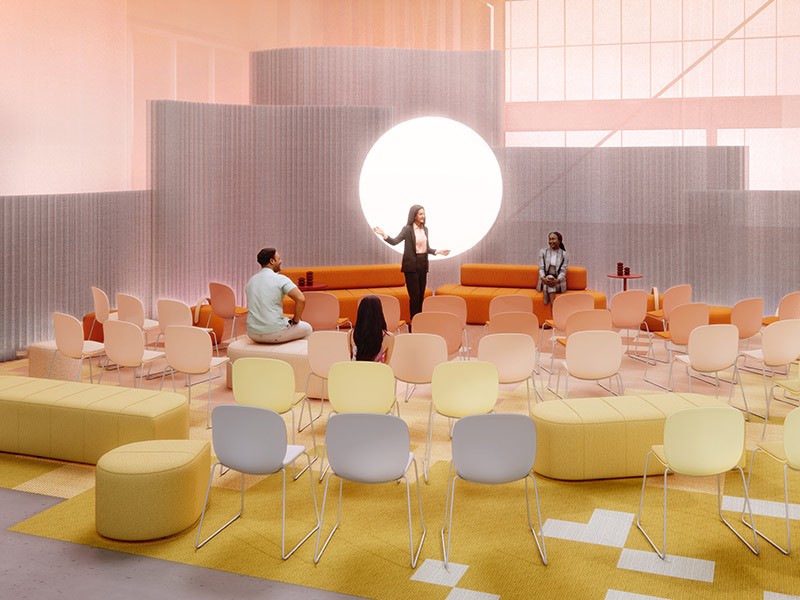
The modern workplace is evolving faster than ever. Traditional layouts of rows of desks and enclosed cubicles are giving way to offices designed around flexibility, collaboration, and employee wellbeingThe modern workplace is evolving faster than ever. Traditional layouts of rows of desks and enclosed cubicles are giving way to offices designed around flexibility, collaboration, and employee wellbeing. For organisations seeking to stay ahead, the key lies in thoughtful workspace zoning—creating adaptable environments that respond to how people actually work today. One of the most significant trends shaping office design is flexibility. Work patterns have changed: teams collaborate in bursts, focus deeply in concentrated periods, and switch between in-person and digital modes throughout the day. Workspaces that can transform to meet these changing needs without major disruption are becoming essential. Mobile partitions and modular systems allow offices to create temporary or permanent zones that can adapt in real time, supporting a mix of focused work, collaboration, and social interaction. (more…)

The power of play: how pool and table tennis can transform the workplace

The power of play: how pool and table tennis can transform the workplace

While workplace wellness programmes and flexible policies have their place, one of the most simple and effective interventions is often overlooked: playWorkplaces are under growing pressure to support both productivity and well-being. Hybrid schedules, long desk hours and rising stress levels mean organisations are rethinking what the office should provide. While wellness programmes and flexible policies have their place, one of the most simple and effective interventions is often overlooked: play. Games like pool and table tennis may once have been dismissed as gimmicks, but today they are increasingly recognised as part of a serious workplace strategy. Far from being distractions, they support movement, collaboration, mental health and focus – all of which are critical in a modern knowledge economy. (more…)

Where are the iconic office furniture products of yesterday?

Where are the iconic office furniture products of yesterday?

Originally published November 2023: Occasionally, this image goes viral on social media. It is of a group of Bauhaus design students from around 1927. They are called Martha Erps, Katt Both and Ruth Hellos. The full image (reproduced below) shows them with legendary office furniture designer Marcel Breuer, who Erps would later marry. The story of the photograph can be found here. On social media, though, the standard response from people of a certain vintage – my vintage admittedly – is to suggest that they were last seen supporting Echo and the Bunnymen at the Barrowland Glasgow in 1984.  (more…)

Leadership teams are struggling to cope with the pace of change

Leadership teams are struggling to cope with the pace of change

Executive teams are failing to keep pace with the demands of a world defined by constant disruption, according to a new report.Executive teams are failing to keep pace with the demands of a world defined by constant disruption, according to a new report. The study, from  consultancy Waldencroft, claims that most senior teams remain fragmented and reactive, with only a small proportion taking a strategic, enterprise-wide view. The report, The Executive Readiness Gap, draws on insights from 20 in-depth interviews and 40 surveys with Chief People Officers across a range of complex and international organisations. It suggests that disruption has become a permanent fixture in the business environment, but many leadership teams continue to treat it as episodic—responding only when necessary before trying to return to a previous norm. (more…)

Does your employee benefits package have a marketing problem?

Does your employee benefits package have a marketing problem?

Despite many businesses investing heavily in employee benefits, many of these perks fail to deliver their full potential. Here's what to do about itDespite many businesses investing heavily in employee benefits, many of these perks fail to deliver their full potential. According to the 2025 Drewberry Employee Benefits and Workplace Satisfaction Survey, just 12 percent of UK employees report being truly satisfied with their benefits package. This gap in satisfaction isn’t always about the benefits themselves, but is often a failure of communication. This latest research shows that while benefits may be in place, just 36 percent of employees fully understand what’s on offer. Even fewer regularly engage with these benefits. (more…)

Occupiers seek broader value from workplace strategies

Occupiers seek broader value from workplace strategies

A new report from Cushman & Wakefield, in partnership with CoreNet Global, claims to highlight how corporate occupiers are adjusting their real estate and workplace strategies in response to ongoing cost pressures and shifting organisational prioritiesA new report from Cushman & Wakefield, in partnership with CoreNet Global, claims to highlight how corporate occupiers are adjusting their real estate and workplace strategies in response to ongoing cost pressures and shifting organisational priorities. The What Occupiers Want 2025 survey is based on responses from over 230 senior real estate leaders across global markets. While cost remains the primary driver of decision-making, the findings suggest that occupiers are placing increased emphasis on performance, employee experience and long-term value. (more…)

Study claims that working from home can significantly boost productivity

Study claims that working from home can significantly boost productivity

A new study of a large Turkish call centre provides fresh evidence that working from home can improve productivity and workforce diversityA new study of a large Turkish call centre provides fresh evidence that working from home can improve productivity and workforce diversity — though in-person onboarding remains crucial to long-term success. The research, conducted by economists from King’s College London, Stanford, the Paris School of Economics and the EBRD, examines Tempo BPO, a Turkish business process outsourcing company that moved fully remote in 2020. The authors include well-known remote work researchers Nick Bloom and Steven Davis, alongside Cevat Giray Aksoy, Victoria Marino, and Cem Ozguzel. (more…)

At home down under: hybrid working has become a way of life in Australia

At home down under: hybrid working has become a way of life in Australia

The majority of Australian employees work from home at least part of the week, with hybrid working now embedded in organisational cultureThe majority of Australian employees now work from home at least part of the week, with hybrid working becoming embedded in organisational culture, according to a new report from the University of Melbourne and Western Sydney University. The study, Navigating the Future of Working from Home in Australia, is based on survey data collected in late 2023 and charts how working patterns have changed in the years following the pandemic. It suggests that while fully remote work remains uncommon, most employees now work from home one to three days per week and expect that flexibility to continue. (more…)

Rise of AI gives us a chance to rediscover a world beyond the screen

Rise of AI gives us a chance to rediscover a world beyond the screen

If scheduling, communication, analysis, and recall can be handled by AI that operates through conversation or ambient cues, the screen starts to look less essential and more habitual.Over the past three decades monitors have colonised desks in workplaces, homes and in public spaces, with the presence of a screen often signalling that something productive is taking place. This assumption may now be under quiet revision with implications for technology, management, and workplace culture. The growing maturity of artificial intelligence agents is having an incremental but significant impact on how we work. AI is now more capable of carrying context across tasks, acting independently, and responding through natural language, which is leading to the need for visual interfaces to be reduced. If scheduling, communication, analysis, and recall can be handled by systems that operate through conversation or ambient cues, the screen starts to look less essential and more habitual. (more…)