
February 22, 2018
Report calls for better understanding of the future risks of tech to workplace wellbeing
 In a workplace dominated by insecurity, gig work and intelligent machines we need to improve our understanding of their potential impact on health, safety and wellbeing claims a new report. Future risk: Impact of work on employee health, safety and wellbeing, commissioned by the British Safety Council from RobertsonCooper researchers argues that the public debate on the future of work has centred so far on the likely shape of the workplace and its implications for both employers and employees. There has been far less focus on what this might mean for workers’ health, safety and wellbeing, with discussions centring on the present, rather than preparing us for the challenges of the future. Yet, the impact of automation on the workplace will be more fundamental than is commonly understood, with 11 million jobs predicted to be lost in the next 20 years in the UK. As we are already seeing with some ‘gig’ working, it may undermine such basic human needs as social identity, economic security and a sense of belonging. The report reviews the existing literature on this subject and makes a number of recommendations.



 A third of workers (32 percent) regularly struggle to be productive in their job, and one in six (16 percent) blame their manager – claims a new survey from ADP. This puts bad management ahead of inefficient systems and processes (15 percent) and staff shortages (13 percent) as the biggest drain on productivity in the UK workplace. The UK has been grappling with low productivity levels for a number of years, consistently placed behind other leading economies, such as Germany and the US in official productivity tables. While recent ONS figures suggested a recovery is underway, reporting




 Less than a quarter (23 percent) of employees feel completely informed about the values of the organisation they work for and just 19 percent of employees feel completely informed about their employer’s corporate mission claims a new survey by Reward Gateway. These statistics are even more problematic when you consider that 83 percent of employers say it’s critical to the success of their business that employees understand their mission. Recognition is one of the key drivers needed to ingrain employees with a company’s values and corporate mission, however, 40 percent of employees don’t agree that their employer recognises them when they demonstrate the values their company cares about. Furthermore, the study has found a break-down of communication and trust between employees and their employers. 81 percent of senior decision makers say that their organisation is transparent with employees about how they plan to achieve the company mission. However, only 22 percent of employees say they strongly agree that they trust their employer to communicate information openly and honestly.


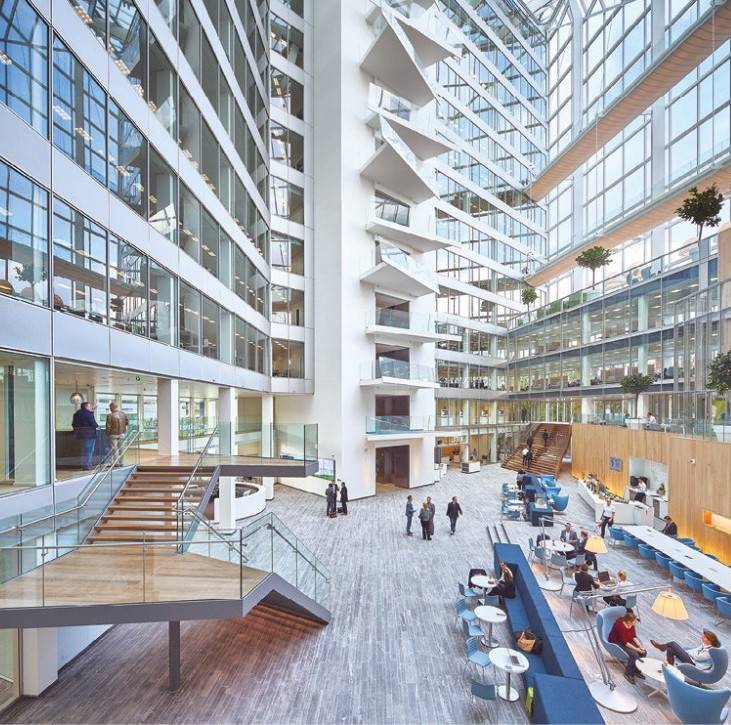
 The creative team behind the development of the world’s most sustainable building – The Edge in Amsterdam – has announced the launch of a real estate technology company. EDGE Technologies, launched by OVG Real Estate CEO Coen van Oostrom will focus on creating a new generation of buildings which feature the latest innovations in sustainability and wellbeing. Whereas parent company OVG is focussed exclusively on the development of its existing portfolio, EDGE Technologies will focus on both the development and the long-term operations of this new generation of buildings, aiming for a cohesive experience across cities. Each EDGE building will be built and operated on the same technology platform and offer consistent user-centred design, created to serve the needs of today’s fast-changing and demanding workforce. To help achieve this the new company is launching a product that will capture and aggregate data across its properties in order to optimize, measure and inform both the user experience and the building’s environmental performance.