






October 9, 2014
Winner and shortlist announced for UK Prime Minister’s Better Public Building Award

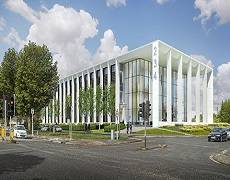
Wiltshire County Council Offices
The (rather long) shortlist of nominees for the Prime Minister’s Better Public Building Award 2014 has been announced by the UK Cabinet Office. Hosted as part of The British Construction Industry Awards which aim to ‘recognise all-round excellence in construction, including the overall design, and delivery of buildings and civil engineering projects’ the award’s original nominees were assessed on a range of standards including economic and social value. As well as the rather impressive new headquarters for Wiltshire County Council (above), the Government claims the shortlist includes a college building that is engineered to be one of the quietest buildings in the country as well as a building that will almost entirely be powered by fish oil. Previous winners include Tate Modern and the Velodrome at the Queen Elizabeth Olympic Park. The Government, ever keen to be down with the kids, has produced a Buzzfeed feature on the nominated projects.
















October 6, 2014
A feeling of togetherness is essential and motivating, so why would we kill off the office?
by Mark Eltringham • Comment, Facilities management, Flexible working, Knowledge, Workplace design
It is still depressingly commonplace to read proclamations of the death of the office. These are usually appended to some survey or other about the rise of flexible working or a case study of a workplace devoid of desks (or, more likely, one in which none are pictured). Of course, the actual conclusion we can draw from such things is that the office as we once knew it is now dead or mutating into something else, but that’s true for every aspect of modern life. The constant factor that ensures offices will always exist, in some form or other is the human they serve. We know that because, as Tom Allen proved at MIT in the 1980s, people communicate less well the greater the physical distance between them. Now new research from Stanford University shows how the very idea of ‘togetherness’ can have a significant impact on the way people perform. The study, by researchers Priyanka Carr and Gregory Walton was published in the Journal of Experimental Social Psychology and concluded that ‘social cues that signal an invitation to work with others can fuel intrinsic motivation’.
(more…)