

Search Results for: business

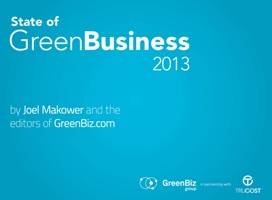
Greenbiz publishes latest State of Green Business report

Green Biz_0000Greenbiz has published its sixth annual State of Green Business report, setting out what it claims are the ten key environmental trends for organisations to look out for in 2013. Many focus on the overlap between pure business goals and corporate social responsibility, for example in terms of managing supply chains to reduce risk, making more efficient use of resources, the impact of new technology and working practices and the role of creating value through a healthy working environment.

Third of businesses see flexible work as main Olympic legacy

300px-Olympic_Stadium_(London),_16_April_2012

Flexible working facilities brought in for London 2012 are the most important legacy of the Olympic Games for a third of businesses, according to a new BT legacy survey. The survey of 600 large private and public sector organisations across the UK found 34% are continuing to enjoy the benefits from flexible working facilities (34%), with sales/revenue for 37% higher than before the Games. When asked what they have learnt about their organisation’s capabilities, 36% think that when they are pushed they can do a lot more business, 26% are more resilient and 25% feel they could increase their margins.
(more…)

Global trust demands business acts as force for good

Edelman_blogs-02-620x315

Government trails business, media, and non-governmental organisations as the least trusted institution worldwide. The 2012 Edelman Trust Barometer reveals trust in government fell a record nine points to 43% globally, and in 17 of the 25 countries surveyed, government is now trusted by less than half. “Business is now better placed than government to lead the way out of the trust crisis,” said Richard Edelman, President and CEO, Edelman. “But the balance must change so that business is seen both as a force for good and an engine for profit.”

(more…)

Business spending to grow for two years, forecast Ernst & Young

Business spending will grow tentatively over the next two years, according to a new report from the ITEM Club, an economic research group established by Ernst & Young. It predicts that overall spending by businesses will grow by just over three per cent this year and a further 8.1 per cent in 2014. This is good news following a number of recent economic forecasts but means that spending will remains some way short of its pre-downturn peak. The ITEM Club also called on the UK Government to do more to stimulate growth. (more…)

UK businesses lag behind US counterparts in adoption of Cloud tech

Businesses in the UK are significantly lagging behind their US counterparts when it comes to adopting Cloud technology according to new research from Redwood Software. The study found that 58 percent of US businesses were already using the cloud for private data storage, compared to just 35 percent in the UK. Meanwhile twice as many organisations in the US are using Cloud technology for supply chain integration and capacity management than their Brit contemporaries. (more…)

Go ahead granted for Manchester Airport business district

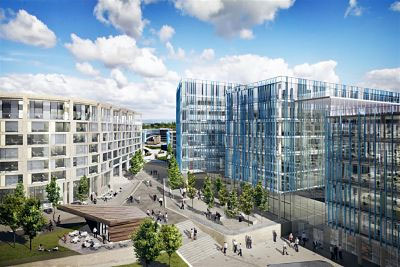
The application to build a new business district within the government-designated Airport City enterprise zone in Manchester has been granted outline planning permission by Manchester City Council. The UK coalition government made the area one of its first four “vanguard” enterprise zones in March 2011 to provide fastrack planning and tax breaks to encourage rapid development. The application involves the creation of  113,400 sq. m. of office space, 49,000 sq. m. of industrial units, and 5,800 sq. m. of retail and leisure facilities on the outskirts of Manchester. The £650 million scheme is anticipated to create over 11,000 jobs over the next 15 years.

Greenest commercial building in the world opens for business

The Bullitt Center, proclaimed as the greenest, most energy efficient commercial building in the world, is opening in Seattle. The goal of the Bullitt Center is to change the way buildings are designed, built and operated to improve long-term environmental performance and promote broader implementation of energy efficiency, renewable energy and other green building technologies. Tenant are now moving into the six-storey, 50,000 square-foot building located at the intersection of Capitol Hill and the Central District in Seattle, Washington. (more…)

Cloud computing set to transform business models

[embedplusvideo height=”196″ width=”300″ standard=”https://www.youtube.com/v/Y7hHXRIRflg?fs=1″ vars=”ytid=Y7hHXRIRflg&width=300&height=196&start=&stop=&rs=w&hd=0&autoplay=0&react=1&chapters=&notes=” id=”ep6634″ /]

As an issue explored in our own briefing on the technologies that will do most to transform the workplace during 2013, we know the Cloud is set to be adopted (and understood) by more and more organisations and individuals in the coming year. Doubtless it will follow the usual process of technological adoption as people begin to understand its unintended consequences as well as its uses but it pays to know what some of its implications will be for office designers and managers as shown by this programme from Deloitte.

Hobbies have the power to improve creativity and personal lives

Hobbies have the power to improve creativity and personal lives

Hobbies could do more than improve your personal life, they could make you more creative and better at work, according to new research published today. Hobbies could do more than improve your personal life, they could make you more creative and better at work, according to new research published today.  The study by researchers from the University of East Anglia (UEA) and Erasmus University Rotterdam explored how ‘leisure crafting’ – intentionally shaping your free time through goal setting, learning and connection – does not just boost well-being outside the office but can spill over into creativity, engagement, and meaning at work, especially for older employees. Published in the journal Human Relationsthe findings show that giving people simple, doable advice about how to grow through their hobbies can make a real difference in their daily lives. (more…)

Surface Design Show announces the finalists in its awards programme

Surface Design Show announces the finalists in its awards programme

The Surface Design Awards have announced the shortlist for the 2026 edition. The winners will be announced during the Surface Design Show in early FebruaryThe Surface Design Awards have announced the shortlist for the 2026 edition. The winners will be announced during the Surface Design Show in early February. The awards are intended to champion material excellence and design innovation from the UK and around the globe. The announcement follows a judging day with some of the design industry’s most respected experts deliberating and debating the entries. The organisers of the Surface Design Awards 2026 promise to “uncover and celebrate the very best in design excellence, offering a global platform for ground-breaking projects and product design”. (more…)

How leadership can drive positive changes in workplaces

How leadership can drive positive changes in workplaces

Leadership has the power to reconnect people to their workplaces, rebuild trust, and create environments where employees feel motivated to contribute.The contemporary American professional landscape is at a turning point. While people are sticking with their employers, they feel more disconnected than ever. Gallup calls this the ‘Great Detachment’. (more…)

Addressing the problem of burnout in high stress industries 

Addressing the problem of burnout in high stress industries 

This article will explore the root cause of burnout, which often goes unnoticed and unaddressed. You will gain insights into what the early signs look like and how a sustainable workplace design can help reduce unnecessary strain on employees.What would happen if a bridge constantly supports a stream of traffic over time? No matter how robust or well-built it is, there will come a time when the materials begin to strain, revealing cracks and deeper structural issues.  Now, high stress industries tend to operate in a similar manner. Employees, acting as the bridge, may crumble under the continual weight of increasing workloads. Inevitably, burnout awaits at the end of the rope, something which serves as a warning of an overextended system.

This article will explore the root cause of burnout, which often goes unnoticed and unaddressed. You will gain insights into what the early signs look like and how a sustainable workplace design can help reduce unnecessary strain on employees.


Burnout As a Signal of Systemic Imbalance 

For the longest time, burnout has been viewed as an individual failure to cope. However, the fact that this condition is so persistent across industrial sectors reveals something far more structural.

Personal resilience, or lack thereof, becomes secondary when exhaustion and disengagement are reported across roles and sectors. By this stage, burnout has turned into a system-level signal that organizational demands have drifted out of alignment with human capacity.

A 2025 report showed that 72 percent of employees reported moderate to high levels of work-related stress. This marked the highest figure recorded in the past six years. Another independent research conducted the same year discovered that 66 percent of employees were experiencing some form of burnout.

The truth is that certain industries are known to be high-stress, including education, healthcare, emergency services, finance, and technology. When burnout is reported across these, it’s a sure sign that the operating models are relying on endurance rather than sustainability.

Since time pressure and emotional labor are treated as inherent to such sectors and the roles therein, burnout goes largely unaddressed. Common indicators of systemic imbalance include:

  • Workloads remain high despite changing demand cycles.
  • Recovery time is treated as optional.
  • Professionals are given high responsibilities with limited control or discretion.
  • Crisis conditions become normalized, masking long-term risk.
  • Moral and emotional strain occur, especially where workers cannot meet professional standards consistently.

Interestingly, burnout first appears among the most capable employees, those most invested in the outcomes. This should ring alarm bells, but sadly, many continue to see it as an individual issue. It’s time to understand that burnout is an early warning that the system itself is operating beyond sustainable limits.


How Workforce Shortages Intensify Burnout Cycles 

It’s important to note that high-stress industries also suffer from workforce shortages alongside burnout. This means the two are not separate challenges. When staffing levels are inadequate, the result is sustained pressure on remaining employees, no matter the market demand.

Staffing gaps go beyond redistributing work. They reshape job conditions in such a way that burnout only gets worse. The scale of this problem is most evident in the healthcare sector. As per a 2025 report, 72 percent of hiring professionals reported ongoing staffing shortages in their facilities.

What’s more is that such conditions are expected to continue in the near future. When more than two-thirds of managers cannot find enough qualified applicants to fill their vacancies, we can understand that the problem is real.

Under such circumstances, burnout tends to intensify through the following mechanisms:

  • Workloads don’t get reduced, just redistributed. The remaining staff have to work harder to complete the additional tasks generated due to high demand.
  • The work environment continues to stay fast-paced and high-stakes.
  • Experienced staff members spend more time covering direct services and less on mentoring or decompression.
  • Since shortages persist, the workforce doesn’t get replenished properly.
  • As the existing employees strain under pressure, that in itself fuels burnout and attrition rates.


Rethinking Talent Pipelines in High-Stress Sectors 

If organizations operating across high-stress industries are somehow able to replenish and sustain their workforce, that should provide some relief from burnout. The problem is that traditional talent pipelines, particularly in sectors like healthcare, emergency services, and education, were built for linear careers and predictable demand.

Under prolonged pressure, these models struggle to respond quickly enough. As a result, existing staff members are left to absorb the ongoing gaps. Many organizations are now reconsidering how people enter demanding professions in the first place.

In other words, many have decided not to rely solely on early-career entrants. Mid-career transitions and return-to-practice routes are also becoming a part of broader workforce strategies. For instance, in healthcare, career changers with a university degree in other disciplines can also pick up nursing training.

Within this context, online second-degree accelerated BSN programs have emerged as one example of how talent pipelines are being restructured. These programs lead to a Bachelor of Science in Nursing, the standard qualification for registered nurses.

As Elmhurst University shares, students with a prior Bachelor’s in any other discipline will earn their basic nursing degree within 16 months. The online structure addresses burnout in ways that traditional programs may not, as follows:

  • Trainees can stay partially employed while they complete their coursework.
  • The workforce across crucial, high-stress sectors can be replenished faster.
  • Candidates across different regions and demographics can have access to learning.
  • Organizations are able to avoid cyclic depletion caused by pulling staff out for upskilling or retraining.

Such adaptations can reduce the duration and intensity of understaffing across high-stress sectors. However, pipeline flexibility alone cannot resolve burnout. Parallel improvements in workload design and staffing support are also needed. Otherwise, the system already operating beyond sustainable limits will keep feeding itself.


Moving From Wellbeing Rhetoric to Sustainable Work Design 

Addressing burnout through well-being initiatives has become commonplace across high-stress industries. The world is all too familiar with wellness apps and stress management workshops. These interventions do provide short-term relief for individuals. However, they do little to tackle the root of the problem: systemic drivers such as chronic understaffing and excessive workloads.

According to Gallup’s State of the Global Workplace 2025 report, only 33 percent of employees worldwide said they were thriving. 58 percent were struggling to cope, and 40 percent even experienced significant stress “a lot of the previous day.” Such trends cut across sectors, showcasing that burnout and disengagement are not merely isolated personal challenges.

The need of the hour is sustainable work design that addresses how work is structured and paced. Key elements of this include the following:

  • Realistic workload distribution to ensure tasks are aligned with staffing levels and capacity
  • Predictable scheduling that reduces last-minute changes, which could erode recovery time
  • Built-in recovery periods to protect rest as a structural requirement
  • Clarity of roles to prevent overload that results from blurred responsibilities
  • Feedback loops that adjust workflows before the strain escalates

This type of design views burnout as a signal of system failure, rather than an individual employee’s weakness. High-stress industries cannot afford to consider this design as an optional enhancement.

The same is critical to stabilizing teams and protecting workforce capacity so as to mitigate long-term burnout. This is especially important as recent research has emphasized that organizations need to adapt workforce structure and skills to evolving demands.

With that being said, organizations also need to factor in anticipated future pressures, not just current workforce strain. This means the next frontier lies in intelligent workforce design. It would include predictive workload modeling and cross-training of teams for flexibility.

As digital tools and remote learning expand access, changes in workplace policy and culture can help prioritize sustainable work practices. This is crucial because the future of high-stress industries depends on proactive, structural solutions if burnout is to become a thing of the past.