Search Results for: culture

University staff love to connect on campus, but also value time working from home

University staff love to connect on campus, but also value time working from home

A new survey reveals distinct trends in campus work culture and the growing preference for in-person interactions among academic staff, coupled with a desire to continue working from home when needed.A new report from Hassell, the 2024 Education Futures Survey, explores how hybrid working is reshaping the needs and expectations of Australian university staff. Based on responses from 300 university employees and a benchmark group of 500 office workers, the survey reveals distinct trends in campus work culture and the growing preference for in-person interactions among academic staff, coupled with a desire to continue working from home when needed. (more…)

Workspace Design Show announces Workspace Wellbeing Hero initiative

Workspace Design Show announces Workspace Wellbeing Hero initiative

The Workspace Design Show (26 – 27 February 2025, BDC, London) has announced the launch of the “Workspace Wellbeing Hero” initiativeThe Workspace Design Show (26 – 27 February 2025, BDC, London) has announced the launch of the “Workspace Wellbeing Hero” initiative, recognising and celebrating exceptional individuals in the workspace design industry who go above and beyond to support the wellbeing of others through acts of kindness and resilience in their work environments. This initiative shines a spotlight on those who make a tangible difference in workplace culture through selflessness, compassion, and perseverance. (more…)

Is salutogenic design the next big issue for the workplace?

Is salutogenic design the next big issue for the workplace?

Colleagues talk in a bright and lively office design

A number of progressive workplace issues have crossed into mainstream thinking over the past few years, and perhaps none more so than biophilia. It is now a principle that has become an issue talked about in the mass media, as shown by a CNN interview with one of Europe’s leading proponents of biophilic office design, Oliver Heath. The interview explores how biophilia taps into our embedded love of nature to evoke certain behaviours and emotions. (more…)

Four honest impressions of Orgatec 2024

Four honest impressions of Orgatec 2024


Here are four of my impressions of Orgatec 2024. Spoiler alert: Orgatec is big. It's the furniture that got small

I’ve been going to Orgatec in Cologne since 1992. It has always been one of the twin global behemoths of office design shows. The other being NeoCon in Chicago. Over that time, I’ve seen it dwindle significantly in size, if not relevance. It is held every two years, which means it can offer a better snapshot of current thinking about offices than an annual show might. The last show, two years ago, was still hungover from the pandemic (2020 was cancelled) so this year’s event was, in a way, the first chance to see how things stand in whatever era we might now be in. (more…)

Remote workers are more likely to miss out on promotions

Remote workers are more likely to miss out on promotions

A new report claims that more than a quarter of remote workers believe they have missed out on a job promotion or opportunityA new report claims that more than a quarter (27 percent) of office workers who work flexibly believe they have missed out on a job promotion or opportunity. Even so, most remote workers say they still wouldn’t want to give up on flexibility. The Work Remastered 2024 survey of 1,000 office workers in the UK and US, carried out by consultancy United Culture claims to highlight a disconnect between what leaders and employees want. (more…)

Sick days rise 41 percent over last three years as business productivity falls post-pandemic

Sick days rise 41 percent over last three years as business productivity falls post-pandemic

sick daysSick days have surged by 41 percent over the past three years as employers continue to struggle with declining levels of productivity. The latest Hiring Trends Index by Totaljobs, surveying 1000 UK HR decision-makers, highlights how this rise in absenteeism is perpetuating a cycle of poor business performance affecting both employers and employees. (more…)

Employers need to be proactive to address problem of sexual harassment at work

Employers need to be proactive to address problem of sexual harassment at work

In today's evolving workplace landscape, the issue of sexual harassment at work and the work-related environment remains a pressing concernIn today’s evolving workplace landscape, the issue of sexual harassment at work and the work-related environment remains a pressing concern for employers and employees alike. Recent surveys have shed light on the pervasive nature of this problem, revealing that a significant portion of workers continue to experience sexual harassment at work not only from colleagues, but also from third parties such as suppliers, customers and patients. As new legislation approaches, it’s imperative for employers to take reasonable anticipatory steps to prevent sexual harassment at workplace to improve workplace culture, the organisation from expensive and damaging claims and its workforce from such abhorrent conduct. (more…)

Over 57 and looking for work? Forget it, say HR managers

Over 57 and looking for work? Forget it, say HR managers

Millions of people aged 57 and over in the UK are being overlooked when looking for work, as employers consider this age too oldMillions of workers aged 57 and over in the UK are being overlooked for job opportunities, as employers increasingly consider this age ‘too old’ to hire, according to a new poll. The survey, conducted by Totaljobs, claims that a third of people over 50 worry they will struggle to find work due to age discrimination, with one in seven reporting being rejected for jobs because of their age. The study suggests that two-fifths of HR decision-makers have faced pressure to hire younger candidates, placing older workers at a disadvantage when looking for work. In response, more than a fifth of over-50s have chosen to omit their age from their CVs, while a quarter hesitate to apply for roles, fearing potential bias. (more…)

Office design goes to the movies

Office design goes to the movies

What can the movies tell us about office designFollowing our recent attempts to create a rudimentary playlist of songs that tell us something, or perhaps nothing, about office design, office life and office furniture, here’s another look at how the parochial world of the workplace can brush up against popular culture. It does this unnoticed for most people, I suppose, but not for those of us bound up in this world. We’re not the sort of people who can ignore the regular, brief glimpse of an Aeron chair’s ubiquitous mesh without a synapse of recognition sparking up. So, here is a brief rundown of nine movies that use office design to make a plot point or set up a character development.

(more…)

Magenta Associates becomes employee owned

Magenta Associates becomes employee owned

Our friends at comms specialist Magenta Associates have announced that the business is now owned by its employees.Our friends at comms specialist Magenta Associates have announced that the business is now owned by its employees. The company has set up an Employee Ownership Trust which owns the majority of the business. The trust will be led by five trustees to ensure the management team is running the business in the best interests of the employees. Magenta was set up in 2011 by Cathy Hayward, the former editor of FM World (now Facilitate) and FMJ magazine who spotted a gap in the market for a PR agency specialising specifically in facilities management. (more…)

The science and art of change management

The science and art of change management


change management, like potentially most professional roles, is actually split into two halves with one being science and the other being artWith all the talk about generative AI, the impact it will have on people, businesses and industries, I started to think what will be the impact on change management and particularly the role of a change professional? And I realised that change management, like potentially most professional roles, is actually split into two halves with one being science and the other being art. The science element is made up of the products that one can typically see/point to, like a change plan, stakeholder map, training plan, etc.  Whereas the art element is made up of what you can see as well, but only if you take the time to observe and notice the impact it has on environments, people, productivity, retention rates, etc. because it involves the people side of change. (more…)

Did you hear the one about offices and creativity?

Did you hear the one about offices and creativity?

the places we go for ideas

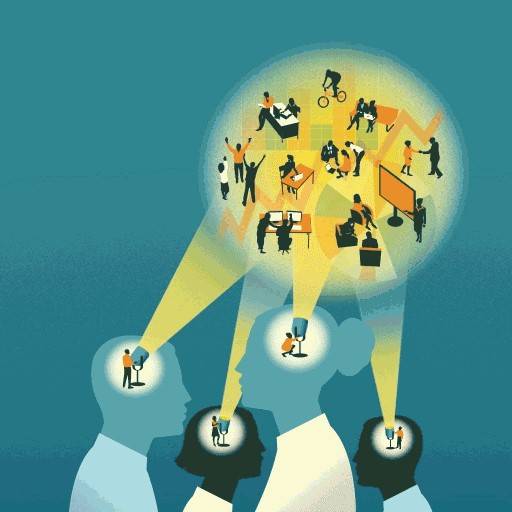
There is a famous episode of Seinfeld in which the character George is insulted in a business meeting and only thinks of a perfect retort while driving away from the office. This being George, he decides that he doesn’t want to waste his ‘killer line’ so engineers a second meeting so he can use it with the person who had insulted him, only for it to blow up in his face yet again. It’s an example of what the French refer to as l’esprit de l’escalier and the Germans as Treppenwitz, in both languages the wit you develop on a staircase.

It describes the phenomenon we all experience of having our best ideas when we stop trying to have them. When our mind wanders, and especially when the body is wandering too, it is free to have its own moments of insight and inspiration. And, contrary to the idea that structured collaboration leads to good ideas, when we are alone.

Unsurprisingly, there are good reasons why this happens. In his book The Eureka Factor: Aha Moments, Creative Insight, and the BrainProfessor John Kounios argues that our brains have essentially two ways of solving problems. One is analytical in which we use a rigid methodology to arrive at a solution. It is based on the frontal lobe of our brains that is responsible for attention, organising information and focus. The other is one where we experience a eureka moment in which an idea seems to pop out of nowhere.

His own insights into these phenomena are based on his research into what happens to the brain when it has ideas or solves problems. Using neuroimaging technology, he and his fellow researchers invited a number of research subjects to solve puzzles. What they found was that shortly before a burst of activity in the right temporal lobe of the brain indicating a moment of inspiration, the brain would shut down its own visual cortex which processes sight and perception.

Kounios and his fellow researchers compare it to the way we might close our eyes or look away immediately before a eureka moment. For a moment we become unaware of our surroundings while the idea flares into being. The brief change in function in the brain allows it to focus inwards and use the subconscious to make links between information it has stored and then present it to our conscious mind.

By contrast, when thinking methodically about a problem, the brain uses the frontal lobe to focus attention outwards to acquire as much information as it possibly can.


Eureka!

The process of having creative epiphanies is best served when we are not in a methodical frame of mind and ideally when we are not processing information in a formal way. That is why a walk in the park, a change of activity or setting or doing something routine like taking a shower are conducive to those aha moments. Sitting at our workstation in an office may be a great way of completing many tasks, but it is not necessarily suited to the creative spark.

Merely being in the outdoors or being able to perceive the natural world from our place in the office building can release endorphins and increase our feelings of wellbeing, putting the brain into the right frame of mind for an aha moment. Stepping away from a problem also gives the brain a chance to place less emphasis on its frontal lobe and allows the subconscious to intervene.

A study published in the Journal Psychological Science called Inspired by Distraction: Mind Wandering Facilitates Creative Incubation found that when we create the conditions in which our minds can wander, the brain makes connections between pieces of information unconsciously, massively increasing our ability to have revelatory insights and ideas.

We can achieve this by doing simple things like exercising outdoors, going for a walk or simply relaxing, by changing our behaviours but also by changing our surroundings. An office that encourages people to move and be aware of the natural world is not just good for physical and psychological wellbeing, it allows us to work in different ways that are best suited to the ways our brains function.

That includes moments of doing nothing in particular or sitting back or closing our eyes or simply walking up some stairs to tap the potential for creativity we all have hidden within.