




Search Results for: employer

Sydney leads the way in activity-based working finds global cities report

Sydney leads the way in activity-based working finds global cities report 0

hub-city-sydneyIf employers want to attract the best, they need to create spaces where their staff want to work, because providing an inspiring and enjoyable office is now the most critical, cost-effective way to successfully attract the world’s most talented employees. Knight Frank’s Global Cities: The 2016 Report highlights a shift in thinking by the newest generation of workers who expect the same kind of environment which historically, was the preserve of technology and media firms. This new office combines collaborative spaces with individual work areas, as well as providing amenities that encourage people to think of work as an extension of home. Sydney is leading the way with just under a third (28 percent) of all offices already offering activity-based working (ABW) for employees, where the workspace is specifically designed to suit the whole range of activities which will be accommodated.
(more…)

Working parents suffer in silence, as managers kept in the dark

Working parents suffer in silence, as managers kept in the dark 0

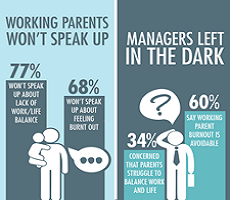
Managers left in the darkA new US study of working parents and their managers has found that the combination of work and family responsibilities is causing parents anxiety and depression and keeping them from doing their best at work. The study, the second annual Modern Family Index commissioned by Bright Horizons Family Solutions explored the challenges working parents have in managing their work and family responsibilities and the impact these challenges have on employers. It found that working mothers and fathers feel it’s extremely important to work for a company that supports the needs of working parents (62 percent) and has a culture that addresses their family responsibilities (53 percent). However, there is a growing disconnect between managers and employees about how working parents are feeling. This may be attributed to the fact that even in 2015, most are reluctant to share their concerns with their employers.

(more…)

How workplace design is more closely reflecting how we actually work

How workplace design is more closely reflecting how we actually work 0

workplace design and how we workIn years gone by, a ‘one size fits all’ approach to office design might have been the norm, but as the decades have progressed, so too have the options available to businesses designing ‘homes from home’ for their office-based workforces. As new interpretations of the office environment proliferated, so the open plan model came to into being and eventually evolved into the default office design model. This initially brought greater variety than ever before but, ultimately, a one size fits all mentality in workplace design ultimately prevailed – every worker was expected to work in certain ways, utilising the equipment and furniture supplied and designed for them. From inception through to occupancy, the average new office involves a six-year period of design and construction involving varying teams of people discussing the best and most attractive solution for the actual end user.

(more…)

UK’s best workplace? + Apple’s new office + Design and happiness

UK’s best workplace? + Apple’s new office + Design and happiness 0

Insight_twitter_logo_2In this week’s issue; Mark Eltringham says Jeremy Hunt’s views on the UK’s need to work longer hours does not make practical sense and explains why workplace design isn’t the only way to engage people. The Civic Centre & One Stop Shop in Keynsham, near Bath wins ‘Best of the Best workplace in the country’ in the BCO awards; Apple plans to add another tech palace alongside its Norman Foster designed campus in California; and a new survey finds that companies are rethinking the tools they use to keep employees loyal. Employers admit to an ad hoc approach to flexible working practices; millennials prefer value accelerated career paths and diversity over job security; and we preview a new Technology and Trends event. Visit our new events page, subscribe for free quarterly issues of Work&Place and weekly news here. And follow us on Twitter and join our LinkedIn Group to discuss these and other stories.

Millennial workers value variety over job security and tenure

Millennial workers value variety over job security and tenure 0

Millennial 'job hopping'Employers may continuously be looking at ways to engage staff to ensure they still loyal to the organisation, but according to new research it seems they needn’t bother. Over one third (37 percent) of US workers — regardless of their satisfaction level — are seriously considering leaving their organizations, up from 33 percent of the workforce who were considering leaving in 2011. According to Mercer’s latest Inside Employees’ Mind research, which surveyed 3,000 people representing a complete cross-section of the US workforce, nearly one out of two employees who said they are very satisfied with their organizations and their jobs (45 percent and 42 percent, respectively) are still looking to leave. And perhaps unsurprisingly, it’s the Millennial workers who seem to value accelerated career paths and diversity (in the workplace and the work itself) over job security and tenure.

(more…)

Collaborative work goes hand in hand with better talent retention

Collaborative work goes hand in hand with better talent retention 0

Companies are rethinking the tools they use to keep employees engaged and loyal – especially at a time when flexibility and choice are increasingly important to an workforce that craves mobility and choice. A newly released survey from Jive Software claims that as the workforce continues to evolve and new future of work trends emerge, seven out of ten (72 percent) employees want to use more technology in the workplace that enables them to work from anywhere. Furthermore, the same percentage state that the freedom to try tools make them more effective in their job, with 43 percent finding it a powerful loyalty driver. According to the study of 1,000 US based employees, firms are also catching on to future of work trends and the impact that technology can have for employee retention. Eighty-four percent of employers want to implement technology that enable workplace flexibility.

(more…)

US sees biggest jump in working from home since 2008, claims study

US sees biggest jump in working from home since 2008, claims study 0

working from homeAccording to an analysis of the just-released 2014 American Community Survey (ACS) conducted by GlobalWorkplaceAnalytics.com, approximately 3.7 million US employees (2.5 percent of the workforce) called home their primary place of work in 2014. This represents a 6.5 percent increase and the largest year over year growth in the number of people working from home since before the recession. The ACS data is based on a nationwide survey of answers to the question “What was your primary means of travel to work during the survey week—’Worked at Home’ is one of the choices. The count only includes those who work at home at least half of the time. According to Global Workplace Analytics far more people work at home on a less frequent basis and many work in “third places” such as coffee shops, co-working facilities, libraries, and just about anywhere there’s an internet connection.

(more…)

More people are working from home, but they can end up feeling lonely

More people are working from home, but they can end up feeling lonely 0

RoneryMore and more British workers are working remotely, from home and other locations, but they are growing increasingly disconnected from their colleagues. Those are the findings of two studies into new ways of working conducted independently by Plantronics and Regus. According to the Plantronics survey of 2,500 staff, flexible working was given another boost over this Summer in response to the (intermittent) good weather and industrial action by London public transport staff. During August, more than half (55 percent) of the workforce chose to work from home or remotely more convenient to them, the audio communications firm’s study found. On the flipside,  the survey of 4,000 workers by serviced office provider Regus claims that almost two-thirds of employees who work from home miss mixing with colleagues and can feel lonely as a result.

(more…)

Visions of the future of work + Gen Y hype + flexible firms

Visions of the future of work + Gen Y hype + flexible firms 0

Insight_twitter_logo_2In this week’s issue; legend of the UK office furniture sector, John Fogarty reflects on his five decades of experience; Mark Eltringham argues the TMT sector no more fell from the heavens than Gen Y, and Charles Marks weighs up the pros and cons of the BREEAM environmental standard. The financial sector dominates the annual list of Top Employers for Working Families and we reveal there’s a tendency to drift into caricature when describing multigenerational working. Activity in Europe’s commercial property markets is at its highest level since 2007 and colleagues, not bosses can make people feel more engaged at work. Check out our video evidence which shows how some visions of the future of work can be remarkably prescient while others get it completely wrong. Visit our new events page, subscribe for free quarterly issues of Work&Place and weekly news here. And follow us on Twitter and join our LinkedIn Group to discuss these and other stories.

Colleagues more likely than managers to make people feel engaged at work

Colleagues more likely than managers to make people feel engaged at work 0

Engagament

A new report from Oracle claims that the people most likely to make employees feel engaged at work are their peers rather than their managers. The study, Simply Talent, also suggests that employees think their employer’s HR function is least likely to have a positive impact on their engagement levels. The study, which sets out to understand the drivers and benefits of employee engagement in Europe, polled 1,511 employees at large European businesses. The survey claims that 42 percent of employees across Europe believe that their peers have the most positive impact on how engaged they feel at work, well ahead of line managers (21 percent) and business unit managers (7 percent) and HR (3 percent) Conversely, when it comes to negatively affecting engagement, employees believe the senior leadership team (19 percent) and line managers (11 percent) are the most responsible.

(more…)

Unhelpful generalisations about generations based on hype, claims report

Unhelpful generalisations about generations based on hype, claims report 0

Generations hypeFor the first time, the age span of people in any workplace is now routinely between 16 and 75, as more people work past 60 than ever before. This means the UK is experiencing the widest working demographic in living memory. Yet generalisations about generations may simply be unhelpful, a new study into employee benefits has concluded. The report by Martha How, reward partner at Aon suggests a trend towards generational segmentation is much too simplistic and not necessarily supportive of employees or employer’s needs. She argues that the common view that we now have five generations in the workforce, each with differing needs and preferences are being overplayed. In fact, there is often too much of a tendency drift into caricature – for example, that twenty-somethings aren’t interested in pensions, while fifty-somethings worry mainly about pension and health.

(more…)

Commission welcomes appointment of new diversity champions

Commission welcomes appointment of new diversity champions 0

Diversity in the workplaceThe Equality and Human Rights Commission has welcomed the announcement of four new Whitehall diversity champions to help the Civil Service become more representative of modern Britain. In a National Audit Office report earlier this year, the NAO said that although Whitehall had made some progress on promoting diversity, it needed to place greater emphasis on departments’ valuing and maximising the contribution of every member of their staff. The report by the watchdog also concluded that the Cabinet Office was not using the data it holds on staff to manage workforce changes and hold departments to account. The new advisers, who include Paralympic swimming hero Chris Holmes, Director of Paralympic Integration for London 2012, will work to challenge policies and advise ministers and Civil Service leaders on increasing the numbers of people in the workforce from under-represented groups.

(more…)