Search Results for: population

New long term standing desks study announced at Virgin Media

New long term standing desks study announced at Virgin Media 0

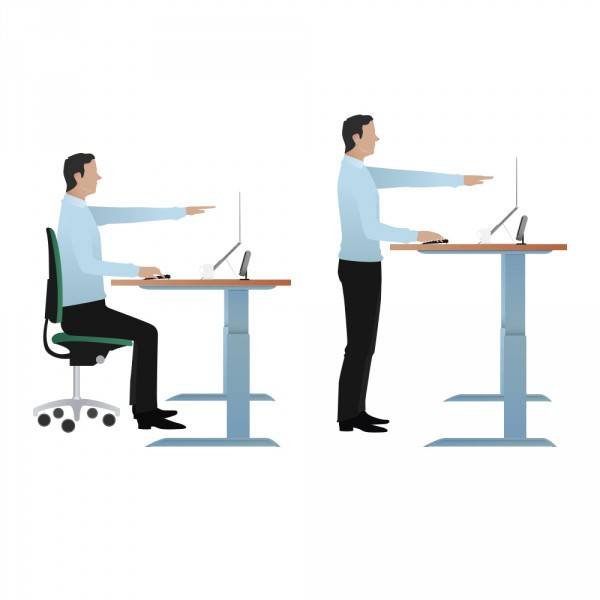
sit-stand-desking_illustrationA new 12 month study into the application and effects of working with standing desks has been announced by the University of Chester in conjunction with Virgin Media. However it’s a pretty small scale model – at just one site and presumably with a limited cross section of the general population. It will involve the participation of two groups of 12 agents at Virgin Media’s contact centre in Sheffield. The research will be led by John Buckley, Professor of Applied Exercise Science at the University of Chester, with the aim ‘to uncover the impact of a less sedentary working environment on health, wellbeing and productivity.’ The two groups of agents involved will take it in turns to spend six months each using adjustable sit-stand desks and staying on their feet for a minimum of two hours daily.

(more…)

How local approaches to ergonomics redefine worldwide standards

How local approaches to ergonomics redefine worldwide standards

ergonomicsWe live in the Global Village, Marshall McLuhan’s construct of an electronically contracted world in which attitudes, cultures and our political, business and legislative framework begin to pull together. And yet still each nation is characterised by the little differences that set it apart from its neighbours and even nations on the other side of the globe. So while there are many common threads that bind workplace design in different countries many of the core issues that shape the way we design and manage offices, such as demographics, status, organisational culture, technology, legislation and corporate identity can  vary from country to country. The way these are viewed and the emphasis each country places on each of them shape how they manifest themselves in the local market.

(more…)

UK’s health and social systems failing to improve workforce wellbeing

UK’s health and social systems failing to improve workforce wellbeing 0

workforce wellbeingA new report published this week by The Work Foundation, Healthy, Working Economies sets out the challenges facing the next UK government to improve the health and wellbeing of the country’s workforce. The report calls on the government to review how it is using local organisations, such as Health and Wellbeing Boards and Local Enterprise Partnerships to encourage improvements in workforce wellbeing and health. The Work Foundation recommends that a standardised set of measures be included in the Joint Strategic Needs Assessments performed by Health and Wellbeing Boards, including measures of employment outcomes for individuals with health issues. The report also suggests that employer leadership is needed to drive the step-change needed to improve the health of the workforce.

(more…)

Workplace wellness programmes can reduce obesity levels of staff 0

Workplace wellness programme can reduce obesity levelsWorkplace wellness programmes can help people lose weight, but are more effective when staff are actively involved in the process, a new study has found. The results of a two-year project published in the American Journal of Public Health show that providing healthier food choices and increasing opportunities for physical activity, successfully reduced the number of people considered overweight or obese by almost 9 percent. Results were particularly good when these efforts were designed with the input and active participation of employees. An estimated 68 percent of Americans are overweight or obese. As they spend on average a third of their lives at work; researchers based at the University of Rochester’s Department of Public Health Sciences worked with a local company to see how effective workplace intervention could be in addressing the obesity problem.

(more…)

New study explores link between workplace design and productivity

workplace designThe latest report linking specific workplace design elements with increases in productivity and wellbeing has been published by flooring manufacturer Interface and organisational psychologist Cary Cooper. The Human Spaces report into The Global Impact of Biophilic Design in the Workplace, claims that employees who work in environments with natural elements report a 15 percent higher level of well being, are 6 percent more productive and 15 percent more creative overall. The report is based on a study of 7,600 office workers from 16 countries. It concludes that office design is so important to workers that a third (33 percent) of global respondents believe it would ‘unequivocally’ affect their decision whether or not to work somewhere. Design is particularly important in India (67 percent), Indonesia (62 percent) and the Philippines (60 percent).

(more…)

London remains world’s most expensive city in which to live and work

Commuters walking into the central financial business district of London's DocklandsLondon has retained its place as the world’s most expensive city for businesses to accommodate their employees. But according to the latest analysis from Savills, Hong Kong and New York are closing the price gap. The three cities have dominated the Savills Live/Work Index since its launch in 2008 and form a tight group of world class cities where it now costs over US$110,000 per employee per year to rent typical office and living space. London is now 7.3 percent cheaper in dollar terms than in June 2014, while 4th placed Paris has slipped below the US$100,000 per employee threshold for the first time since mid-2012 as a result of rental falls, dollar appreciation and euro weakness. Meanwhile, fuelled by an improving US economy and tech industry expansion, San Francisco has outpaced all other cities in the live/work index, with growth in rent and other real estate costs of 55.1 percent since 2008.

(more…)

Wellbeing continues to improve despite static pay levels, claims ONS

WellbeingThe overall wellbeing of the UK population continues to improve despite ongoing concerns about pay levels and job security, according to a new report published today by the Office for National Statistics. The latest analysis includes an assessment of changes in national wellbeing for the first time and finds that year on year 33 percent of indicators had improved, 42 percent showed no overall change, 21 percent were not assessed and 5 percent deteriorated. The proportion of people in the UK giving the highest ratings for each aspect of personal wellbeing measured by the report increased significantly in the financial year ending 2014. The report defines wellbeing as a measure of “how we are doing as individuals, as communities and as a nation, and how sustainable this is for the future” based on 41 metrics.

(more…)

Film: The Japanese workers who withdraw to live in Internet cafes

Japanese workers appear to manifest some of the most extreme reactions to the challenges of modern life. Often these are related to the uncertainties of work and the fracturing of time and space associated with contemporary working life. Two of the most common characteristics of the Japanese response appears to be isolation and exclusion. Recently, the Japanese Government investigated the phenomenon of banishment rooms which some firms are alleged to have used to exclude unwanted employees. There has also been a great deal of talk about hikikomori, those people who lock themselves away from the rest of the world, estimated to be up to 1 percent of the population. Now, a new film from Shiho Fukada tells the story of two Japanese men who have taken to living in Internet cafes as they seek to find their way in life.

(more…)

Guidance published for SMEs on management and wellbeing of older workers

Guidance published on supporting older workers wellnessSince the the Default Retirement Age (DRA) was abolished in 2011, there’s been a growing awareness that the UK population is ageing at a rapid rate. One in six people in Britain are now over 65, with eight million workers aged 50 and over. But what is often overlooked is that the majority of older workers work for small and medium sized businesses. Of the 8 million workers who are 50 and over, 5.2 million work for businesses with less than 250 employees. Now in the first of its kind to specifically target smaller employers, new guidance published by Healthy Working Lives, part of NHS Health Scotland, aims to provide advice on hiring and managing older employees. Managing Healthy Ageing Workforces has been written by Dr Matt Flynn, Director of Newcastle University’s Centre for Research into the Older Workforce, and Kathleen Houston, Development Manager for Healthy Working Lives.

(more…)

What the colonisation of new domains tells us about how we work

40-Leadenhall-StreetHeadlines about the world’s accelerating taste for skyscrapers tend to be dominated by the big numbers. This is a world in which size is important, but get behind the focus on height and you find some very interesting data about the rapid and significant changes in what these tall buildings are actually for and how this chimes with broader changes in the way we create and use workplace and shared spaces. According to the most recent annual report on the world’s skyscrapers from the Council on Tall Buildings and Urban Habitat, last year was a record breaker with 97 new skyscrapers completed globally. The devil here is in the detail. While the world’s tallest new building was One World Trade centre in New York, the overwhelming majority of new skyscrapers are to be found in Asia generally and China in particular.

(more…)

Multi generational workplace could boost economy by £25 billion

mult generational workplaceThe Government has published a new report which describes the challenges faced by the UK’s over 50s in the workplace and sets out ways in which more of them can stay or move into work. The report is the culmination of eight months’ work by a team led by the Government’s ‘ageism tsar’ Ros Altmann and highlights why action is needed based primarily on the twin issues of demographic change and increasing life expectancy. The report, Retain, Retrain, Recruit, recommends action that would help older workers thrive and ensure individuals, industry and the economy can reap the financial and social benefits of a multi generational workplace. The report outlines how businesses could recruit more older workers, retrain existing staff and provide greater flexibility to retain them as well as setting out measures that should be taken to reflect the multi generational workforce in the media and policy making.

(more…)

Firms not offering staff the technology they need, claims report

Flexible working techMore than half (55 percent) of UK employees believe they do not have access to all the technology needed to do their jobs, according to research by Fujitsu. The study, Digital Inside Out, was based in a survey of just over 1,400 UK based employees and claims to reveal a significant disconnect between the needs of a digital-savvy working population and the digital services UK employers are currently providing. According to the report, 73 percent of UK employees believe that digital is vital to the future success of their organisation. However despite this, only 45 percent of employees feel they are provided with access to the technology services and applications they need to do their job sufficiently and 29 percent state that their ability to do their job is being hindered due to poor digital services. The report argues that the mismatch can be very costly for organisations.

(more…)