





Search Results for: technologies

The future of next generation TMT workplaces explored in new report

The future of next generation TMT workplaces explored in new report 0

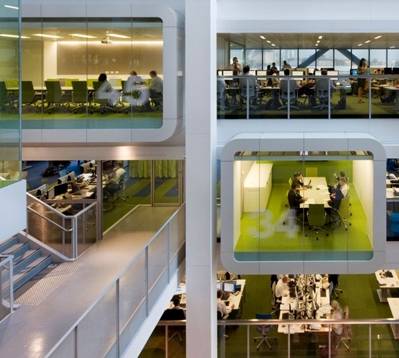
TMT WorkplaceA new report from property adviser Cushman & Wakefield claims to outline the key future property trends for TMT workplaces based on the views of decision makers from global Fortune 500 organisations, architects, designers, founders of start-ups and high-growth businesses. The Future of the TMT Workplace report produced in association with Unwork, identifies the key forces ‘driving change and necessitating TMT players to fundamentally rethink their workplace strategies’. These include frictionless growth, engineered serendipity, the ‘gig’ economy, the pace of technological change, demand for top technological talent far outstripping supply and where to locate in order to succeed.At this week’s launch event for the report, a panel of expert speakers agreed that workplaces have a critical for TMT firms to respond to challenges such as the need to attract the most talented tech workers.

(more…)

New smart working code of practice launched by BSI and Cabinet Office

New smart working code of practice launched by BSI and Cabinet Office 0

CaptureWe’ll return to this in detail next week, but yesterday the business standards company BSI working with the Cabinet Office launched a new code of practice on Smart Working. The Smart Working Code of Practice, BSI Publicly Available Specification (PAS3000) has been designed to support organisations in implementing smart working principles. The Cabinet Office sponsors it on behalf of the Smart Working Charter Steering Group of industry, academia, institutions and other public sector bodies. According to the Cabinet Office, the code brings together best practice from across the world and across disciplines and will enable organisations to move from principles to standards and benchmark themselves against high performers in smart working. At the launch, the organisers also announced the second annual The Way We Work (TW3) Awards, a Civil Service programme recognising government teams that have created smarter ways of working.

(more…)

Digital media is having ‘largely positive’ effects on professional lives

Digital media is having ‘largely positive’ effects on professional lives 0

Digital workplaceThe digitization of content and data, along with new digital communication technologies, has fundamentally changed the way work gets done, and affected the nature of the employment relationship. While it has a largely positive impact on peoples’ lives, including individuals’ ability to find work, learn and develop skills, and balance work and life, it can, in some cases, lower worker productivity and increase inequality. These are among the key findings from Shaping the Future Implications of Digital Media for Society  – a report by the World Economic Forum conducted in collaboration with Willis Towers Watson and presented at the WEF 2016 annual meeting in Davos. In the study, which included a survey of more than 5,000 digital users from five of the world’s most important markets; Brazil, China, Germany, South Africa and the US, over half (56 percent) reported digital media has transformed the way they work, and two-thirds said digital media has improved their ability to do work.

(more…)

Generation Z are preparing themselves for an automated world of work

Generation Z are preparing themselves for an automated world of work 0

AutomationThe automated world is far closer than many people suppose. Yet one demographic group that is less fooled than others on that particular score is the one now starting to make its mark in the workforce, suggests a new report. Amplifying Human Potential: Education and Skills for the Fourth Industrial Revolution, commissioned by Infosys from researchers Future Foundation, claims that 42 percent of 16-25 year olds worldwide feel their education did not prepare them for the world of work they are encountering for the first time with over three quarters having to learn new skills to meet the demands of employers. The report also claims that 40 percent of young workers believe their current job could be replaced by automated systems including robotics within 10 years. The report lands in parallel with a cluster of stories which highlight just how quickly the world is moving towards an automated future.

(more…)

Number of smart cities worldwide jumps 40 percent in past two years

Number of smart cities worldwide jumps 40 percent in past two years 0

SmartCities_Icon_SBAccording to a new report from Navigant Research, the total number of identified smart city projects worldwide has grown from 170 in the third quarter of 2013 to 235 today. The report examines the current state of global smart city development, covering the related aspects of the smart energy, smart water, smart transportation, smart buildings, and smart governments sectors, segmented by region. The authors of the report claim that, as the benefits of smart cities become clearer, the number of projects and partnerships supporting the cause is rapidly increasing. In the last few years, city leaders, central government ministries, and technology and service suppliers have announced a range of new smart city initiatives, incentives, and product and service offerings, while more cities are moving from one specific technology interest to a broader range of solutions that have multiple applications.

(more…)

Fourth industrial revolution will result in five million job losses by 2020

Fourth industrial revolution will result in five million job losses by 2020 0

Worktech 2015

Disruptive global employment trends, including flexible working, the rise of robots, other forms of automation and Big Data analytics will see over five million jobs disappear worldwide over the next four years, a new report claims. The World Economic Forum’s Future of Jobs report has calculated that current disruptive labour market trends, including improvements in artificial intelligence, cloud technology, the Internet of Things and flexible working arrangements, could lead to a net employment loss of more than 5.1m jobs in the 15 countries surveyed. The report estimated that new trends would result in a total loss of 7.1m jobs – two thirds of which are concentrated in the office and administrative functions – and a total gain of 2m jobs. The WEF surveyed those who it felt were best placed to observe the dynamics of workforces including heads of HR departments and CEOs in 15 developed and emerging economies.

(more…)

UK Government opens consultation on its new national digital strategy

UK Government opens consultation on its new national digital strategy 0

s300_digital-economy-640x4001Digital Economy Minister Ed Vaizey has called on members of the public and industry to share their ideas on how the UK’s digital revolution can be taken to the next stage. The announcement of the consultation follows what the Government claims was a successful first stage of its strategy with the creation of digital clusters in East London, centred on Tech City. Five years on, the Government claims that  the UK is now truly a ‘Tech Nation’ with more than 70 per cent of digital businesses now based outside of the capital. According to Vaizey, “this revolution has been led by entrepreneurs but supported by Government in creating the right environment for ideas and businesses to flourish. Government is now looking at a new Digital Strategy for the UK for the next five years. It wants the UK to be synonymous with digital – a place where digital technologies transform day-to-day life, the economy and government.”

(more…)

Report claims we will probably all be using at least three devices by 2018

Report claims we will probably all be using at least three devices by 2018 0

dilbert-stuff cropIf you ever feel completely overwhelmed by the sheer amount of technology demanding your time and attention, rest assured that things are only going to get worse. A new report from tech analysts Gartner claims that as each new type of device enters the market, we don’t choose between it and what we already have, we simply add the latest addition to our technological armoury. This challenges the commonly held assumption that people choose between different devices as new ones emerge. The report suggests that by 2018, a typical user in a mature technological market will own and use at least three devices including phones, tablets, PCs and wearable tech. Worryingly, the study also suggests we will use more than two devices per person at any given time. The report suggests that during 2016, the installed base of devices will total 7.8 billion units worldwide and is on track to reach 8.3 billion units in 2018.

(more…)

How our preconceptions can lead us to fail the office design bench test

How our preconceptions can lead us to fail the office design bench test

Logan Offices New YorkThe office furniture design scene certainly came alive in the early 1990s. New ideas and new technologies wove themselves into the grand narrative of new ways of working. Everything was possible and there was no longer one best way of doing things. In New York, Chiat Day’s offices featured touch-down desks, garish crimson floors and walls and a reception framed by a huge pair of plastic, glistening lips. In Helsinki, Sol Cleaning Services did away completely with ideas as outmoded as desks and working hours. In the UK, British Airways gave their staff olive groves and indoor streams to work alongside. And in London a small media company called Michaelides and Bednash had offices that consisted of a room furnished with a single 20m long serviced table for its 20 staff to share. Such workplaces were surely one-offs, mere footnotes to the grand narrative.

(more…)

Remote workers endure poor communications and working practices

Remote workers endure poor communications and working practices 0

Poor communciation within remote teamsPoor communication and working practices among remote teams is widespread, a new report by the Institute of Leadership & Management (ILM) claims. Organisations are failing to capitalise on the potential for remote working to improve performance and efficiency with 88 percent of remote workers struggling with inconsistent working practices and miscommunication, while 83 percent feel overwhelmed by emails. Although 84 percent of remote workers report improvements to their work-life balance, a lack of team identity can cause isolation and loneliness. The study with over 1,000 remote workers highlighted a range of potential benefits for organisations with a remote or geographically-dispersed workforce, including increased business reach, improved productivity, cost and time savings, and access to a more diverse set of skills and experience.

(more…)

OECD report urges firms to use Big Data analytics for growth and wellbeing

OECD report urges firms to use Big Data analytics for growth and wellbeing 0

WellbeingA new OECD report claims that organisations could be doing far more to use the data they and their employees generate to deliver a wide range of social, economic, commercial and personal benefits. In Data-driven innovation for growth and wellbeing, it suggests that  governments do more to encourage investment in Big Data and promote data sharing. The report urges countries to act to train more data scientists, reduce barriers to cross-border data flows and encourage investment in business processes to incorporate data analytics. It also claims that few companies outside the ICT sector are changing internal procedures to take advantage of data. This is particularly the case for small and medium-sized companies who face barriers to the adoption of data-related technologies such as The Cloud, partly because they have difficulty implementing organisational change due to limited resources.

(more…)

UK’s digital leaders set to deliver £92 billion boost to economy

UK’s digital leaders set to deliver £92 billion boost to economy 0

DigitalA new report from Virgin Media Business and Oxford Economics claims that the UK’s ‘Digital Leaders’ are set to use digital technology deliver a massive boost to the UK economy in the very near future. The study of 1,000 companies employing 470,000 people claims that the UK economy could see an increase of 2.5 percent in GDP (£92 billion) and create more than a million new jobs over the next two years. According to the respondents, they had already increased their revenues by 4.4 per cent and reduced costs by 4.3 per cent over the past year by making better use of digital technology, generating an estimated £123 billion contribution to the UK’s economy, equivalent to 3.4 per cent of GDP. In terms of jobs, 44 per cent of executives don’t expect any jobs to become obsolete and, across the economy, companies anticipate hiring 1.1 million employees as a result of digital investments.

(more…)