




Search Results for: technologies

Many UK facilities managers still failing to see the magic of BIM, claims report

Zim Sala BimAccording to a new survey from the Royal Institute of Chartered Surveyors, the UK’s facilities managers are simply not ‘getting’ what Building Information Modelling is all about and how it can be applied. The latest research into the acronym replete debate about the role of BIM found that more than a third of facilities management professionals are unfamiliar with building information modelling and its uses. RICS is calling on facilities managers to increase their general awareness of the potential of the technology. The survey was carried out on behalf of RICS by the crudely monikered and government funded BIM4FM initiative and found that of the nearly two thirds (65 percent) of respondents who were aware of BIM, nearly all (62 percent) believed it would help them in their roles.

(more…)

Global urbanisation trends present UK cities with new opportunities

Country_Mouse1There is a great deal of talk about the growing urbanisation of the world right now, and its effects on societies, economies and individuals. The numbers of people involved are daunting, especially in the developing world.  As a  result, many countries are currently experiencing the sort of upheaval we in Britain experienced nearly 300 years ago, and they are doing so in a very compressed time span compared to the 150 years it took in Britain. But the changing nature of cities is also apparent in the UK where it is having an effect not only in the country’s only megacity but in regional centres too.  For places such as Manchester, Birmingham, Bristol and Glasgow the challenges presented by a new generation of initiatives focussed on urbanisation can be profound and mark an opportunity to shift at least some of the UK’s economic focus away from London.

(more…)

Co-op’s One Angel Square in Manchester wins RICS’ Project of the Year

RICS Award Winner - 1 Angel Square

One Angel Square in Manchester has been awarded Project of the Year in the RICS Awards that celebrate the built and natural environment. More than 600 building projects entered the awards which also saw category awards presented for building conservation, community benefit, design and innovation, and regeneration. The overall winning project – a £100 million new headquarters for The Co-operative Group – is the largest commercial office building in Manchester and has also achieved the highest scoring BREEAM ‘outstanding’ office rating in the country, setting a new national benchmark in sustainable design in the commercial sector. RICS judges said every aspect of the building has been constructed with sustainability at heart. (more…)

New Smart City Forum to capitalise on $400 billion global sector

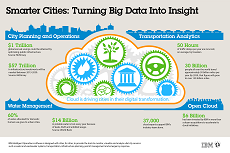
Infographic  Smarter Cities. Turning Big Data into Insight

IBM Infographic

London, Dublin, Barcelona, Boston and Bristol have something in common – they’re smart cities that use intelligent technology to monitor their urban infrastructure. The data is used in a variety of ways; to save money, minimise waste, measure water usage and manage transport routes. Solutions range from utilising IBM’s ‘Big Data’ to analyse traffic congestion on Dublin’s public transport network, to monitoring greenhouse gas emissions from Boston’s buildings. The smart cities industry has been valued at more than $400 billion globally by 2020, with the UK expected to gain a 10 per cent share ($40 billion). Now the government has announced it is to set up a new Smart Cities Forum, chaired by Universities and Science Minister David Willetts and Cities Minister Greg Clark, with representatives from cities, business, and scientists. (more…)

Nearly two thirds of SMEs now trust employees to work flexibly

One of the main arguments against flexible working amongst blue chip organisations – which was well documented following the Yahoo furore earlier this year, is that it is detrimental to fostering a collaborative working culture. Amongst small and medium sized companies, the reasons against are more straightforward, in that it demands a level of trust small business managers can ill afford to bestow unwisely. Now a new survey, carried out among over 200 UK-based SME decision-makers, highlights a growing acceptance of flexible working within these businesses. Well over half (63%) of senior executives say they trust their employees to remain productive when working away from the office, the Citrix-commissioned YouGov survey has shown. (more…)

Businesses report a growing appetite for social media work tools

social-media

Social media, as politicians and celebrities are all too aware is a double edged sword. Just last week David Cameron read out a Twitter message during Prime Minister’s Questions sent to a Labour MP, who had asked people for suggestions about what to ask at PMQs. The first reply was “how happy are you that the Labour leader will still be in place at the next election?” And Cameron himself has not been exempt to the odd twitter gaffe. Social media is such a powerful tool however, that employers can’t afford to ignore it – so demand for enterprise social networks – business tools that use Facebook-style features to allow staff to interact with one another on work projects are on the increase. (more…)

Three quarters of companies allow BYOD, but most admit data security concerns

Three quarters of companies allow BYOD

In the same week that Apple launches the iPhone 5S, over half (56%) of CIOs have said they allow employees to use their own smartphones in the workplace, and over three quarters (76%) of staff are allowed to use their own mobile data devices. While the research from Robert Half Technology found the biggest BYOD challenge is security, cited by over half (53%) of respondents, the Verizon 2013 Data Breach Investigations Report into global data breaches provides some reassurance that 86 per cent of cyber-attacks do not knowingly involve insiders. However lax internal practices, like copying data onto a USB drive or leaving a device in a cab does lead to security breaches, accounting for 41 per cent of cases of misuse. (more…)

Construction sector awarded £60m for development of more energy efficient buildings

New Government funding announced to develop more energy efficient buildings£60 million to help the UK construction industry design and develop more energy efficient buildings is to be awarded by the Government’s Technology Strategy Board. The projects, which address the challenges of both new and existing buildings, are expected to leverage in an additional £60 million of industry investment and £30 million extra funding from across government and other agencies. The board has already invested £83 million of funding through the Low Impact Buildings Innovation Platform, (LIBIP). It aims to help the UK construction industry deliver buildings with a much lower environmental impact by investing jointly with industry and other funders in projects to bring innovative solutions to a growing market for more environmentally friendly buildings.   (more…)

Mobile apps will dominate workplace communications within next three years

The news this week that Microsoft is to purchase Nokia’s mobile phone business for £4.6bn is a reminder of how rapidly app-based communications tools have transformed mobile phones and computer devices. Within the workplace, fragmentation and lack of standardisation of the technologies have resulted in organisations often using multiple tools, including that of employees’ own consumer smartphones and tablets. According to analysts Gartner most collaboration applications will be equally available on desktops, mobile phones, tablets and browsers by 2016. Over the next three to five years it predicts, every business will be using mobile collaboration tools – boosted by BYOD, personal cloud file sharing and the increasing availability of mobile applications. (more…)

FMs must overcome engagement barriers to sustainability implementation

Engagement still barrier to successful sustainability implementation

There is overwhelming support for sustainability to be embedded into business operations, but still some challenges in its successful delivery, according to the 7th annual Sustainability in Facilities Management survey from the British Institute of Facilities Management (BIFM).  Of the top five barriers to implementation success, three related to engagement; engagement overall, amongst senior management and middle management. The report also found that many FMs are not targeting the areas of highest priority relating to behaviours or processes which have the highest impact, but tend to focus on technologies. (more…)

Designs unveiled for new Google London headquarters in King’s Cross

Detailed plans have been submitted for the design of the new Google London headquarters building in King’s Cross. The 1 million sq. ft scheme designed by architects Allford Hall Monaghan Morris does not exceed 11 storeys at any point and will be home to up to 4,500 employees, double the company’s current London workforce and potentially making it the largest Google operation outside of New York.  The scheme is part of a wider development of Kings Cross and will incorporate 750,000 sq. ft. of office space with 50,000 sq. ft. of shops and cafes.  Current employees will relocate from three existing buildings in the capital.  Subject to approval for the detailed design from Camden Council, who have already granted planning permission,  work will begin on the site next year with completion set for 2016-2017.

Google is evidently keen to emphasise its investment in the UK, following weeks of criticism of its tax affairs from the media and politicians. Dan Cobley, Google UK’s managing director, in announcing the details of the development said: ‘Building our new headquarters in King’s Cross is good for Google and good for London.’ Certainly the deal is one of the biggest in recent years in the UK property industry, worth around £650 million and is expected by the developers to create 1,500 construction jobs and 35,000 new employment opportunities over all.

Some of the more interesting aspects of the proposed design are:

  • The primary way for workers to move between floors will be stairs rather than lifts as the firm looks to challenge the sedentary workstyles of staff. No news yet on any wretched slides.
  • The building is designed as a ‘groundscraper’ eschewing London’s recent trend for tall buildings, but is larger than the Shard at 1,083 ft long compared with the Shard’s 1,016 ft height.
  • Over two thirds (71 percent) of the office space are designated for workstations with the remainder set aside for meeting and breakout spaces, cafes and lobbies. Nearly half of the roof of the building will be landscaped.
  • The intention is to achieve a BREEAM outstanding accreditation.
  • The architects claims the design is inspired by the Victorian industrial heritage of the area and will act as a theatre in which the drama of Google’s business will unfold, but with stage settings that can change quickly and easily.

Commenting on the development, Simon Allford, of Allford Hall Monaghan Morris, said: ‘This building is underpinned by cutting edge design intelligence and technologies to provide a sophisticated twenty first century working environment for Google’s staff. The architectural approach, which has taken inspiration from King’s Cross and St Pancras International railway stations, complements the local area’s strong industrial heritage and will be a building London can be proud of.’

The three Rs of the RIBA Awards winners – risk, reticence, recession

Risk, reticence and recession are the 3 Rs  that leap out from the education dominated RIBA awards winners. The premise being that only a really bold architect would design something daring at a time of economic constraint. However, given what vanity has been displayed in recent years one would have supposed that boldness would not have been in short supply. It is the reality that falls some way short. A largely egg- and shoe-box inspired collection with windows best described as minimalist, the common theme is seemingly one of modesty. Even the big public projects seem derivative and cautious. Images of the visitor centre for the Giants Causeway (above) in Ireland suggest an attractive scheme but bring to mind Stonehenge, another early attempt at brutalist monolithic human construction with a spiritual dimension. Unless I’m missing something.

(more…)