To provide the best experiences, we use technologies like cookies to store and/or access device information. Consenting to these technologies will allow us to process data such as browsing behaviour or unique IDs on this site. Not consenting or withdrawing consent, may adversely affect certain features and functions.
The technical storage or access is strictly necessary for the legitimate purpose of enabling the use of a specific service explicitly requested by the subscriber or user, or for the sole purpose of carrying out the transmission of a communication over an electronic communications network.
The technical storage or access is necessary for the legitimate purpose of storing preferences that are not requested by the subscriber or user.
The technical storage or access that is used exclusively for statistical purposes.
The technical storage or access that is used exclusively for anonymous statistical purposes. Without a subpoena, voluntary compliance on the part of your Internet Service Provider, or additional records from a third party, information stored or retrieved for this purpose alone cannot usually be used to identify you.
The technical storage or access is required to create user profiles to send advertising, or to track the user on a website or across several websites for similar marketing purposes.







 This year’s shortlist for the Business Booko Awards features more books than ever on wellbeing and happiness in the workplace as well as career self-development, company culture and business ethics. A record number of women authors have also made the shortlist. (more…)


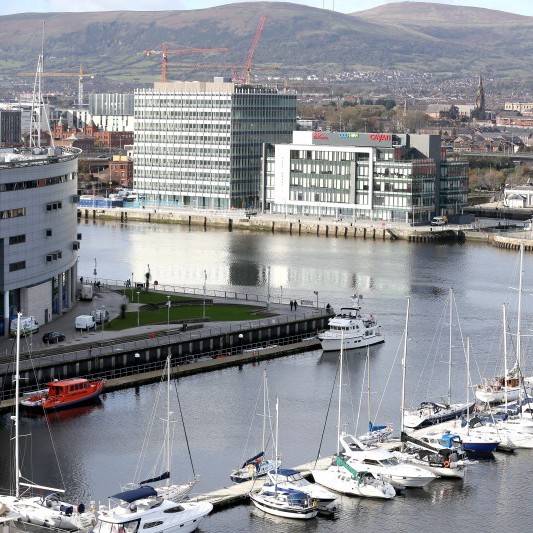
 The Northern Ireland office market had a record year in 2018, with a 100 percent increase in take-up, according to the latest figures from CBRE. The Northern Ireland (NI) office sector enjoyed its most successful year on record with 885,023 sq ft of take-up reported across 84 transactions, more than double that achieved last year. Notable office deals completed in 2018 included the PwC move to Merchant Square, Northern Ireland Civil Service at 9 Lanyon Place, Allstate at Mays Meadow, TLT at River House and Baker McKenzie at City Quays 2, which is part of Belfast’s City Quays mixed-use regeneration project. However, according to CBRE’s Real Estate Outlook report, the office market in NI is hampered by a severe lack of investment deals in the face of ongoing local, national and international political uncertainty. This means that while the real estate market in Northern Ireland generally has performed well in 2018, the investment sector experienced a decrease in activity as a resulting knock-on effect of the current political situation locally at Stormont as well as ongoing Brexit negotiations.



 The European property sector is predicted to grow next year, according to CBRE’s 2019 EMEA Market Outlook report. Although recent indicators suggest some slowing of momentum economic growth in Europe will remain above-trend rate in 2019 and 2020, with Spain, Ireland and the central European countries expected to see the fastest economic growth. France’s growth is expected to accelerate as recent economic reforms begin to pay off; however, UK growth is expected to remain below-trend, but with better long-term potential once the current uncertainty around Brexit passes. Office markets around the region are expected to see positive growth in leasing levels in 2019. However, major European cities, including Paris, Berlin, Stockholm and London, are expected to see lower levels of employment growth in office-using sectors.