







February 20, 2017
Digital workplace is ineffective without workers’ technical empowerment 0

Shifting digital dynamics are reshaping the way organisations operate and are recasting the traditional route to business success, claims new research into the rise of the digital workplace. Ricoh’s new report into digital workplace trends produced in partnership with polling company Censuswide, argues that the latest technology strategies are rendered useless without proper commitment to skills training and the empowerment of those workers who will be making use of it. It advises that businesses need to work on improving the workforce’s digital dexterity by creating an office culture fit for sharing ideas and skills across social, video and digital platforms. The report identifies digital skills training as a key differentiator for employees seeking a new job. Over a third of UK office workers (37 per cent) say they would move jobs to a company which offered better digital skills in the workplace. Likewise a modest 18 per cent of respondents rated their skills as ‘excellent’ whilst 51 per cent said ‘good’ and 30 per cent considered themselves ‘average.’

 The
The 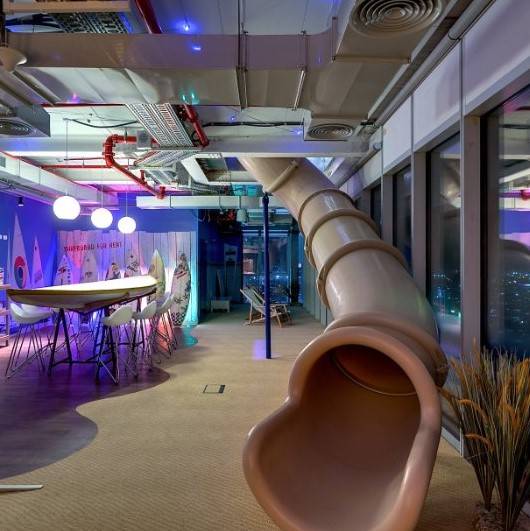
 The majority (79 percent) of workers say reliable and modern technology is more important to them than office aesthetics, while accessories such as ping pong tables, slides, hammocks and wacky office designs may look good in pictures, but they don’t necessarily make employees any happier or productive. The is according to a survey, conducted by storage firm Kiwi Movers, which found that 86 percent of UK adults who work in an office said fun features were of no specific value to their working life, 11 percent said they were nice-to-have and of some value and 3 percent said they were very valuable. The most popular office perks are those offer an immediate tangible benefit to the employee, but even so, as many as 23 percent don’t take advantage every day; while 71 percent overall said they’d like more space in their office and of those, 58 percent believe that could be achieved by removing non-essential items. The research also found that younger workers were more likely on average to take advantage of ‘environmental’ perks like chill out areas and recreational equipment.

 The more recent employment figures for London suggest that until the terms of Brexit are known and put in motion, the jobs market will remain cautious. This is according to the latest Morgan McKinley London Employment Monitor which found that despite an 81 percent increase in jobs available and an 83 percent increase in professionals seeking jobs; compared to a 115 percent increase in jobs this time last year, the 2017 spike was muted in comparison. The 83 percent increase in job seekers month-on-month is coupled with a 29 percent decrease, year-on-year. Contributing to the decrease is the trickling off of non-British EU nationals working in the City, who comprise up to 10 percent of its workforce. In a post-Brexit survey of professionals conducted by Morgan McKinley, these individuals reported either moving abroad, or considering leaving London because of Brexit.




 Amos Tversky and Daniel Kahneman introduced the concept of Loss Aversion in 1984, highlighting people’s tendency to strongly prefer avoiding losses to acquiring gains. Most studies suggest that losses are twice as powerful, psychologically, as gains. Lose £100 and we will feel a remorse that easily outweighs winning £100. In a similar fashion we find it very hard to see future positives when confronted with short term loses. We understand easily what we have lost but cannot imagine what there is to be gained. Furthermore, as Frederic Bastiat wrote in an 1850 paper, “That Which is Seen, and That Which is Not Seen”, man has a tendency to “pursue a small present good, which will be followed by a great evil to come, rather than a great good to come, at the risk of a small present evil”. Put these together and it is no wonder that, by and large, the future of work, corporate real estate and the workplace is so widely misunderstood.









February 10, 2017
Reflections on the future of work from a mirrored room 0
by Neil Usher • Comment, Facilities management, Technology, Workplace design
(more…)