Search Results for: organisations

How well designed office hives can foster swarm intelligence

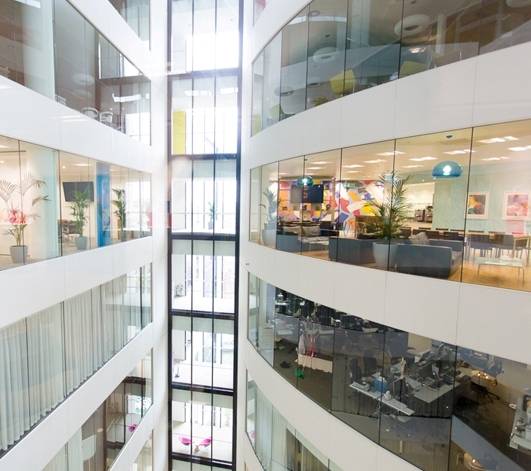
sourceimageA beehive in your back-garden is hardly ideal, nor is stumbling across an ants’ nest while searching for a picnic spot. However, these swarms have become the inspiration for a revolutionary new way of working. Swarm intelligence describes how a group of people find effective solutions to difficult problems and their ability to adapt automatically to changing environments and work as a team of equals. To get the full benefits of swarm intelligence, we need to make sure that our offices have areas where staff can collaborate. There can be no rigid structures or process chains that ideas have to go through. The flow of knowledge shouldn’t be restricted. It should be allowed to flood through our businesses and offices and take no account of whether the people sharing knowledge, ideas and opinions have been with a company for five days or five years.

(more…)

Employers need to do more to attract and train older workers says REC

Hiring older workersEmployers need to provide more training opportunities for older workers and how they advertise jobs to attract recruits over 55, according to the results of a survey issued by the Recruitment and Employment Confederation (REC). Asked to identify the most important change businesses should make to encourage applications from jobseekers aged 55 and over, almost four in ten (37%) respondents highlighted issues around advertising, while a third (34%) indicated that they should be providing more opportunities for older workers to upskill or reskill. Twenty percent said that businesses need to be more careful with language used in job adverts while 17 percent said that hirers need to look beyond posting jobs exclusively online. Evidence for the business case for retaining, retraining and recruiting older workers will be published by the Department for Work and Pensions in March.


(more…)

Firms are wary of BYOD but confident they can deliver flexible working

Invisible BYODDespite greater awareness of the potential benefits of Bring Your Own Device (BYOD), especially as a way of supporting flexible workers, a large number of European firms remain concerned about the security implications of the practice, according to a new study by HP of their attitudes to workplace technology. The study of 1,130 organisations in eight European countries found half believe that BYOD was likely to compromise their organisation and of those firms who had already implemented the practice, a fifth had experienced at least one security breach in the preceding year. In addition, fewer than half (43 percent) are confident that personal devices are properly secure, with a third (36 percent) expressing specific concerns about the contamination of networks with malware and viruses.

(more…)

Employers and fathers increasingly keen on shared parental leave

shared parental leaveOver three quarters of employers welcome shared parental leave despite concerns about its complexity and implementation and many are considering adapting their policies in light of new legislation set to be introduced in April, according to a report from Workingmums.co.uk. The survey of over 400 employers found that 81 percent welcomed shared parental leave, with 19 percent saying they would find it difficult to implement. The report coincides with new data from the Department for Business, Innovation and Skills which found that more than half of Britons (53 percent) believe that childcare should be divided equally between mothers and fathers with men more likely than women to back shared parenting with 56 per cent in favour, compared to 50 per cent of women.

(more…)

We all need to embrace the opportunities presented by BIM

contemporary-reception-desk-66059-2171731Described as ‘key to growth in the sector’ by chief construction adviser, Peter Hansford and increasingly recognised as a much more collaborative and efficient way of working, Building Information Modelling (BIM) continues to gather supporters from across the industry, yet there is a percentage of people who are still keeping their heads down and hoping it will all just go away. Maybe it’s the required element of investment or maybe it’s the small matter of change itself – always a difficult one for the construction industry – but there is still an amount of SMEs who are shrinking away from BIM, despite the fact that it is destined to become the established way.

(more…)

Three quarters of firms are now using or adopting BYOD practices

A new report by TechPro Research claims that just five years after it was first given the label, the practice of Bring Your Own Device (BYOD) is now so prevalent that nearly three quarters (74 percent) of organisations are either already using or planning to allow employees to bring their own devices to work. The report contrasts with past research into the uptake of BYOD to show how quickly the practice is developing and its implications for companies as a way of introducing new working practices and cutting costs (their own, natch) but also in the way they deal with the potential downsides relating to security and maintenance. The report also looks at the evolving role of the practice in light of new technologies such as wearable tech and the Internet of Things.

(more…)

CIPD claims 2015 should be a ‘rollover year’ for workplace productivity

workplace productivityThe UK labour market will continue to expand at a strong rate in 2015 but there are unresolved issues relating to levels of pay and how best to increase workplace productivity to drive further growth, according to Mark Beatson, chief economist for the Chartered Institute of Personnel and Development (CIPD) in a new report. While the report argues that the ongoing economic recovery and improvements in the labour market are good news for jobseekers and good news for businesses, it also considers it unlikely that we’ll see any real increase in wage growth until 2016. The author also warns that the UK’s steady growth remains vulnerable to developments in Europe and that the UK’s ‘workplace productivity puzzle’ is an urgent issue for policy makers and businesses to address in order to sustain growth.

(more…)

Majority of firms lack a coherent approach to employee engagement

Employee engagementIn spite of the fact that the overwhelming majority of employees worldwide are disengaged at work, most organisations still don’t think they take a strategic approach to the issue. A new study by technology consultancy Altimeter claims that just 41 percent of organisations believe they take a strategic approach to employee engagement, while only 43 percent believe they have an organisational culture of trust and empowerment with many unable to use technology as part of the solution. The authors of the report cite another study published by Gallup in 2013 which found that 87 percent of employees globally are engaged, rising to 70 percent in the US. The report is based on a study of 114 organisations but mirrors the findings of Deloitte in their report from earlier this year which studied 2,500 organisations and found the same mismatch.

(more…)

Only a third of staff trust their senior management, finds CIPD

Only a third of staff trust their senior management, finds CIPDThere is little evidence of improvement in the quality of management in the UK over the last decade – and it is one of the reasons behind the UK’s long-standing productivity weakness compared to the likes of the US and Germany. According to the CIPD report ‘Are UK organisations getting better at managing their people?’ while 65 percent of employees are generally satisfied with their line manager and largely trust them and value their honesty, only 33 percent say they trust their senior management. It found that management processes are not always applied consistently or fairly and this is one reason why there is a lack of trust in senior leadership. These are deep-rooted problems and the solutions are largely down to organisations, says the CIPD, which is urging the Government to consider ways in which it can raise awareness of the challenges and potential approaches to tackling them, not least in its capacity as an employer.

(more…)

Flexible working is best built on the foundations of a great office

flexible working loungeIt’s getting on for two years since Yahoo’s much talked about decision in 2013 to ban its staff from homeworking but, in many ways, the fallout has continued ever since. Certainly a lot of commentary on the subject refers back to CEO Marissa Mayer’s trend bucking decision. This can only be because it was a defining event in what is an enduring debate about where we work and what that means for a range of factors including our productivity, wellbeing, sense of belonging, access to information, the way we structure our time and our ability to communicate with and develop relationships with our fellow human beings. If those things were the same regardless of how and where we worked, there would be no discussion in the first place. But they do make a difference and there is a discussion.

(more…)

Wearable tech will change the workplace in unexpected ways

diceThe idea that we are all about to be supplanted by a new generation of artificially intelligent robot overlords has been in the news a great deal recently, partly as a result of Stephen Hawking’s recent pessimistic intervention on the subject. Whatever the truth of this apocalyptic musing, a more imminent generation of tech products means we are already testing the law of unintended consequences with regard to the stuff we create to help us. As technology firms clamber over each other in their attempts to be the first to open up the lucrative frontiers of wearable tech, a range of understandable concerns have been raised about some of the more obvious potential problems of security and privacy. But if we have learned one thing about our relationship with technology over many years, it is that whatever we expect from it will usually be wrong, sometimes spectacularly so.

(more…)

Can the workplace environment change an organisation’s culture?

Woolverine02 workplace It is rare that organisations are totally satisfied with their current culture. They will often see what can be improved and at the same time recognise that these improvements will inevitably stem from a change in behaviour or the attitude of their employees. What is important to remember is that a change in the design of the physical environment will not, by itself, change the culture of an organisation. But workplace design can reflect the desired culture of the organisation, and help to promote certain behaviours and attitudes. It can also help to reinforce the unique attributes of your organisation in a powerful, subliminal way. Culture results from the values and behaviours of employees and is best understood by the relationships internally between individuals, teams and departments. Culture can also be seen through relationships externally with customers, suppliers and stakeholders

(more…)