





Search Results for: pay ratio

Flexible working is a more important perk than nap time for employees 0

Google Nap RoomHeadline grabbing employee perks such as free catered lunches and massages; whether Google’s free nap times during the day or Netflix’s free unlimited holidays are all very well, but they are hardly the norm. Back in the real world, over half (61 percent) of people in the UK believe they don’t get near enough employee incentives at work. Yet, when losing and hiring employees is far more costly than keeping current employees happy and motivated – for instance, an Institute of Leadership & Management (ILM) study revealed that 17 percent of employees claimed they were looking for a new career due to feeling under-appreciated in their place of work – it might be wise to find out what employees really want. Workplace services supplier Direct365 did just that and discovered that workers want perks that they can relate to and enjoy, and which cater towards and take into consideration their individual needs. Unsurprisingly, flexible working is at the top of the list.

(more…)

While politicians squabble, here’s what the Budget meant for the workplace

While politicians squabble, here’s what the Budget meant for the workplace 0

Bash streetStrange as it may seem now, there was a Budget last week. We’d planned to produce a report on it once the dust had settled but given that whatever dust had originally been kicked up has now been swept away by a political storm, it’s only now we feel able to offer some perspective a few days out. As ever these days, the budget touched on a number of aspects of the workplace, sometimes hitting the mark and sometimes suggesting politicians don’t yet understand how people work. There was the usual stuff about rates and commercial property but also plenty to digest about the freelance economy, productivity, new technology, flexible working legislation and the current, often faltering attempts to develop wealth and infrastructure as well as the 21st Century creative and digital economy in places other than London. There’s plenty to digest here and plenty of people have already had their say, so a chance to grab a coffee and take all or some of it in.

(more…)

Many firms only hold on to paper documents for their signatures

Many firms only hold on to paper documents for their signatures 0

Paper stackWhile many people find it convenient to use paper as a medium for note taking and idea generation, the only reason many firms hold on to paper documents is to preserve the signatures on them. That is the key finding of a new survey from knowledge management trade association AIIM.  The study found that  56 percent of executives retain signed contracts and order forms and 31 percent agree their paper documents are around only for the signatures. Consumption of paper remains high in many firms, but less and less of it is actually retained. The research is published ahead of new regulations which come into force in the EU later this year which are designed to standardise and codify the practice of retaining e-signatures on business critical documents. However, AIIM remains sceptical that the eIDAS regulations which come into force this Summer  will quickly create a standard trust based form of e-signature.

(more…)

Fewer than ten percent of business processes will rely on paper by 2018

Fewer than ten percent of business processes will rely on paper by 2018 0

PaperlessA new report from Xerox suggests that the use of paper in business processes continues to fall away. The Digitisation at Work report claims that the move from paper to digital processes is nearly upon us although many of the 600 survey respondents admit they may not be ready for it. The report found concerns remain over paper-based processes, with cost (42 percent) and security (42 percent) cited as primary issues. Survey respondents predicted an average of nine percent of key business operation processes will run on paper in two years time. However, over half (55 percent) of the respondents admit their organisation’s processes are still largely or entirely paper-based and about a third (29 percent) are still communicating with customers via paper.This is despite the fact that 41 percent agree moving to digital workflows will cut organisational costs and 87 percent appear to have the skill sets available to make this happen.

(more…)

Smart Cities emerging rapidly in China due to increasing urbanisation

Smart Cities emerging rapidly in China due to increasing urbanisation 0

Hangzhou“Smart Cities” are emerging as a major force in China. According to a recent CoreNet Global report, China’s urban population surpassed that of the rural population in 2011 and it is estimated that by 2035 there will be more than 70 percent of the population living in urban areas.  That urbanisation is creating more pressure for China to leverage digital technology to create smarter cities, which are defined as metro areas that leverage digital technology and intelligent design to facilitate sustainability, along with high-quality living and high-paying jobs. Initially, there were several ‘beachhead’ cities that embraced Smart City initiatives such as Hangzhou (above), Chongqing and Chengdu. Subsequently, the China Central Government issued clear guidelines to roll out smart cities in a systematic and more widespread way. While smart cities are definitely on the long-term agenda for China’s strategic planning, their impact on corporate real estate and site location decisions remains to be determined.

(more…)

Three workplace performance indicators that may make or break you 0

Want to find out how your business is performing? Setting and analysing performance indicators for your company is the best way to forecast and get on track with your business goals. Creating Key Performance Indicators will help you measure your company’s success. While choosing the right KPIs relies upon a good understanding of what is important to the organisation and its workplace , the question is what to focus on? Performance measurement is not just related to collecting data associated with a predefined performance objective or standard. It has to be considered as an overall management system involving prevention and detection in order to meet clients expectations of the service or product you’re offering. Many companies have different methods regarding performance measurement, so how you measure performance says a lot about your company’s objectives and will decide whether they make or break you.

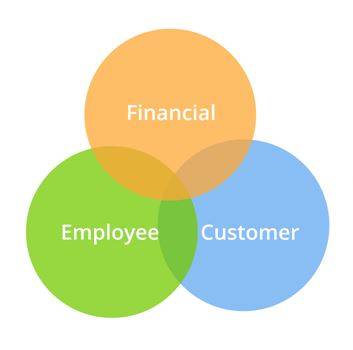
There are two common types of performance indicators: financial and customer focused.

Financial indicators are the most commonly used metrics for performance including: revenue growth rate, net profit, return on investment, among others. In terms of employee performance these are often quantified using output related measurements. These can be useful for growing your company’s finances but companies that focus solely on profit related indicators often face an innovation problem.

A focus on financial goals can put pressure on managers to focus on short term profitability over creativity. Financial indicators also don’t provide a full picture of a company’s performance. Rather than taking risks on new ideas, these companies can become known for creating ‘one hit wonders’ that sell and repackaging past successes. Eventually, quality and customer satisfaction can become compromised and employee motivation drops.

Microsoft learned this lesson at the expense of its top spot in the tech world. Originally a leader in cutting edge technology, after 2000 it began slipping in the rankings against companies like Google and Apple with its inability to keep up with new trends. As these companies began producing paradigm shifting products like the iPhone and Google Maps, Microsoft continued to survive off of its updated versions of Windows Office. Financial indicators demonstrated the company’s shift in popularity but not the contributing factors.

Internally, Microsoft had taken a cut throat approach to performance management called stack ranking. In this system employees were ranked according to their performance, with the top being put in line for promotions and the bottom 5-10% being shown the door. Rather than boosting productivity, this system merely increased competition and discouraged teamwork. Ultimately, instead of being encouraged to collaborate on new ideas, employees had to focus on gaining favor to survive.

Customer success indicators are increasingly seen as the most important performance metric. Some of the main customer centred KPIs include: conversion rate, customer retention, Net Promoter Score (NPS), etc. Due to differing objectives, companies that focus on customer centred indicators focus more on gaining a loyal customer base by producing great quality products, utilizing different marketing techniques and emphasizing a strong customer support service.

CaptureAn example of this is Riot Games’ ‘Free To Play’ games which helped them to gain a loyal customer base by allowing gamers to play some of their best games for free online. Zappos’ customer service is famous for providing unsatisfied customers with gifts and free shoes to improve their customer experience. Creating a customer service culture is an essential part of their business strategy and the focus of CEO Tony Hsieh’s book Delivering Happiness.

However, for companies that don’t take off straight away, the money and time put into each product can lead to slower profit generation and financial instability. Furthermore, while customer satisfaction is an extremely important key to success, what customers ultimately want are state-of-the-art products. Though customer focused indicators can help you build a loyal client base, they do not necessarily solve a company’s innovation problems.

Companies should use a combination of both financial and customer focused indicators but there is a third key measurement which is essential to meeting your company’s goals.

Why employee centered indicators are so important

More and more companies are beginning to realize the importance of employee centered metrics. These types of indicators include: employee engagement, satisfaction and turnover.

Studies show that higher employee engagement is linked to higher customer satisfaction. When employees are happy at work and believe in their product/company this comes across to customers. Gallup revealed that companies with high employee engagement levels outperformed companies with lower levels of engagement in customer ratings by 10%.

Engaged employees take less sick days. A study by Workplace Research Foundation found that engaged employees take an average of 2.69 sick days annually compared to disengaged employees who take an average of 6.19 days. Most important, they’re motivated to achieve more. Gallup’s study also showed that engaged companies outperform others in productivity by 21% and profitability by 22%.

In fact, the treatment of employees is also an important factor for consumers. Deloitte’s 2015 study on millennials revealed that this generation considers the treatment of employees as the top characteristic of industry leaders, even over profit generation and impact on overall society. Furthermore, “While they believe the pursuit of profit is important, that pursuit needs to be accompanied by a sense of purpose, by efforts to create innovative products or services and, above all, by consideration of individuals as employees and members of society.”

Companies that have employee centered strategies are also more likely to foster innovative environments that promote autonomy and employee ownership. Atlassian became famous for its ‘Shipit’ days during which it actually encourages employees to drop their work and spend twenty-four hours on a creative project of their choice. Allowing employees the freedom to try out new ideas sounds like a great financial risk but it turned out to have great returns. The projects developed during these sessions have resulted in some of the company’s most profit generating products. Atlassian not only dominates Australia’s tech industry, it has also been named the best company to work for the past two years in a row.

More and more companies have started focusing on an employee first strategy: In an interview with Inc. Virgin Atlantic CEO Richard Branson disclosed that the company puts staff first, customers second and stakeholders third. He explains, “If the person who works at your company is not appreciated, they are not going to do things with a smile.” Southwest Airlines, the company consistently reaching the top 10 in employee and customer satisfaction surveys, follows the same ideology. The company does this by motivating employees through its company values and creating an environment that regularly recognizes employees for going above and beyond.

Southwest Airlines follows the same strategy. Founder Herb Kelleher posited, “A motivated employee treats the customer well. A customer is happy so they’ll keep coming back, which pleases the shareholder. It’s just the way it works… They can buy all the physical things. The things you can’t buy are dedication, devotion, loyalty—the feeling that you are participating in a crusade.”

Belief in a corporate wellness narrative is more important than action

Belief in a corporate wellness narrative is more important than action 0

Millais_Boyhood_of_RaleighThe complexities of wellness at work are laid bare in a new report from the US based pressure group Global Wellness Institute. The most eye-catching conclusion from The Future of Wellness at Work study is that it’s not actual wellness programmes that do most to boost worker health and productivity, but whether employees identify that company as ‘caring’. The report claims that ‘unwellness’ now costs the US around $2.2 trillion each year, equivalent to 12 percent of GDP.  The report is published alongside a white paper which lays out the findings from a survey of American employees. Unlocking the Power of Company Caring gauges how employees feel about their work culture and wellness programmes. The main finding of the two reports is that to understand what has the most powerful impact on employee wellness ‘you must look well beyond the wellness programme’ itself. Instead, the pivotal factor is whether an employee identifies their company as caring about their health and wellness.

(more…)

UK in bottom four of European countries for workplace benefits

UK in bottom four of European countries for workplace benefits 0

UK economySocial benefits for people in the workplace in Europe are generally far more generous than in the US, but the UK is in the bottom four overall taking into account factors such as maternity and paternity leave, general parental leave, paid holiday allowance, paid sick leave and unemployment benefits. Only the Swiss, the Irish and the Americans have a more frugal government policy. According to a report by Glassdoor of 14 key European neighbouring economies, conducted in cooperation with Llewellyn Consulting, the countries offering the most generous workplace and welfare benefits overall are Denmark, France and Spain. In terms of paid annual leave, Sweden, France and Denmark all offer 25 working days a year as minimum –the highest entitlement. The UK is bunched towards the bottom again with the likes of Italy, Greece, Germany, Portugal and Switzerland – all offering the minimum 20 days.

(more…)

Government needs to play catch up with needs of the self-employed

Government needs to play catch up with needs of the self-employed 0

self employmentPoliticians and legislators are failing to keep pace with the changing nature of work and as a result many of the UK’s growing army of freelancers feel like second class citizens. That is the key finding of a new report commissioned by the Government and authored by entrepreneur Julie Deane. She claims that the Government should do more to bring the self-employed into line with legislation affecting the wider working population, including access to higher rates of parental leave and pay. The report sets out ten key recommendations, notably that the parental allowance should be brought into line with the rules for employees, who are paid a higher portion of their salary for the first six weeks of statutory maternity pay before the percentage drops. It also suggests that the education system should do more to prepare young people for a changing world of work and that more should be done to offer a choice of workplaces for the self-employed..

(more…)

Embracing the inevitable rise of the robots in the workplace

Embracing the inevitable rise of the robots in the workplace 0

387773-computers-circuit-board-hdWe often have reason these days to speculate on the truth of an idea known as Amara’s Law. First coined by the researcher Roy Amara it states that “we tend to overestimate the effect of a technology in the short run and underestimate the effect in the long run”. But defining what we mean by short and long term can be very difficult when technology is changing so quickly. Nothing better illustrates this than the issue of how automation will transform society and workplaces. For the past few years, the effects have mainly been the subject of academic and scientific research alongside some lurid headlines in the mainstream media. So, a fairly typical 2013 paper from researchers at Oxford University assessed the risk faced by over 700 professions and discovered that nearly half of all jobs in the US could be categorised as at high risk of automation. Less academic studies such as a report published last year by Deloitte draw similar conclusions.

(more…)

Government plans to cut size of estate by 75 percent by 2023

Government plans to cut size of estate by 75 percent by 2023 0

Old_War_Office_Building_London_MOD_45137377The UK Government has today published the latest edition of its annual State of the Estate report, which gives an update on plans to consolidate, divest and modernise the central government property portfolio. Minister for the Cabinet Office Matt Hancock claims that the current administration has reduced the size of the estate by 2.4 million sq. m. since 2010. (As is the way of these things, the minister claims this is equivalent to 336football pitches, 43 Shards or more than the entire principality of Monaco. Presumably individual departments measured their own successes in blue whales and double decker buses.)  He claims that this means that the total central government estate has fallen below 5,000 holdings for the first time and could fit inside the area of West Finchley (which is a new measurement on us). The reduction has been achieved by selling property ranging from the historic Old War Office (top) to an old bakery and lighthouse.

(more…)

Delivering the low-down on the sit-stand workstation phenomenon

Delivering the low-down on the sit-stand workstation phenomenon 0

Kinnarps-sit-standWhile the UK, US, Australia and other nations continue to treat them as something of a novelty, across Sweden, Norway and Finland, over 80 per cent of office workers use sit-stand desks. Offering employees a height adjustable work station is now mandatory in Denmark. However, sit-stand working is still in its infancy in the UK, with only 2 per cent of similar workers having access to variable-height workstations.  Given the huge amount of news coverage devoted to the subject of sedentary lifestyles in the last couple of years, ‘sit-stand’ and ‘active working’ have become buzz terms in UK workplace design. The ‘On Your Feet Britain’* campaign has raised awareness of the health perils risked by the many Brits who spend an average of 8.5 hours a day sitting, whether at their desk or slumped in front of the telly.  Inevitably, savvy employers will be asking themselves if they can afford to ignore the problem.

(more…)