Search Results for: people

Children are much more comfortable about the idea of working with robots

Children are much more comfortable about the idea of working with robots

A new poll from measurement tech firm Hexagon suggests that younger people have very different ideas to older generations about the idea of working with robots.A new poll from measurement tech firm Hexagon suggests that younger people have very different ideas to older generations about the idea of working with robots. According to the report, across nine countries, children are growing up with fundamentally different expectations of robotics than today’s adults, shaped by growing up with AI and new experiences of intelligent technology. Four in five children (80 percent) say they are excited about robots, compared with 59 percent of adults. However, that generation gap varies dramatically around the world. (more…)



The hidden cost of a poorly planned office relocation

The hidden cost of a poorly planned office relocation

Ask anyone who has managed a poorly executed office move and they will describe it in similar terms: it took longer than expected, disrupted more than it should have, and the final cost bore little resemblance to the original estimate. What tends to be harder to quantify — but is often the most significant expense — is the productivity lost during and after the move. Office relocations are among the most disruptive events in the working life of an organisation. When they go well, barely anyone notices. When they go badly, the effects ripple through the business for weeks. (more…)

Men face greater career penalty for working from home, study finds

Men face greater career penalty for working from home, study finds

Men working from home for most of the week may face a greater career penalty than women when being considered for jobs and promotions, according to new research into attitudes towards remote workers in the UK and Germany.Men working from home for most of the week may face a greater career penalty than women when being considered for jobs and promotions, according to new research into attitudes towards remote workers in the UK and Germany. The study found that people described as working from home were rated less favourably than otherwise comparable office-based workers, with the penalty increasing significantly for those working remotely three or four days a week rather than one or two. Fathers and workers without children generally experienced larger declines in their ratings than mothers. However, the researchers cautioned that this should not be interpreted as an advantage for mothers. In the UK, mothers already received relatively low ratings when candidates were described as working entirely in the office. The research, led by King’s Business School at King’s College London, analysed almost 13,000 assessments made by around 5,300 employed people in the UK and Germany. (more…)

Rethinking office space: can phone booths cut costs and free up meeting rooms?

Rethinking office space: can phone booths cut costs and free up meeting rooms?

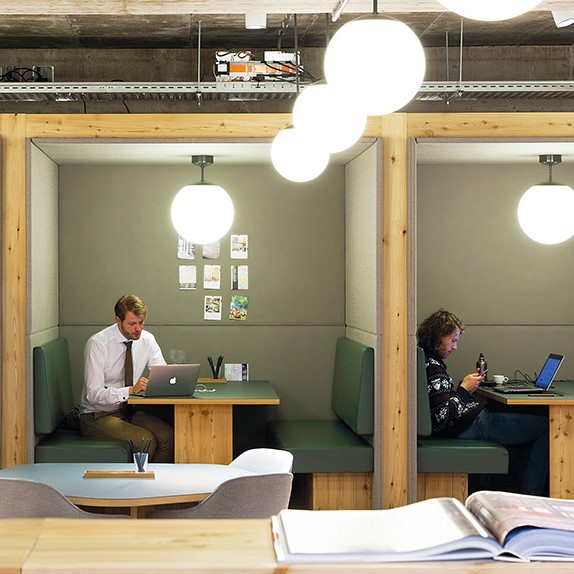
Acoustic office phone booths like those designed by MEAVO, give every type of conversation a home of its own, creating calm, private spaces exactly where people need them.The hybrid office has found its rhythm. Teams come together on their anchor days to collaborate, share ideas and meet clients, then spend the rest of the week wherever they work best. It is a model that suits people well, and it is encouraging organisations to take a fresh look at how every part of their office is used. Meeting rooms are a natural place to start. On busy days they are in high demand, often for activities that need far less space: a solo video call, a quick one-to-one, an hour of focused work away from the buzz of the open floor. The good news is that there is a simple, flexible way to create more of the right kind of space. Acoustic office pods like those designed by MEAVO, give every type of conversation a home of its own, creating calm, private spaces exactly where people need them. (more…)

Hybrid working could deliver productivity gains from staff retention alone, report claims

Hybrid working could deliver productivity gains from staff retention alone, report claims

Hybrid working could deliver significant productivity gains by helping organisations retain employees, recruit from a wider talent pool and preserve institutional knowledge, according to new economic modelling from International Workplace Group (IWG) and Arup. The analysis estimates that improved employee retention associated with more flexible working practices could be worth $204.7 billion to the US economy and £10.8 billion to the UK over five years. Retention represents the largest potential source of productivity gains identified by the modelling. (more…)

The AI utilisation gap: why employees use AI more deeply at home than at work

The AI utilisation gap: why employees use AI more deeply at home than at work

While AI is becoming embedded in how people search, learn, create and organise their personal lives, its use at work remains comparatively limitedArtificial intelligence has crossed an important threshold. For most people, it is no longer a technology they are experimenting with occasionally; it is increasingly becoming part of everyday life. According to the 2026 annual WIN World AI Index, based on approximately 40,000 respondents across 44 countries, global AI adoption has risen to 74 percent up from 62 percent a year earlier. More significantly, 39 percent of people now intentionally use AI ‘often’ or ‘every day,’ representing a substantial shift from experimentation to actual habit. (more…)

The right workplace culture can enhance trust, creativity and performance, report claims

The right workplace culture can enhance trust, creativity and performance, report claims

Workplace culture can have a significant impact on employees’ capacity to adapt to change and innovate, according to new pollingWorkplace culture can have a significant impact on employees’ capacity to adapt to change and innovate, according to new polling from O.C. Tanner, which argues that organisations should pay greater attention to compassion, employee development and trust. The firm’s 2027 Global Culture Report, based on data gathered from more than 25,000 workers in 23 countries, claims that organisational culture can act as an “amplifier”, either exacerbating uncertainty and burnout or strengthening employees’ sense of trust, connection and purpose. (more…)

Health insurance renewal: why you should review before you renew

Health insurance renewal: why you should review before you renew

The renewal notice for your business health insurance arrives. The premium is up, as it usually is. You approve it, the policy rolls over, and you move on to the next thing on the list. For most businesses, that is the entire renewal process. And in most cases, it is leaving money on the table. The business health insurance market is not static. Insurers reprice their books every year. New products come to market. Competitors adjust their terms to win business. The gap between what a business is paying on an auto-renewed policy and what it could be paying on a properly reviewed one is often significant, and it widens every year the review does not happen. This guide covers what a proper renewal review involves, what to look at, what questions to ask your broker or insurer, and why it is worth treating renewal as an active decision rather than an annual formality. (more…)

Before trying to work out whether AI can be conscious, we need to work out what consciousness is

Before trying to work out whether AI can be conscious, we need to work out what consciousness is

The conversation about whether AI is conscious or not has a problem it usually fails to acknowledge. And it’s this. We don’t know what consciousness is.For those keeping up with the conversations about AI, beyond the hour-by-hour flip flopping about whether it will create hell or heaven on Earth, all driven by the hype merchants behind it and their critics, the most vigorous seems to be about whether AI is conscious or not. Now this is worth addressing, of course, but the entire conversation has a problem it usually fails to acknowledge. And it’s this. We don’t know what consciousness is. (more…)

Over-reliance on Gen-AI may weaken moral insights, understanding, and know-how

Over-reliance on Gen-AI may weaken moral insights, understanding, and know-how

Generative artificial intelligence (Gen-AI) has become a routine part of working life but over-reliance on the technology may erode managers’ ability to build moral insights, contextual understanding and know-how to do get a job done, according to a new study from the University of Bath.Generative artificial intelligence (Gen-AI) has become a routine part of working life but over-reliance on the technology may erode managers’ ability to build moral insights, contextual understanding and know-how to do get a job done, according to a new study from the University of Bath. The research, published in the Academy of Management Review, explores how tools such as ChatGPT may affect what academics call “managerial phronesis” – the practical wisdom managers develop through real-world experience, reflection and human interaction. (more…)

Your office may be busy, but is it working?

Your office may be busy, but is it working?

Hybrid work has turned office attendance into one of the most watched numbers in the workplace. It is easy to understand why. A booking can be counted. A badge swipe can be counted. A sensor can count bodies in a room. When leaders are making expensive decisions about leases, policy and design, those numbers feel reassuringly solid. The problem is not that the data is wrong. The problem is that we keep asking it to answer a question it cannot answer.

A reservation tells us that somebody intended to come in. A swipe tells us that somebody crossed a doorway. A sensor tells us that a body occupied a zone at a point in time. None of those signals tells us whether the person found the colleague they came to see, whether the room supported the meeting, whether the noise level made concentration impossible, or whether the journey was worth making. That distinction matters because attendance is increasingly being treated as a proxy for workplace performance. It is not. At best, it is the beginning of the measurement chain.

Workplace teams often combine three different layers of evidence as if they were interchangeable. The first is intent, usually captured by a reservation or schedule. The second is presence, captured through access control, Wi-Fi, sensors or observation. The third is outcome: whether the office supported the work people needed to do. Each layer is useful. The mistake is assuming that one proves the next. A booked desk may be a no-show. A badge swipe may represent a short visit. A busy floor can still be a poor place to concentrate. A full meeting room can host a meeting that should have been an email. Measurement becomes more credible when the layers are connected, but the gaps remain visible.

Current US federal guidance is surprisingly clear about this. The General Services Administration describes multiple occupancy methods and notes their limitations. Reservation data can contribute to occupancy reporting, but becomes more useful when combined with turnstile or sensor data. Visual analysis can reveal patterns and valued amenities, but does not capture absolute occupancy. Timecard analysis can infer presence, but is not fully accurate. The practical message is simple: every source sees only part of the workplace.


A crowded office can still be underperforming

Imagine a company with a crowded Tuesday. The dashboard looks healthy. Yet half the people on that floor are on individual video calls, the project team that wanted to work together is scattered across three zones, and two groups are searching for rooms because the ones shown as available are occupied. Attendance is high. The workplace experience is poor.

The reverse can also be true. A quieter floor may be doing exactly what the organization needs. A small group may be using a project room for focused work that unlocks a decision. A new employee may be spending time with a manager. A client workshop may occupy a small portion of the building while creating disproportionate value. Low density does not automatically mean low usefulness.

This is why the language of utilization can become dangerous. It sounds like a verdict, when it is usually a description. It tells us how much of a resource was occupied, not whether the resource supported a valuable result.


Measure the office as part of the work system

A better approach starts by treating the office as part of the work system, not simply a container for employees. The useful questions are more specific. What did people come in to do? Did they have access to the people, spaces and tools that work required? Where did friction appear? What conditions made them more or less likely to return for the same kind of work?

This does not require turning workplace measurement into an endless survey programme. It does require joining operational data with experience evidence. Bookings and presence can show patterns. Short pulse questions, service requests, room conflicts and team-level observations can explain those patterns. The goal is not a single perfect score. It is a chain of evidence that is strong enough to support a decision.

Leesman’s research makes the same broader point from a different direction. Its hybrid-work studies argue that there is no universal recipe and that employee requirements, circumstances and concerns have to be understood. Its more recent work on the power of place focuses on whether the office actually supports experience and performance. Counting attendance without that context reduces a complex workplace to a turnstile.

There is a management implication here too. If an attendance target becomes the headline measure, people will optimize for attendance. They will show up on the required day, book the desk and cross the threshold. If the real aim is connection, learning, collaboration or client work, leaders need to state that aim and measure it more directly.


The number should lead to a better question

Occupancy data is valuable. It can expose peak days, empty zones, room shortages and mismatches between supply and demand. It can help workplace teams test a change instead of arguing from instinct. But it should trigger investigation, not end it.

The next time a dashboard shows that the office was busy, the most useful response is not celebration or alarm. It is curiosity. Busy doing what? Supported by which spaces? Frustrated by what? And would the people who came in choose the same setting again for the same work?

Those questions are harder to fit into a monthly executive scorecard. They are also much closer to the decision leaders believe they are making.

The office furniture price on the page has always been an opening bid

The office furniture price on the page has always been an opening bid

The published prices of office furniture are there to start a conversation, they don't mean anythingAsk anyone who has worked in office furniture what the list price is for and they will pause before answering, because the honest answer is embarrassing. The list price is the number the trade agrees not to charge. It exists so there is something to discount from. The mechanism is simple. A manufacturer publishes a recommended price. A dealer buys at a trade price a long way below it. The dealer then sells to the end customer at whatever point between the two the conversation lands. Where it lands depends on the customer: how large they are, how many desks they sound as though they might need one day, whether they have a competing quote in their hand, whether they mention a framework, and, more than anything, whether they know the game is on. The buyer who asks for a discount gets one. The buyer who does not ask pays the number on the page. (more…)