








August 10, 2016
Poor tech and long meetings remain key sources of workplace misery 0
 Badly run and overrunning meetings remain amongst the main sources of workplace conflict and unhappiness, according to a study of 1,000 US employees from workplace software provider Eventboard. The main sources of this conflict appears to be the number of meetings that overrun and poor technology, claims the report. More than half (56 percent) of frontline employees spend 1-2 hours in meetings daily and three-quarters (75 percent) of senior and mid-management level employees spend 3-4 hours in meetings daily. The report also highlights the inadequate provision of workplace technology even though the tools people use are seen as essential for their happiness and productivity. More than half of respondents claim they have to supplement the technology they are given by their employer with their own devices, even though technology can be twice as important as other perks in terms of making people happy and productive.

 We’re operating in an increasingly tech-centric environment, but human talent still remains one of the core differentiators if a business is to thrive. Not surprisingly, the mission to get the very best people on board and optimise the potential of those already in situ has become the Holy Grail for many companies, irrespective of scale and sector – a challenge that demands a more intuitive and precise, even scientific approach to human capital management. Data analytics is a case in point, designed to extrapolate insight from intelligence across a variety of disparate sources and establish actionable intelligence, capabilities which naturally lend themselves to powering key decisions around hiring and retention and building on existing talent. Yet despite the proliferation of analytics across many strands of the workplace, take up in the HR sphere remains relatively modest, in tandem with a long-held reticence over the use of the technology in this area.

 Fifteen million UK internet users have undertaken a ‘digital detox’ in a bid to strike a healthier balance between technology and life beyond the screen, according to a new Ofcom study. The study of around 2,500 people suggests that our reliance on the internet is affecting people’s personal and working lives, leading many to seek time away from the web to spend time with friends and family. Ofcom’s
 New research from AXA suggests that small firms are sceptical about the prospects of technologies such as 3D printing, robotics and driverless cars affecting their workplace in the near future. While more than 40 per cent of small businesses still don’t have a website, the study of 898 firms claims that most of these plan to move online in the next twelve months. If these plans are fulfilled, only seven per cent of UK businesses will remain offline by this time next year. However, just one in five plan to migrate to the Cloud and only six per cent say they expect to adopt smart technologies. Driverless cars, which are set to hit UK roads as early as 2020, have an equally low resonance, as just eight per cent of business owners expect they will travel in one. Businesses were also highly sceptical when it comes to 3D printing. Just two per cent of UK businesses who might use the process expect to see it used here ‘during their lifetimes’.
 The changing energy demands of British cities are revealed in
 Two of the most persistent and related structural problems facing the UK economy are the productivity and digital skills gaps. Earlier this month, the Office for National Statistics reported that there had been a further 1.2 percent fall in productivity. Part of the reason for this is that there is an underlying digital skills gap. According to a report from Barclays, nearly a third (31 percent) of working-age adults in the UK lack even basic digital problem-solving skills which places the country comfortably below the 37 percent average across OECD countries. Despite this, a mere 38 percent of UK employers offer their workers digital skills training, perhaps because on the other side of the coin, the UK ranks highly in what the report calls ‘digital empowerment’, which it defines as ‘the ability and desire to use one’s digital skills to work productively and creatively, and to have the opportunity to continually upgrade them to keep pace with changing technology’.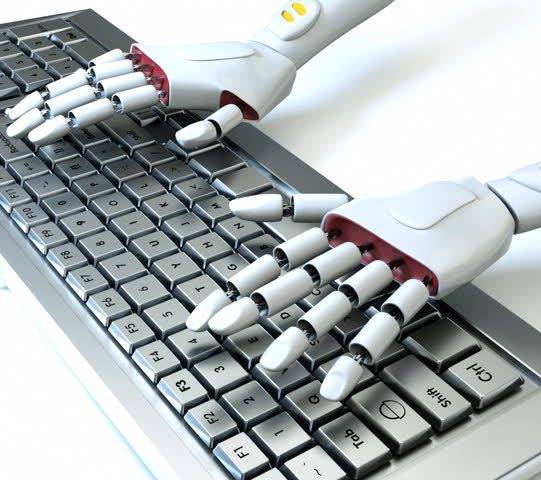
 Businesses are ready to embrace the new era of robot workers, automation and artificial intelligence, according to a new report.











August 8, 2016
Universal basic income is an idea whose time has come at last 0
by Mark Eltringham • Comment, Flexible working, Technology, Wellbeing
(more…)