Search Results for: employer

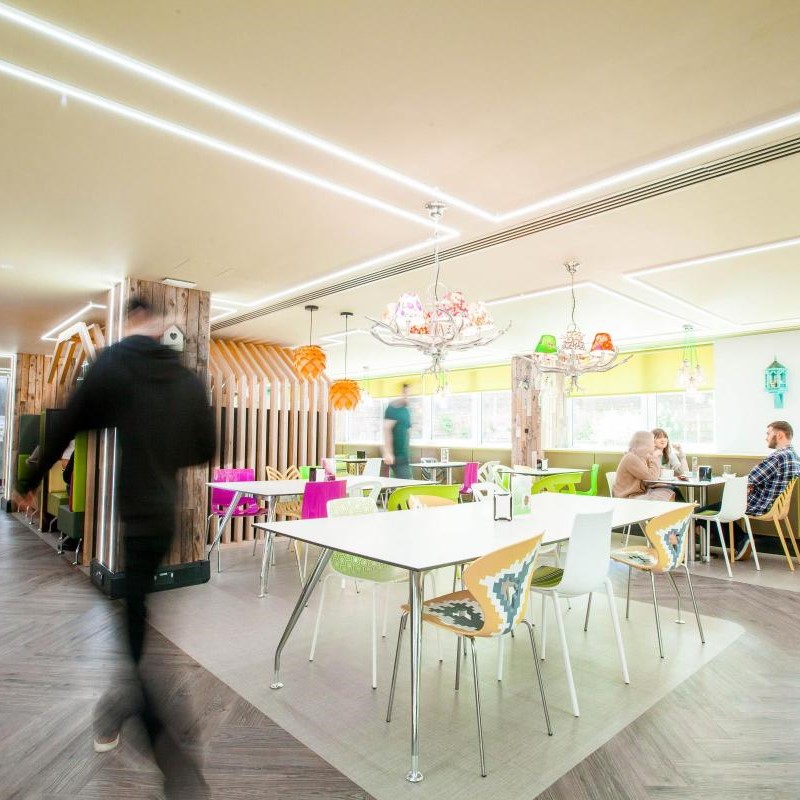
Interiors are not enough to win the war for talent

Interiors are not enough to win the war for talent

I often refer to Google and Facebook in my blog, due to their influence on workplace design. Many consider them to be workplace interior’s holy grail. But today’s big employers are competing with one another on a much broader set of principles. Cool interiors alone just won’t cut it. Zürich, like many European cities is home to a large number of global brands, with bustling financial services and tech sectors. I regularly hear of people with multiple job offers taking a job with a lower salary, rather than accepting a role in a company that doesn’t reflect their ideals. This decision can be influenced by office design and facilities, career development options, corporate culture and much more. (more…)

Digital workplace pioneered by medium sized businesses, study claims

Digital workplace pioneered by medium sized businesses, study claims

Medium-sized businesses now account for over 60 percent of US jobs, and are investing fast in technology. However, with digital now a priority for businesses of all sizes, they must ensure they have the necessary skills and security management in place to handle the change, or risk falling behind competitors according to a new report from Aruba. (more…)

Feeling appreciated and the quality of workplace both key to employee happiness

Feeling appreciated and the quality of workplace both key to employee happiness

The quality of the workplace has a powerful effect on the levels of happiness of staff, with nearly half of respondents (49 percent) to a recent survey stating that having a great office environment is important to their happiness at work, but according to the figures, only a quarter (25 percent) say a good workplace environment is a current positive about their work. The survey from Peldon Rose also found that less than half (45 percent) of employees actually feel appreciated at work and only two-thirds (67 percent) report feeling happy. Yet the majority of workers (80 percent) who took part, believe that feeling appreciated is most important to their happiness at work – ahead of salary (58 percent) and feeling trusted (55 percent).

(more…)

RNIB launches new focus for Disability Confident scheme

RNIB launches new focus for Disability Confident scheme

The Royal National Institute of Blind People (RNIB) has launched a new suite of resources that will help employers support blind and partially sighted people in the workplace. The resources have been created as part of the DWP’s Disability Confident scheme, the nationally-recognised Government accreditation that supports businesses to attract, recruit and retain disabled employees.

(more…)

What a 90 year old study teaches us about flexible working and productivity

What a 90 year old study teaches us about flexible working and productivity 0

uncertainty Flexible working has developed a reputation as something of a silver bullet for a range of workplace challenges. It is the perceived solution to almost any of the major workplace problems you care to mention, including the gender pay gap, work life balance, churn, property costs, staff engagement, personal autonomy, stress, physical wellbeing, productivity and – of course – as a way of meeting the needs of those alien beings we refer to as Millennials. There is some truth in all of this, as we have known for some time, but things are far more complicated than often presented.

(more…)

People often feel as if they are kept in the dark about flexible working

People often feel as if they are kept in the dark about flexible working

New research from LinkedIn (registration) claims that a third (36 percent) of UK professionals believe their employer does not do enough to support new parents. The release of the figures comes as LinkedIn claims that 18th March was the day that working families only just start getting paid for the year, once growing childcare costs are taken into account. The survey of 4,000 UK workers suggests that professionals feel they are being left in the dark when it comes to parental policies, with a third (37 percent) not even aware of what support their workplace provides for new parents. (more…)

Demotivated workers would be driven by higher pay and more flexibility

Demotivated workers would be driven by higher pay and more flexibility

Almost a third (31 percent) of UK professionals state that their expectations are ‘not being met at all’ by their current employer, whilst a further 24 percent state that their needs are only just ‘moderately’ being met. The findings, which come from research undertaken by recruiter Robert Walters and job board CV-Library – also suggest that while the amount they were paid was most important to staff, other benefits are increasingly playing a more prominent role in keeping staff motivated. Well over half (61 percent) claimed that work-life balance, flexible working hours (39 percent), and cultural fit (25 percent) are crucial to keeping them happy at work. (more…)

Pressing self-destruct, a final solution to workplace noise, a broken psychological contract and some other stuff

Pressing self-destruct, a final solution to workplace noise, a broken psychological contract and some other stuff

I’ve never really wanted to go to MIPIM. I’m suspicious of it all for a number of reasons I won’t go into although you might reasonably guess what they are. So, I enjoyed this piece from Polly Plunket-Checkemian about her own misgivings. I understand that the testosterone level has been dialled down recently, but like Polly I’d like to see a re-examination of its format and intent, especially given that the real estate sector is having to rethink where it fits into the new era of work and meets the challenge of coworking.

(more…)

Greatest motivator for employees is more recognition, whether monetary or not

Greatest motivator for employees is more recognition, whether monetary or not

Job recognition most important factor for employee motivation

The biggest motivator for staff at work is more recognition, whether monetary or not, according to a new survey on rewards at work by XpertHR. When asked which rewards are most important to employees, more than half (53 percent) said higher basic pay, followed by a wider range of benefits (37.1 percent), but being recognised for the work they do was also cited as an employee priority by 56.1 percent of respondents). The survey also claims that employers are facing a constant battle to get employees’ salaries at the right level. Almost all (97.7 percent) organisations questioned said they would be looking at salary levels in some way over the coming year – whether that be through the annual pay review, benchmarking salaries against the market or complying with the national minimum wage legislation.

(more…)

When exactly did busyness become a sign of status?

When exactly did busyness become a sign of status?

When exactly did “busyness” become a status? At work, in our personal lives and online, the competition to “live our best lives” and “hustle harder” is being taken to the extreme. Neuroscientists refer to busyness as a state of “cognitive overload.” This state can hinder our productivity, as well as our abilities to think clearly, plan and control our emotions. In the early 1990s, John Maynard Keynes predicted that, by 2028, living conditions would improve so much that the working day would shrink to three or four hours. However, it is now 2019 and we are busier than ever.

(more…)

How artificial intelligence changes occupant experience

How artificial intelligence changes occupant experience

If a robot received a signal that you had entered the building, it might bring you a fresh cup of coffee just as you reach your desk. If the front door recognised your face, it might unlock itself for you without requiring you to use a fob to gain access. If your desk knew you had left for the day, it might offer itself to a colleague who is looking for a quiet workspace. Throughout history, the interaction of humans with technology has been pretty much one-sided. We turn our technologies on and off, operate and guide them in their tasks, and use our senses to monitor their functioning and detect anomalies.

(more…)

Great Big Workplace Adjustments survey needs your input

Great Big Workplace Adjustments survey needs your input

A leading not-for-profit business and disability organisation is asking employees and managers to share their experiences of requesting and arranging workplace adjustments via an anonymous online survey. Business Disability Forum wants to use ‘The Great Big Adjustments Survey’ to create a clear and up-to-date picture of what works and what doesn’t work when it comes to making and managing adjustments. The membership organisation will use the findings to develop what it hopes will be one of the most informed pieces of research on the topic, ever created. (more…)