Search Results for: workplace

Majority of American workers are unhappy in their jobs

Majority of American workers are unhappy in their jobs

American workers are unhappyAlthough more people are in work in the US than at any time in the past 50 years, only 40 percent of American workers say that they work in good jobs, according to a new study (registration) from the Lumina Foundation, the Bill & Melinda Gates FoundationOmidyar Network, and Gallup.  The report claims that 44 percent of workers surveyed said they had “mediocre” jobs while 16 percent said they were in “bad” jobs. (more…)

Over 50s account for total five year increase in night working

Over 50s account for total five year increase in night working

over 50s dominate increase in night workforceThe number of people regularly working night shifts is at its highest level since the Office for National Statistics began collecting records in their current form, according to a new analysis from the TUC. The analysis of official data shows that 3.25 million people (more than 1 in 9 workers) work in Britain’s night-time economy – 100,000 more than five years ago. While the number of over 50s doing night work has accelerated in recent years, fewer young workers are doing night shifts. (more…)

Fine tuning office design and its most wonderful invention to our needs

Fine tuning office design and its most wonderful invention to our needs

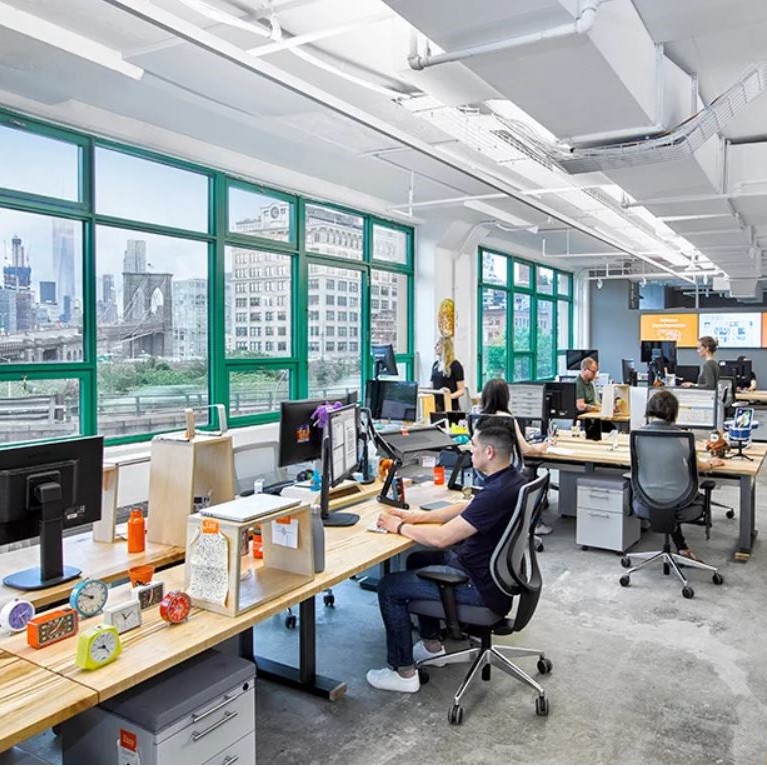
The best workplaces are always focused on people. Which is why many of the great pioneers of workplace thinking are from the social sciences, including disciplines such as psychology, ethnography and anthropology. These are the people who have shared the insights that help us to understand the characteristics of great office design. In particular, this relies on an awareness of the ways in which people interact in particular spaces. (more…)

How office design trends in different countries feed off each other

How office design trends in different countries feed off each other

The term Global Village has passed into general use to describe many of the phenomena we associate with the modern globalised world. But it actually dates back to 1962 when coined by Marshall McLuhan to describe an emerging, electronically contracted world in which cultures converge alongside political, business and legislative frameworks. These forces have been instrumental in bringing nations and organisations closer together and yet each nation continues to be shaped by little differences and residual cultures and conditions. (more…)

Asking about mental health is not the answer, listening is

Asking about mental health is not the answer, listening is

listening to mental healthSo, how are you? As the daughter of a depressive father and the sister of a brother who suffers with similar mental health challenges, I have seen first hand how powerfully destructive a negative state of mind can be to the individuals who suffer as well as those around them.

(more…)

Effects of diversity and inclusion training remain unclear

Effects of diversity and inclusion training remain unclear

diversity

This week the CIPD and Westminster Business School launched their new report: Diversity management that works: an evidence based review. At a launch event at the EY offices in Canary Wharf, academics and people practitioners convened to discuss the reports findings. They also explored what it means for practice. The research maps out the current evidence on the types of diversity interventions in organisations. It analyses recent scientific evidence and exploring what works. This was then tested with practitioners and professionals who regularly work on diversity and inclusion (D&I) practices within organisations. (more…)

Why some people are more creative than others

Why some people are more creative than others

Creativity is often defined as the ability to come up with new and useful ideas. Like intelligence, it can be considered a trait that everyone – not just creative “geniuses” like Picasso and Steve Jobs – possesses in some capacity. It’s not just your ability to draw a picture or design a product. We all need to think creatively in our daily lives, whether it’s figuring out how to make dinner using leftovers or fashioning a Halloween costume out of clothes in your closet. (more…)

Firms not meeting the needs of a growing flexible workforce

Firms not meeting the needs of a growing flexible workforce

flexible workforceA new report claims that US based businesses are not addressing the needs of an increasingly “deskless workforce” which thinks flexible working is a right that should be valued more than other benefits. The Future is Flexible: A New Workforce Paradigm Evolving From the Gig Economy (registration) from Quinyx compiles publicly available data alongside a survey of more than 4,000 employed Americans over the age of 18. It claims that, behind wages, flexibility is one of the most important factors of happiness at work for this growing flexible workforce, higher than health benefits, culture, and employee discounts. (more…)

Mental health at work addressed by new consortium of firms

Mental health at work addressed by new consortium of firms

Mental health at workLloyds Banking Group, Unilever the CBI, Bupa and the John Lewis Partnership are among the major firms and other organisations that have signed up to an agreement that aims to transform the approach to mental health in the workplace. The Mental Health at Work Commitment is a promise to adopt six standards which have been developed with mental health charities, large employers and trade organisations. (more…)

Older workers outshine younger colleagues on cybersecurity

Older workers outshine younger colleagues on cybersecurity

cybersecurityAccording to a new report on behaviour and attitudes to cybersecurity among different age groups, employees over the age of 30 are more likely to adopt cybersecurity best practice than younger colleagues who have grown up around digital technology. The report, Meeting the expectations of a new generation. How the under 30s expect new approaches to cybersecurity (registration), also indicates that the younger generation is more anxious about cybersecurity and their company’s ability to tackle the number of security threats.

(more…)

Many flexible office users would prefer to work in conventional space

Many flexible office users would prefer to work in conventional space

Many people would prefer conventional offices to flexible office spaceJoint-research from Gensler and the British Council of Offices (BCO) on the rise of flexible workspace in the UK corporate sector claims that 40 percent of flexible office users would rather work from a conventional office. According to the report, while the future of coworking is increasingly being explored as part of academic and industry research, there has been limited focus on what it means for large corporate occupiers. The 2019 Rise of Flexible Workspace in the Corporate Sector Report (choir members only) aims to identify the drivers of and the barriers to – the use of flexible space and coworking by large corporate occupiers. (more…)

Women less likely to progress at work than male colleagues after childbirth

Women less likely to progress at work than male colleagues after childbirth

women at work Women and men experience a ‘large divergence’ in their career paths in the years following childbirth, according to a study following more than 3,500 new parents. Only 27.8 percent of women are in full-time work or self-employed three years after childbirth, compared to 90 percent of new fathers. And while 26 percent of men have been promoted or moved to a better job in the five years following childbirth, the figure is just 13 percent for women.

(more…)