







July 25, 2016
Office of the future? + Vaping room call + UK will avoid Brexit recession 0
 In this week’s Newsletter; Mark Eltringham on the narrow focus in descriptions of the ‘office of the future’; Maciej Markowski argues the need to keep an open mind on the open plan office; and Neil Franklin finds the ethics of everyday working life are the subject of two new surveys. News of a new device that can store more data than ever; many employees believe their workplace is not making best use of latest technology; and a new research report focuses on smart cities and the future of the built environment. Public Health England advises employers to set up vaping rooms for e-cigarette users; Brexit won’t lead to crash in commercial property say experts; and young workers are ill prepared for office politics. Download our new Briefing, produced in partnership with Boss Design on the link between culture and workplace strategy and design; visit our new events page, follow us on Twitter and join our LinkedIn Group to discuss these and other stories.

 In America at least, the great symbol of corporate conformity is the office cubicle. Satirised in the Dilbert cartoons and a staple in any movie about the degrading aspects of modern working life, the cubicle provides a perfect shorthand way of portraying an individual crushed by the corporate jackboot. Yet what these things miss is the propensity of people to personalise their surroundings and claim a space as their own, even if only for the short time they may be there. This seems to be particularly the case when it comes to office design and so we were much taken with
 A quarter (25 percent) of British workers would be willing to accept a lower salary in return for better ‘work perks’ a new survey claims. Employment bonuses, such as flexible working, a company car or free food have become increasingly popular over the last few years, which explains why 55 percent of UK workplaces already offer work perks, the survey suggests. Workers in Wales are most likely to accept a lower salary with almost a third saying they would accept a position for less money if it had better perks. The survey was commissioned by
 Office politics is the one thing many young people are least prepared for when starting their first job, according to a new study by the Co-op. The study comes as many them are about to enter the workforce for the first time. With more young people opting for the world of work in the form of apprenticeships and on the job training rather than higher education, the members of ‘Generation Y’ often find they are unprepared for these softer skills needed to get on in the office according to the poll of 1,100 16-25 year olds. Over half of young people (54 percent) said that they were not prepared or informed about office politics. The study is part of the Co-op’s campaign to champion young people in the workplace by taking a closer look at what motivates 16-25 year olds. The research suggests that young people could find it harder to express opinion and ideas in the workplace, which in turn could lead them to feel isolated and unsupported.
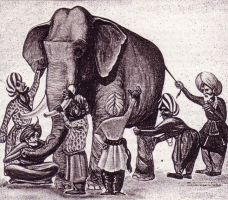 There is an ancient Asian parable which has found its way into a number of cultures including Hindu and Buddhist lore. In one version, the Buddha tells of a king who has nine blind men summoned to his palace. An elephant is brought in and they are asked to describe it. Each man feels a different part of the elephant and describes it to the king. In turn they tell him it is a pot (the man who feels the head), a winnowing basket (ear), a ploughshare (tusk), a plough (trunk), a granary (body), a pillar (foot), a mortar (back), a pestle (tail) or a brush (tip of the tail). They disagree violently with each other to the amusement of the king, and the Buddha surmises that ‘in their ignorance they are by nature quarrelsome, wrangling, and disputatious, each maintaining reality is thus and thus.’ Around 2,500 years later, groups of people continue to describe big things solely based on the bits with which they come into contact and bicker with others who are close to other bits.


 The overwhelming majority of UK employees (81 percent) are working beyond their contracted hours, claims a report from recruitment firm













July 27, 2016
Seven ways managers and employers can build trust in the workplace 0
by Matias Rodsevich • Comment, Knowledge, News, Wellbeing, Workplace
(more…)