Search Results for: organisations

Competition for talent is fierce, but employers edge away from pay to attract people

Competition for talent is fierce, but employers edge away from pay to attract people

competition for talentNew CIPD research claims that almost half (45 percent) of UK employers report having vacancies that are hard-to-fill, and almost two thirds (65 percent) anticipate problems filling vacancies in the next six months. The most common response made in the past six months by employers with hard-to-fill vacancies has been to increase pay (44 percent). However, only a quarter (27 percent) of organisations plan to raise wages in response to the competition for talent in the future. This suggests that organisations may be approaching their limit on this ‘quick win’ strategy and are exploring alternative options, such as upskilling people and flexible working, to attract and retain people. (more…)


ESG ambitions should top organisational agendas

ESG ambitions should top organisational agendas

ESGWhen the idea of ESG (environmental, social and governance credentials) first surfaced nearly two decades ago in a 2005 United Nations report, it was just an acronym businesses were trying to understand and get to grips with. But in the last few years, ESG strategies have gathered steam – it has become integral to C-Suite strategy and business purpose, and is a deal-breaker not just for investors but also for those considering new roles. In fact, a recent report revealed that job-seekers are turning down job offers by companies showcasing weak ESG credentials, a sure sign of the importance of substantive ESG policies for potential talent. Most of the larger conglomerates (if not all) have set targets to reach net-zero by a set date – ranging from as early as 2025 to anywhere within the next two decades. But is this going far enough for employees, stakeholders, future talent, and more broadly, for society? (more…)

Flexible working now arriving at aisle three

Flexible working now arriving at aisle three

flexible working tescoRemote workers might soon be able to do their jobs and shop for groceries at the same time, under a new “Spaces” project between Tesco and flexible office operator IWG. A trial at a branch of Tesco in New Malden that will start later in this month and will accommodate 12 private desks, 30 co-working spaces and a meeting room. The 3,800 sq ft space within the store would normally have been used for electrical goods, music, and other forms of entertainment, most of which are now mainly purchased online. The aim is to make better use of floor space and, if successful, Tesco stores across the country could become flexible working hubs. (more…)

Nature based solutions have the potential to transform cities and buildings

Nature based solutions have the potential to transform cities and buildings

nature based solutionsThe UK Green Building Council (UKGBC) has launched a new framework to help organisations and planners to recognise the significant value and benefit of nature-based solutions across urban developments. The report claims to reveal the scale of positive outcomes which Nature-Based Solutions (NBS) can deliver, as well as the wide range of stakeholders who can benefit from their implementation across cities and urban areas. (more…)

Job dissatisfaction is rife among senior executives – and hybrid working doesn’t help

Job dissatisfaction is rife among senior executives – and hybrid working doesn’t help

job dissatisfactionWidespread job dissatisfaction means a large proportion of senior executives from top US companies plan to leave their organisations in the next two years, according to a new report from KellyOCG. According to the 2022 KellyOCG Global Workforce Report – Re:work – there’s a significant disconnect between employees’ expectations and the support employers provide. Through a survey of C-suite leaders, board members, department heads, directors, and managers in 12 countries, including the United States and Canada, the report claims that 78 percent of US executives and 52 percent of Canadian executives, compared to 72 percent of leaders globally, aim to leave their jobs by 2024. (more…)

Human resources professionals should focus on boardroom partnerships

Human resources professionals should focus on boardroom partnerships

human resources partnershipsThe future of Human Resources remains a hotly debated topic, with conversations often focusing on whether the term is still accurate and how internal and external changes often put HR in a state of flux. As working models shift and new post-pandemic challenges emerge, the focus should be on what skills today’s HR leaders need to support the business and ensure its continuity and success in an evolving landscape. This includes embracing imminent changes to the HR strategy to develop additional skills and capabilities whilst ensuring compliance with new regulations, overcoming staff shortages and meeting heightened candidate expectations. (more…)

We need to seize the chance to make our buildings far more intelligent

We need to seize the chance to make our buildings far more intelligent

Even before the pandemic, statistics were making the case for workplaces to be made up of more intelligent buildings. This includes the fact that offices generally operate at around 55-60 percent utilisation, and as we return to the office are currently at 45 percent utilisation. From presenteeism to absenteeism and many other factors in between, workplaces have seldom been utilised by entire workforces at the same time. However, the prevailing approach has been for firms to drive an office setup with one-to-one desking – a seat for every employee, even though five in 10 would not be in at any one time. (more…)

The ability to choose where they work makes people happier

The ability to choose where they work makes people happier

Employees with full autonomy to choose where they work are happier in their job, yet only one in five are currently able to do so. And though 60 percent of all employees prefer hybrid working, only 39 percent are able to flexibly split their time between the home and office. This is according to Jabra’s 2022 edition of the Hybrid Ways of Working Global Report. Carried out amongst 2,800 knowledge workers across six countries worldwide, the report analyses employee sentiments and motivations around the physical workspace in this hybrid working era. (more…)
Codelocks facilitates future of flexible working

Codelocks facilitates future of flexible working

codelocks flexible workingWith organisations adopting a hybrid working model and moving towards flexible working also comes a need for flexible office solutions. International office and workplace solutions provider Kinnarps, approached Codelocks as it was looking to furnish a UK county council with an access control solution suitable for its hybrid working needs. Codelocks designs and distributes a wide portfolio of innovative, standalone keyless door locks and access products for a range of growing markets.

The UK county council has adopted a hybrid working model to best suit the needs and lifestyles of its employees. The council has multiple working hubs across the country, allowing its teams to choose the office space that is convenient and accessible to them on their chosen office days. However, despite not being tied to a specific location, the need for employees to store possessions in the workplace remains.

The council sought a storage solution that:

  • can be used on temporary basis
  • is easy to manage
  • is within its constrained budget
  • accessed by different people on different days, for varying time periods


Perfect partnership

Due to its longstanding relationship with Codelocks, Kinnarps is familiar with the wide range of KitLocks by Codelocks cabinet and locker locks.

Steve Newman, KitLock Sales Manager at Codelocks explains, “We understood the council wanted to avoid the need to cut keys or have lockers allocated to specific employees. And with the ongoing concern of Covid-19 and the transfer of germs, it was also important to give easy access to personal belongings whilst minimising touch. The KL1100 RFID offers the flexibility the council needs.”

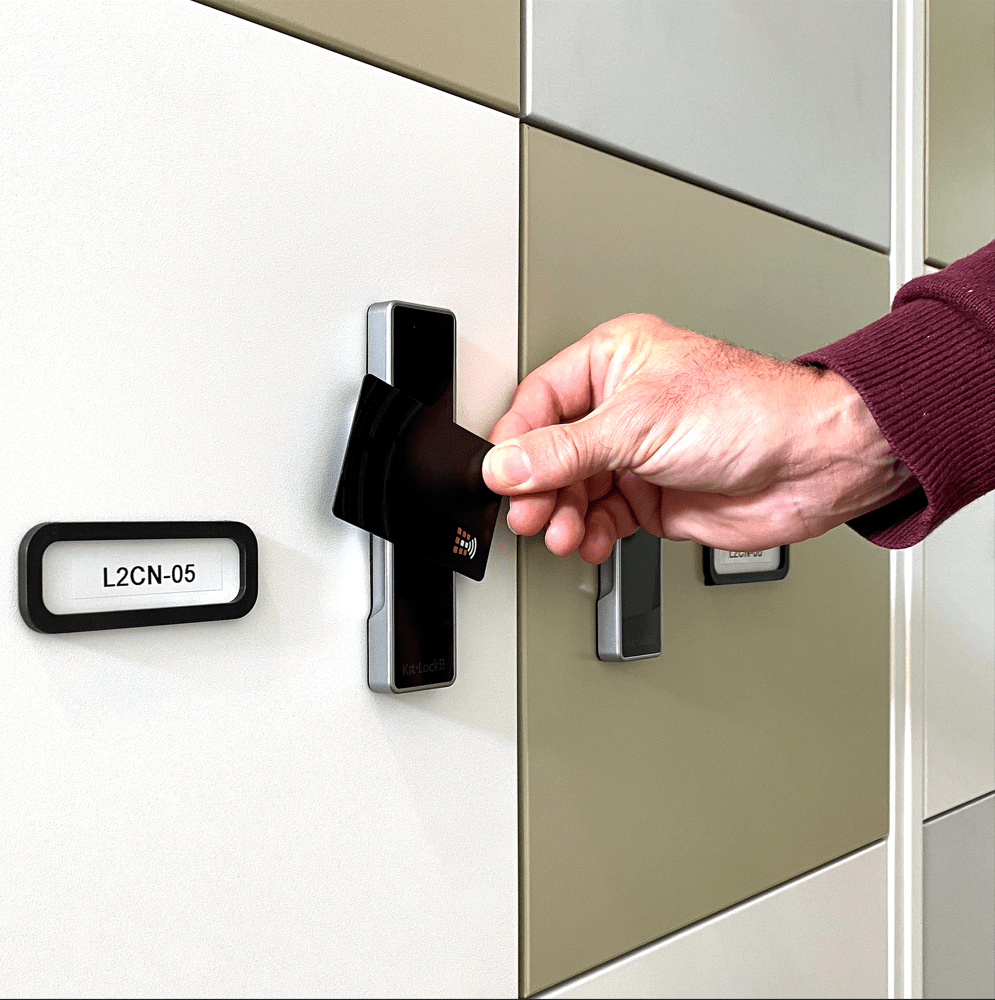
The KL1100 RFID is a smart card operated lock designed for both public and private lockers. It is perfect for building and facilities managers that oversee large quantities of lockers, as they can benefit from managing cards remotely.

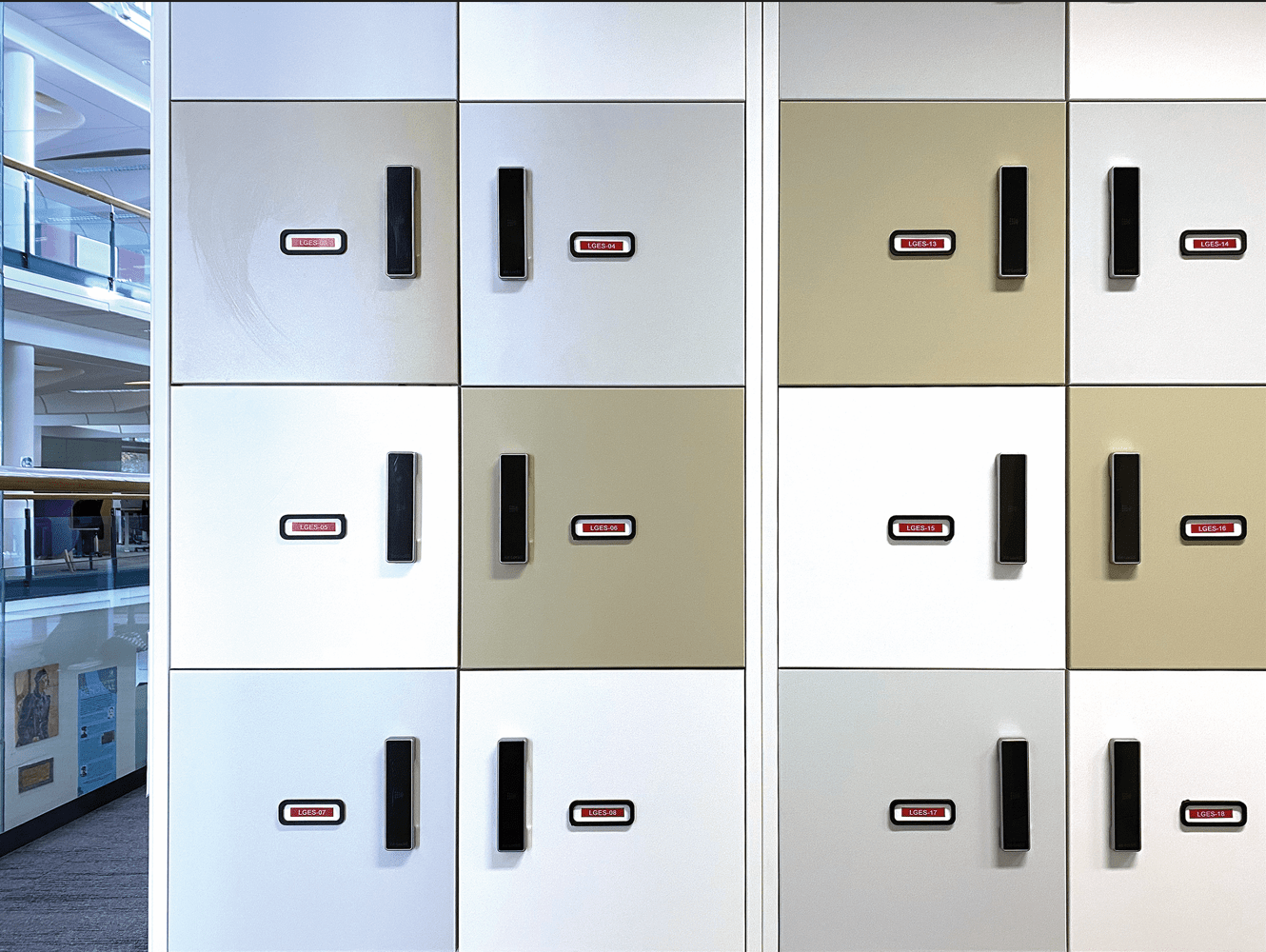
Kinnarps found a locker company that the KL1100 RFID could be installed on and combined the two products to create ‘hot lockers’, similar to hot desks for all of the county council offices. County council employees simply collect a card from the reception at the start of their day, use a dedicated locker to store their personal belongings, and then return the card so it can be used by someone else the next day.

Simon Cotter, Account Manager at Kinnarps said, “We needed to provide over 1000 lockers for the council, so we sought a supplier that had an innovative and stylish lock solution with enough available stock. Due to the volume of lockers we needed to provide, we were glad that the KL1100 RFID was straightforward to install.”


Convenient Contactless Access

The KL100 RFID is perfect for the council’s hybrid-working approach. “The council office manager has expressed the importance of being able to manage card access remotely, as their employees are all working on different days and at different times. It also removes the cost and hassle of having to cut and hand out keys.” explains Simon. “Council employees have found the lockers easy to operate and appreciate the fact the council has put a storage solution in place that is secure and requires minimal contact.”

Council employees can now be sure that whichever office they choose to work from, they have convenient access to lockers to store their belongings.

Growing number of firms link increased productivity to home and flexible working

Growing number of firms link increased productivity to home and flexible working

flexible workingThe number of employers who believe that an increase in homeworking and flexible working has increased their organisation’s productivity or efficiency has jumped significantly over the last year, according to new research from the CIPD. When asked in December 2020, a third (33 percent) of employers said homeworking had increased their organisation’s productivity or efficiency. However, when asked about increased home/hybrid working in October/November 2021, over two-fifths (41 percent) said these new ways of working had increased this. (more…)

Great Resignation: nearly half of job quitters think they were better off in the old job

Great Resignation: nearly half of job quitters think they were better off in the old job

great resignationNearly half of people (43 percent) who quit their jobs as part of the so-called Great Resignation during the pandemic now think they were actually better off at their old job. This revelation comes from a six-country survey of nearly 4,000 people by UKG  that examines sentiment about quitting during the Great Resignation, including if job leavers felt that they made the right decision, the disconnect between managers and employees about why people quit, and the chances workers would boomerang back to their old job. (more…)

The effects of workplace change may not be the ones we expect

The effects of workplace change may not be the ones we expect

There’s a scene in the 1986 horror movie The Fly in which Seth Brundle (Jeff Goldblum) persuades the reporter Veronica Quaife (Geena Davis) to try two steaks, one of which Brundle has just sent between two teleportation pods in an effort to work out why the pods can’t process organic matter, including the organic matter that had recently belonged to a very unfortunate baboon. (more…)