Search Results for: organisations

Design must support knowledge circulation in the next generation workplace

Design must support knowledge circulation in the next generation workplace

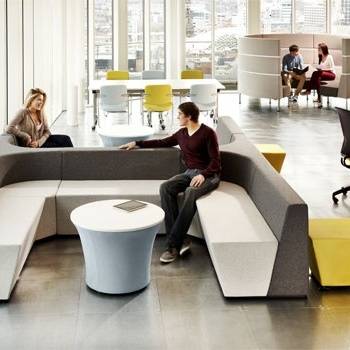
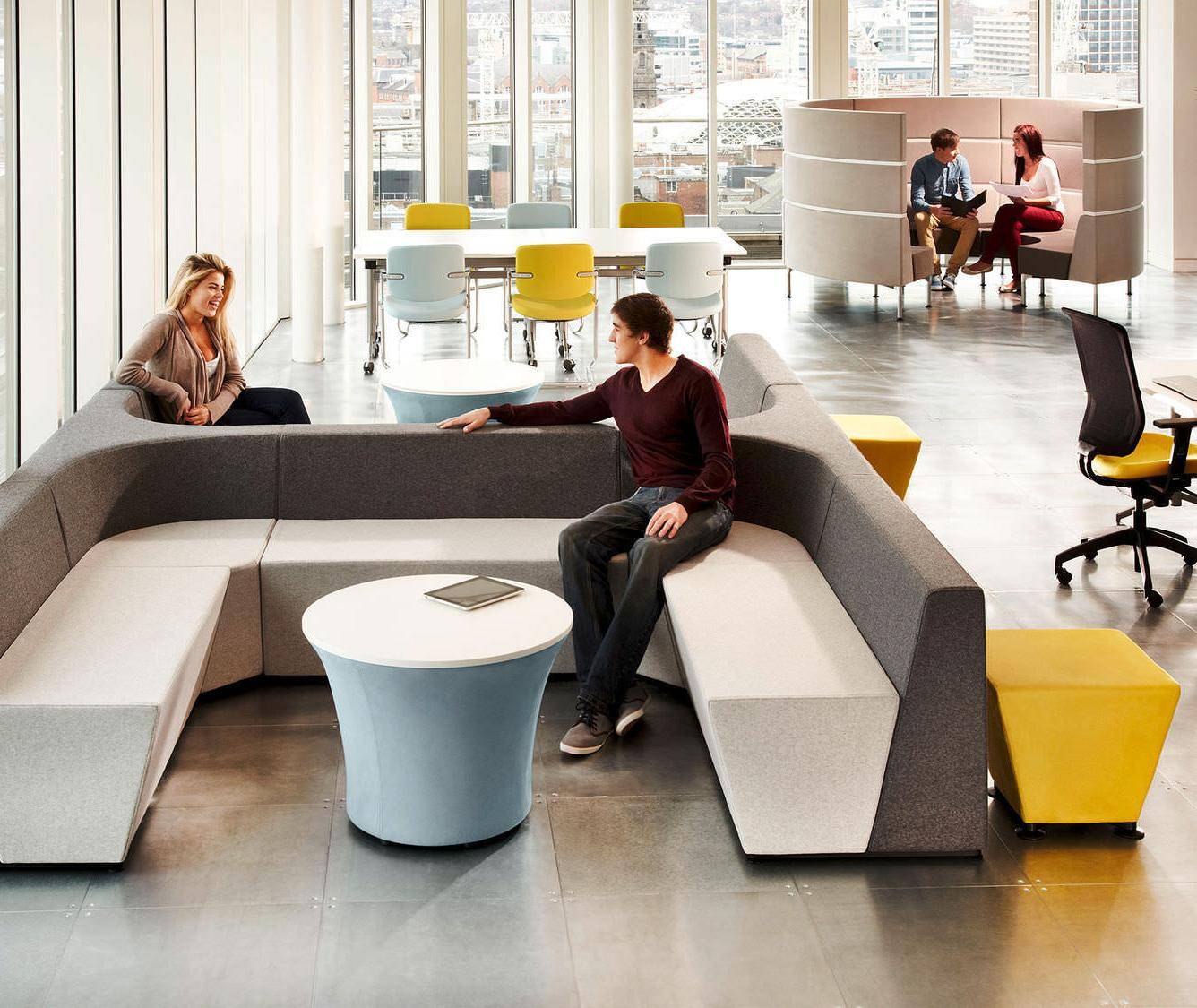
Knowledge circulationBusinesses thrive because of their workforces, and the ideas, work and creations they bring to an organisation. But despite the fact that sharing knowledge and thoughts is vitally important, most designers focus on providing individual space for workers, while little thought is given to creating spaces that support knowledge circulation. Separate offices for one or two people, cubicles and individual desks are just some of the factors included in what is perceived to be an average building, but very often is the reason why there is a lack of knowledge sharing and co-creation. New methodologies are emerging on how to get the most out of employees, by providing an environment that encourages them to work together. These new strategies, such as swarm intelligence, place focus on the entire workforce rather than the individual, encouraging them to work together and share their knowledge and ideas.

(more…)

RICS case studies focus on business impact of strategic facilities management
RICS case studies focus on business impact of strategic facilities management

national-exhibition-centreSix case studies, which outline how businesses can make the most of strategic facilities management to enhance their performance are being launched today (19 June), at the NEC in Birmingham. Developed by International Workplace for the Royal Institute of Chartered Surveyors, the latest set of case studies in the series, provides examples of best practice as outlined in RICS’ Strategic Facilities Management (FM) Guidance Note. The case studies, which can be downloaded from RICS’ website, cover a range of strategic FM issues including procurement, innovation, technology, sustainability, talent management and health and safety. Key themes include a professional understanding of the impact of FM to a company’s reputation, brand and performance, engagement with staff and the supply chain, the importance of measuring impact and outcomes and communication.


(more…)

Facilities managers must focus more on people and less on buildings

Facilities managers must focus more on people and less on buildings

facilities managersA report from facilities management company Mitie claims that the design and management of too many workplaces are hampering the productivity of employees. Based on a survey of nearly 2,500 service sector staff carried out by Quora Consulting, the report comes to the perhaps unsurprising conclusion that facilities managers should prioritise people over buildings. The study found that younger workers are especially critical of their surroundings and working cultures. Two thirds of 20-29 year olds claim that their offices are not designed to optimise productivity. Finance and legal workers also feel let down by their workplaces with almost half claiming their workplaces do not optimise their productivity. These sectors were also emotionally disengaged with fewer than 35 percent identifying themselves as ‘emotionally attached’ to their workplaces.

(more…)

Dietitians publish key findings on workplace health programmes

Dietitians publish key findings on workplace health programmes

Healthy food at workWe spend around 60 percent of our life at work and consume at least a third of our daily food intake, which is why the British Dietetic Association (BDA) has announced that the theme of office for its new Chairman, Dr Fiona McCullough, will be workplace health. Responding to recent policies such as the NHS Five Year Forward View and the NICE public health guidance for the workplace, which recognise that businesses benefit from investing in the wellbeing of employees, the BDA is conducting a review of published peer-reviewed evidence of workplace health studies in order to determine how best individuals and employers can optimise health at work. This review will underpin the development of a BDA Work Ready Programme, which has produced interim research that has already highlighted the key role employers can play in enhancing the wellbeing of staff.

(more…)

Proximity determines how middle managers copy bosses’ unethical behaviour

Proximity determines how middle managers copy bosses’ unethical behaviour

unethical behaviourMiddle managers mirror their bosses’ unethical behaviour, regardless of how ethical they are themselves, claims new research from Rotterdam School of Management, Erasmus University. The research, conducted in partnership with Cambridge University, shows that in cases of unethical leadership at the top of an organisation, middle managers will treat their subordinates unfairly if the social and spatial distance between them and the top management is low. This can lead to employee dissatisfaction, lower organisational commitment and increased employee turnover. In contrast, the effect is reversed if the social and spatial distance between managers and top management is high. Middle managers, who are unfairly treated by their bosses, will treat their employees more fairly if, for example, they are based in different offices or buildings from their managers, and the social distance is high.

(more…)

European employers failing to provide technology for collaborative working

European employers failing to provide technology for collaborative working

European employers failing to provide technology for collaborative workingAlthough most organisations encourage remote team work, only 3 percent of European employees say their current working environment is suitable for collaborative work such as online video conferencing, according to new research by ADP. Almost half (44%) of workers say that technology helps them understand the mission and values of their organisation, whilst 51 percent believe that technology fosters better relationships with colleagues. Yet one in four employees would like to have more quiet zones for detailed thinking, while a third (30%) would like to have access to technologies that enhance collaboration such as file sharing tools. Employees in the UK are less likely to be equipped with the latest technology; more than eight in ten (82%) French, German and Dutch employees have access to the latest business tools to allow them to do their job effectively, compared to 70 percent of UK employees.

(more…)

Trade bodies seek to boost inclusivity and diversity with new initiatives

Trade bodies seek to boost inclusivity and diversity with new initiatives

DiversityThree major trade associations in the built environment sector have announced initiatives to increase the inclusivity and diversity of their respective professions. The Royal Institution of Chartered Surveyors has launched its new Inclusive Employer Quality Mark, which is designed to help firms ‘gain a competitive advantage and a diverse workforce’. Meanwhile, the Royal Institute of British Architects (RIBA) claims it has strengthened its chartered practice criteria to incorporate requirements related to equality, diversity and inclusion. From 2016, chartered practices are required to have an equality, diversity and inclusion policy. In the US, delegates at the American Institute of Architects (AIA) agreed at congress to introduce a resolution known as Equity in Architecture, that calls for measures to increase representation of what are deemed underrepresented groups ‘to move the profession forward’.

(more…)

Association hook-up aims to ‘kick-start the future of facilities management’

Association hook-up aims to ‘kick-start the future of facilities management’

Facilities managementThe Chartered Institution of Building Services Engineers (CIBSE) Facilities Management Group has signed new cooperation agreements with the Building Controls Industry Association (BCIA) and the Building Futures Group as it seeks to ‘kick-start the future of facilities management’ in the UK. The three organisations plan to work together to promote best practice. According to CIBSE its agreement with the BCIA will focus on raising awareness of how building controls can help buildings perform better while its agreement with the Building Futures Group will set out to promote best practice in building services management and maintenance. The three groups signed the agreements last week, which will also see them working together on a number of supporting initiatives and joint events. The partner organisations claim the agreements are a response to the rapid pace of change in the sector.

(more…)

It’s perfectly logical why we should apply emotion in workplace design

It’s perfectly logical why we should apply emotion in workplace design

Emotion in workplace designMost of the arguments put forward for enlightened workplace design are fact based. That’s useful but such arguments can also ignore the fact that we respond to our surroundings on an emotional level as well as a functional one. Once you accept that office design is as much about how it makes people feel as how it helps them work, then the design process can be as much about EQ as it is IQ. While businesses can shy away from dealing with the emotional facets of working lives, there is a growing movement that advocates not only greater awareness of the importance of emotional intelligence but is also able to draw attention to the benefits it brings to organisations and individuals. This was the underlying message of a groundbreaking event that took place in London recently which explored the use of emotion in a business context.

(more…)

Over two thirds of UK staff care about energy efficiency at work

Over two thirds of UK staff care about energy efficiency at work

energy efficiencyNew research claims that 68 percent of UK workers care about energy efficiency at work and of these, 22 per cent said they care a great deal. The survey by YouGov for British Gas Business found that Hospitality and Leisure workers care the most – 82 percent – about saving business energy. Other industries that ranked highly were Financial Services (77%) and Manufacturing (76%). With almost two thirds (62%) confirming that their workplace invests in saving energy, it is clear that it is important for companies and organisations to be energy efficient. Yet, less than half (43 %) of workers said that their company or organisation ensures that all lights and computer screens are switched off when not in use and less than 1 in 5 (18%) said they conduct a regular energy audit.

(more…)

Women over 55 most likely to be business strategists, finds report

Women over 55 most likely to be business strategists, finds report

mult generational workplaceA new report claims that only 8 percent of senior managers currently have ‘Strategist’ leadership capabilities and have the attributes and mind sets to lead transformational change and solve their most difficult problems. This is because employers don’t identify and empower their leaders with the right capabilities and attributes, says the report published by PwC’s Consulting practice. According to “The hidden talent: Ten ways to identify and retain transformational leaders,” the work of strategists is underpinned by inquiry-based experimentation. They see both the vision and detail, employ positive language and exercise power courageously. They understand the complexity of the environment in which they’re working and are able to employ passionate detachment. The report claims that the largest proportion of ‘Strategist’ leaders, are women over 55.

(more…)

Shared office space is redefining commercial property and the workplace

Shared office space is redefining commercial property and the workplace

Hive by Connection

Hive by Connection

The changing way we work presents particular challenges for the development of commercial property as well as those who specify, design and occupy workplaces. As has been highlighted many times before, the days are gone when designing an office was largely determined by the number of people who occupy it and the main determinant of the space needed for them was the size of their desks based on their status and what they did. Now, those are just some of the characteristics that need to be taken into consideration when creating workplaces, alongside others such as how much meeting and shared office space is needed, whether certain people need a dedicated workstation at all, how to give them choices about where they work and with whom and how the building can adapt to changing teams and objectives.

(more…)